 Add to Chrome
 Add to Firefox
 Add to Edge
MIND: Multi-Scale Intent Diffusion for Text-Driven Physics-Based Humanoid Control
May 25, 2026
Enabling physics-based humanoids to execute diverse behaviors from high-level textual commands remains a significant challenge. Existing methods typically follow either a two-stage paradigm that combines kinematic motion generation with physics-based tracking, or an end-to-end imitation-learning paradigm that directly generates actions from text. However, the former suffers from the inherent domain shift between kinematic generation and physics-based tracking, while the latter struggles with the substantial modality gap between textual commands and low-level actions, limiting effective semantic alignment. Notably, humanoid states encode rich motion dynamics that are more semantically aligned with textual descriptions than low-level actions, making them a natural basis for deriving behavioral intent. Building upon this insight, we propose MIND, a novel end-to-end diffusion framework for text-driven physics-based humanoid control that leverages behavioral intent as a semantic bridge between textual commands and low-level actions. At its core, MIND introduces a multi-scale intent diffusion mechanism, where a holistic intent predictor captures global behavioral dynamics to guide overall behavior synthesis, while an immediate intent predictor provides step-wise, fine-grained signals for local behavior refinement at each diffusion step. This hierarchical intent formulation imposes a structured inductive bias for humanoid control, improving semantic alignment and behavioral naturalness. Furthermore, MIND encodes humanoid states into a latent space to enable more effective semantic intent modeling. Extensive experiments demonstrate that MIND outperforms existing methods and synthesizes coherent, physically plausible, and semantically aligned humanoid behaviors from text commands. Our code will be released to facilitate future research.

InterAgent: Physics-based Multi-agent Command Execution via Diffusion on Interaction Graphs
Dec 12, 2025Humanoid agents are expected to emulate the complex coordination inherent in human social behaviors. However, existing methods are largely confined to single-agent scenarios, overlooking the physically plausible interplay essential for multi-agent interactions. To bridge this gap, we propose InterAgent, the first end-to-end framework for text-driven physics-based multi-agent humanoid control. At its core, we introduce an autoregressive diffusion transformer equipped with multi-stream blocks, which decouples proprioception, exteroception, and action to mitigate cross-modal interference while enabling synergistic coordination. We further propose a novel interaction graph exteroception representation that explicitly captures fine-grained joint-to-joint spatial dependencies to facilitate network learning. Additionally, within it we devise a sparse edge-based attention mechanism that dynamically prunes redundant connections and emphasizes critical inter-agent spatial relations, thereby enhancing the robustness of interaction modeling. Extensive experiments demonstrate that InterAgent consistently outperforms multiple strong baselines, achieving state-of-the-art performance. It enables producing coherent, physically plausible, and semantically faithful multi-agent behaviors from only text prompts. Our code and data will be released to facilitate future research.
Mojito: LLM-Aided Motion Instructor with Jitter-Reduced Inertial Tokens
Feb 22, 2025Human bodily movements convey critical insights into action intentions and cognitive processes, yet existing multimodal systems primarily focused on understanding human motion via language, vision, and audio, which struggle to capture the dynamic forces and torques inherent in 3D motion. Inertial measurement units (IMUs) present a promising alternative, offering lightweight, wearable, and privacy-conscious motion sensing. However, processing of streaming IMU data faces challenges such as wireless transmission instability, sensor noise, and drift, limiting their utility for long-term real-time motion capture (MoCap), and more importantly, online motion analysis. To address these challenges, we introduce Mojito, an intelligent motion agent that integrates inertial sensing with large language models (LLMs) for interactive motion capture and behavioral analysis.
HOI-M3:Capture Multiple Humans and Objects Interaction within Contextual Environment
Apr 02, 2024
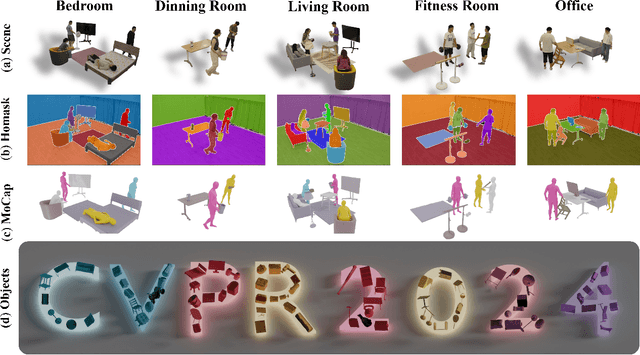

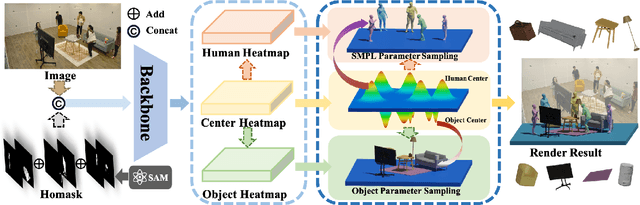
Humans naturally interact with both others and the surrounding multiple objects, engaging in various social activities. However, recent advances in modeling human-object interactions mostly focus on perceiving isolated individuals and objects, due to fundamental data scarcity. In this paper, we introduce HOI-M3, a novel large-scale dataset for modeling the interactions of Multiple huMans and Multiple objects. Notably, it provides accurate 3D tracking for both humans and objects from dense RGB and object-mounted IMU inputs, covering 199 sequences and 181M frames of diverse humans and objects under rich activities. With the unique HOI-M3 dataset, we introduce two novel data-driven tasks with companion strong baselines: monocular capture and unstructured generation of multiple human-object interactions. Extensive experiments demonstrate that our dataset is challenging and worthy of further research about multiple human-object interactions and behavior analysis. Our HOI-M3 dataset, corresponding codes, and pre-trained models will be disseminated to the community for future research.