 Add to Chrome
 Add to Firefox
 Add to Edge
Once Generated, Ranked: End-to-End Generative Slate Recommendation with Unified Semantic-Collaborative IDs
Aug 18, 2026
Slate recommendation treats a slate rather than an individual item as the recommendation unit, requiring joint optimization of item interactions and slate utility. Existing approaches typically separate candidate generation from ranking and restrict optimization to retrieved candidates. Generative recommendation with Semantic IDs (SIDs) offers a path to end-to-end recommendation, but existing SID construction often lacks recommendation-aware semantics and effective local collaborative signals, while next-token prediction is misaligned with slate-level objectives. We propose OGR, an end-to-end framework that directly generates ordered slates-"Once Generated, Ranked." OGR first introduces TUSID, which adaptively fuses item-specific semantic and local collaborative information into hierarchical SIDs. It then uses list-wise preference planning and pipelined position-wise SID decoding to model global preferences and inter-item dependencies while generating ordered slates. We further propose SPA, a reward-guided conservative policy optimization method that aligns generated slates with user preferences beyond likelihood imitation. Offline experiments show that OGR outperforms representative baselines, with 48.2% and 27.2% relative NDCG@5 gains on industrial and public datasets, respectively. Online A/B testing on Kuaishou further yields a 1.120% improvement in Effective Views.

Enhancing 3D Gaussian Splatting Compression via Spatial Condition-based Prediction
Mar 30, 2025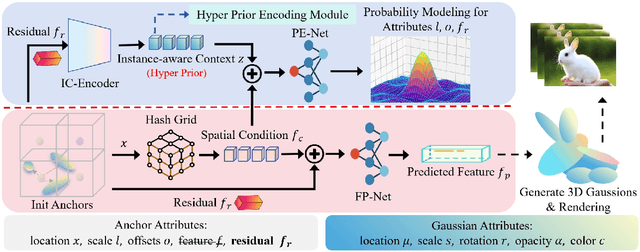
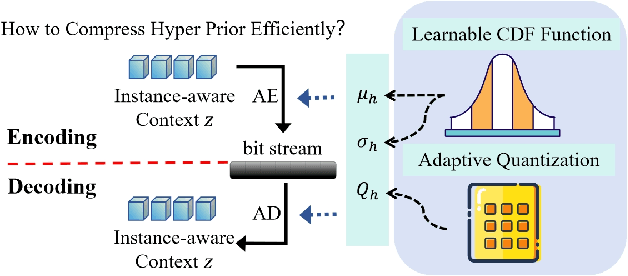
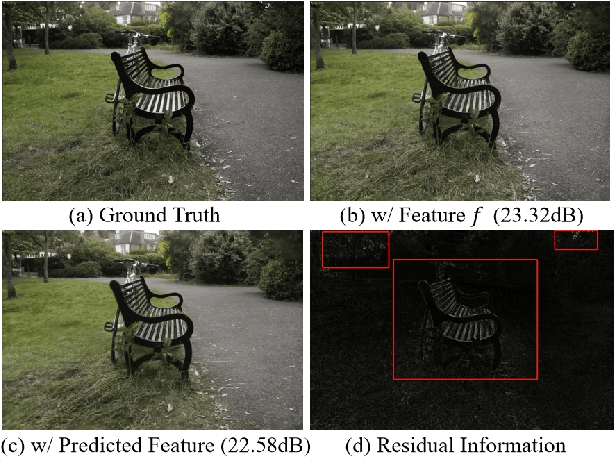
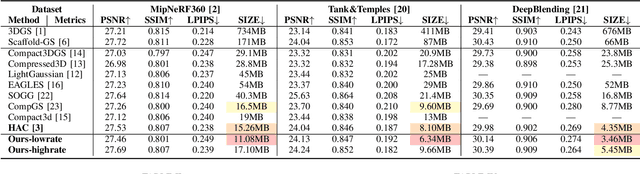
Recently, 3D Gaussian Spatting (3DGS) has gained widespread attention in Novel View Synthesis (NVS) due to the remarkable real-time rendering performance. However, the substantial cost of storage and transmission of vanilla 3DGS hinders its further application (hundreds of megabytes or even gigabytes for a single scene). Motivated by the achievements of prediction in video compression, we introduce the prediction technique into the anchor-based Gaussian representation to effectively reduce the bit rate. Specifically, we propose a spatial condition-based prediction module to utilize the grid-captured scene information for prediction, with a residual compensation strategy designed to learn the missing fine-grained information. Besides, to further compress the residual, we propose an instance-aware hyper prior, developing a structure-aware and instance-aware entropy model. Extensive experiments demonstrate the effectiveness of our prediction-based compression framework and each technical component. Even compared with SOTA compression method, our framework still achieves a bit rate savings of 24.42 percent. Code is to be released!