 Add to Chrome
 Add to Firefox
 Add to Edge
A knowledge-augmented dataset of high-risk driving scenarios with LLM annotations for autonomous driving
Jul 08, 2026
Safe autonomous driving requires both rapid responses to common high-risk events and deeper reasoning over rare, extreme long-tail scenarios in traffic safety. These scenarios are severely under-represented in naturalistic driving data, and existing trajectory and language-augmented datasets seldom provide high-risk event labels, semantic annotations, and verifiable safety signals. Here we present K-Risk, a knowledge-augmented dataset that combines structured driving trajectories with large language model generated semantic annotations for safety-critical driving scenarios. K-Risk integrates 20 human-driven and autonomous-vehicle trajectory datasets from Europe, China, and the United States, covering highways, urban freeways, intersections, and roundabouts. Using a unified risk-centric extraction pipeline, K-Risk curates 31,398 high-risk events, together with a 1,036-event extreme subset of near-collision cases. Each event is released as a synchronized trajectory, metadata, and language triplet containing structured scenario descriptions, abnormal-behavior notifications, and, for a representative subset, causal risk analyses and action recommendations validated through a closed-loop simulator with iterative reflection. By combining multi-dimensional risk annotations, interpretable language supervision, and verifiable decisions, K-Risk bridges structured traffic trajectories, semantic reasoning, and decision supervision, providing a standardized foundation for developing and evaluating next-generation risk-aware autonomous driving agents.

A Survey on Federated Fine-tuning of Large Language Models
Mar 15, 2025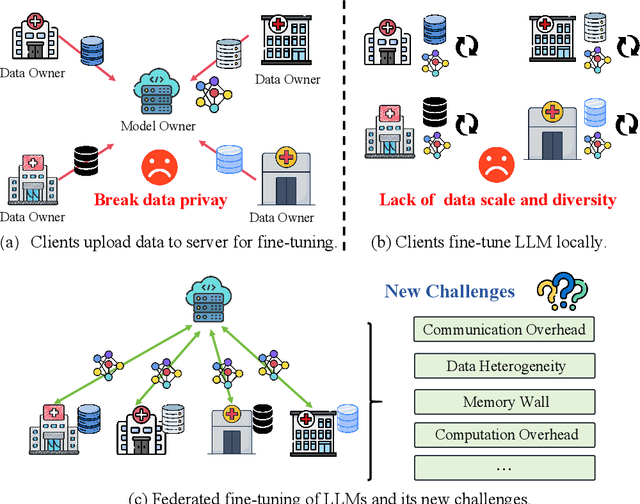
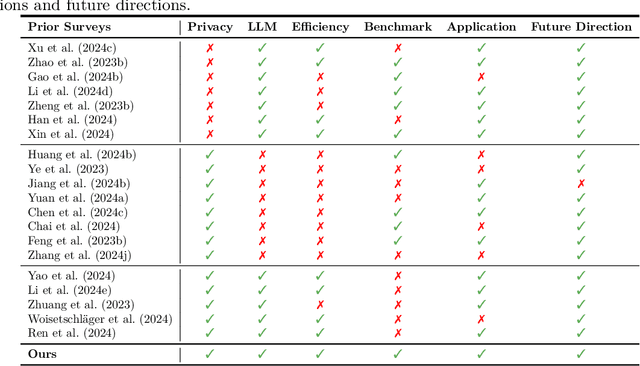
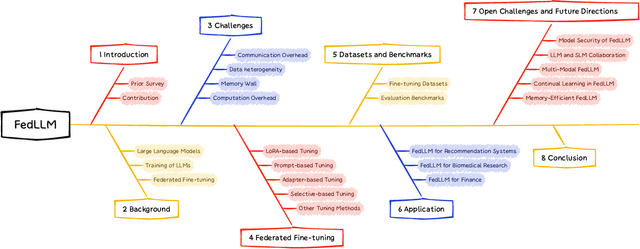
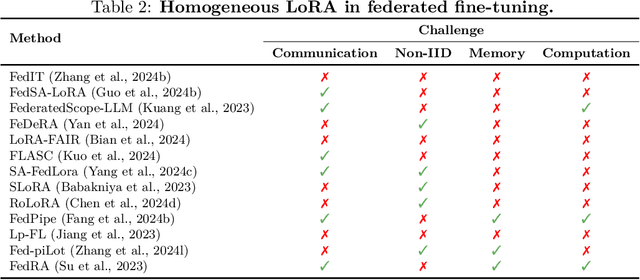
Large Language Models (LLMs) have achieved remarkable success across a wide range of tasks, with fine-tuning playing a pivotal role in adapting them to specific downstream applications. Federated Learning (FL) offers a promising approach that enables collaborative model adaptation while ensuring data privacy, i.e., FedLLM. In this survey, we provide a systematic and thorough review of the integration of LLMs with FL. Specifically, we first trace the historical evolution of both LLMs and FL, while summarizing relevant prior surveys. We then present an in-depth analysis of the fundamental challenges encountered in deploying FedLLM. Following this, we conduct an extensive study of existing parameter-efficient fine-tuning (PEFT) methods and explore their applicability in FL. Furthermore, we introduce a comprehensive evaluation benchmark to rigorously assess FedLLM performance and discuss its diverse real-world applications across multiple domains. Finally, we identify critical open challenges and outline promising research directions to drive future advancements in FedLLM. We maintain an active \href{https://github.com/Clin0212/Awesome-Federated-LLM-Learning}{GitHub repository} tracking cutting-edge advancements. This survey serves as a foundational resource for researchers and practitioners, offering insights into the evolving landscape of federated fine-tuning for LLMs while guiding future innovations in privacy-preserving AI.