 Add to Chrome
 Add to Firefox
 Add to Edge
Radio-FM: A Foundation Model for Radio Signal Representation Learning and Its Applications
Aug 06, 2026
Applying foundation models to the radio frequency (RF) domain presents unique challenges due to the intrinsic physical complexity of raw I/Q signals and the extreme heterogeneity of spectral data. In this paper, we present Radio-FM, a scalable family of foundation models designed for universal radio signal representation learning. Unlike standard architectures, Radio-FM employs dual-channel processing specifically optimized for I/Q independence while capturing cross-channel interactions through a lightweight attention mechanism. To scale pretraining across heterogeneous multi-source corpora with highly variable sequence lengths, we propose a token-budgeted dynamic batching strategy coupled with channel-independent masked reconstruction. We pretrain Radio-FM on a diverse collection of 15 datasets spanning modulation, radar, and communication domains, and rigorously evaluate it on 15 downstream benchmarks. Experimental results show Radio-FM achieves state-of-the-art performance on 13 of 15 benchmarks, consistently improving across modulation, radar, emitter identification, wireless technology recognition, and wireless interference identification. Notably, it exhibits superior few-shot transferability, significantly outperforming existing baselines in data-scarce regimes, validating its potential as a general-purpose backbone for radio signal understanding.

Adaptive Visibility Graph Neural Network and its Application in Modulation Classification
Jun 16, 2021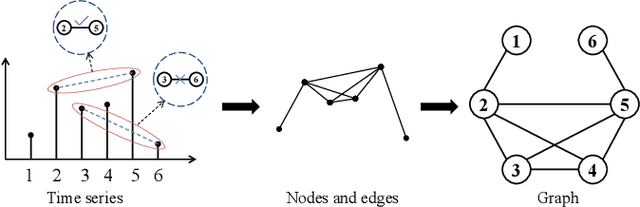
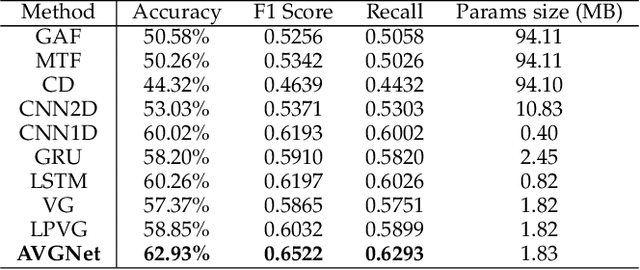
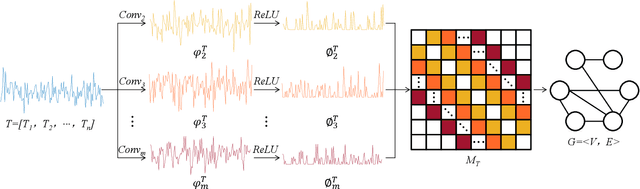
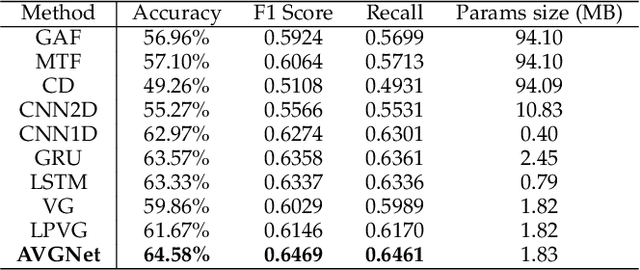
Our digital world is full of time series and graphs which capture the various aspects of many complex systems. Traditionally, there are respective methods in processing these two different types of data, e.g., Recurrent Neural Network (RNN) and Graph Neural Network (GNN), while in recent years, time series could be mapped to graphs by using the techniques such as Visibility Graph (VG), so that researchers can use graph algorithms to mine the knowledge in time series. Such mapping methods establish a bridge between time series and graphs, and have high potential to facilitate the analysis of various real-world time series. However, the VG method and its variants are just based on fixed rules and thus lack of flexibility, largely limiting their application in reality. In this paper, we propose an Adaptive Visibility Graph (AVG) algorithm that can adaptively map time series into graphs, based on which we further establish an end-to-end classification framework AVGNet, by utilizing GNN model DiffPool as the classifier. We then adopt AVGNet for radio signal modulation classification which is an important task in the field of wireless communication. The simulations validate that AVGNet outperforms a series of advanced deep learning methods, achieving the state-of-the-art performance in this task.