 Add to Chrome
 Add to Firefox
 Add to Edge
SongSong: A Time Phonograph for Chinese SongCi Music from Thousand of Years Away
Feb 27, 2026
Recently, there have been significant advancements in music generation. However, existing models primarily focus on creating modern pop songs, making it challenging to produce ancient music with distinct rhythms and styles, such as ancient Chinese SongCi. In this paper, we introduce SongSong, the first music generation model capable of restoring Chinese SongCi to our knowledge. Our model first predicts the melody from the input SongCi, then separately generates the singing voice and accompaniment based on that melody, and finally combines all elements to create the final piece of music. Additionally, to address the lack of ancient music datasets, we create OpenSongSong, a comprehensive dataset of ancient Chinese SongCi music, featuring 29.9 hours of compositions by various renowned SongCi music masters. To assess SongSong's proficiency in performing SongCi, we randomly select 85 SongCi sentences that were not part of the training set for evaluation against SongSong and music generation platforms such as Suno and SkyMusic. The subjective and objective outcomes indicate that our proposed model achieves leading performance in generating high-quality SongCi music.

Covo-Audio Technical Report
Feb 10, 2026In this work, we present Covo-Audio, a 7B-parameter end-to-end LALM that directly processes continuous audio inputs and generates audio outputs within a single unified architecture. Through large-scale curated pretraining and targeted post-training, Covo-Audio achieves state-of-the-art or competitive performance among models of comparable scale across a broad spectrum of tasks, including speech-text modeling, spoken dialogue, speech understanding, audio understanding, and full-duplex voice interaction. Extensive evaluations demonstrate that the pretrained foundation model exhibits strong speech-text comprehension and semantic reasoning capabilities on multiple benchmarks, outperforming representative open-source models of comparable scale. Furthermore, Covo-Audio-Chat, the dialogue-oriented variant, demonstrates strong spoken conversational abilities, including understanding, contextual reasoning, instruction following, and generating contextually appropriate and empathetic responses, validating its applicability to real-world conversational assistant scenarios. Covo-Audio-Chat-FD, the evolved full-duplex model, achieves substantially superior performance on both spoken dialogue capabilities and full-duplex interaction behaviors, demonstrating its competence in practical robustness. To mitigate the high cost of deploying end-to-end LALMs for natural conversational systems, we propose an intelligence-speaker decoupling strategy that separates dialogue intelligence from voice rendering, enabling flexible voice customization with minimal text-to-speech (TTS) data while preserving dialogue performance. Overall, our results highlight the strong potential of 7B-scale models to integrate sophisticated audio intelligence with high-level semantic reasoning, and suggest a scalable path toward more capable and versatile LALMs.
End-to-end Contrastive Language-Speech Pretraining Model For Long-form Spoken Question Answering
Nov 12, 2025Significant progress has been made in spoken question answering (SQA) in recent years. However, many existing methods, including large audio language models, struggle with processing long audio. Follow the success of retrieval augmented generation, a speech-related retriever shows promising in help preprocessing long-form speech. But the performance of existing speech-related retrievers is lacking. To address this challenge, we propose CLSR, an end-to-end contrastive language-speech retriever that efficiently extracts question-relevant segments from long audio recordings for downstream SQA task. Unlike conventional speech-text contrastive models, CLSR incorporates an intermediate step that converts acoustic features into text-like representations prior to alignment, thereby more effectively bridging the gap between modalities. Experimental results across four cross-modal retrieval datasets demonstrate that CLSR surpasses both end-to-end speech related retrievers and pipeline approaches combining speech recognition with text retrieval, providing a robust foundation for advancing practical long-form SQA applications.
Joint Automatic Speech Recognition And Structure Learning For Better Speech Understanding
Jan 13, 2025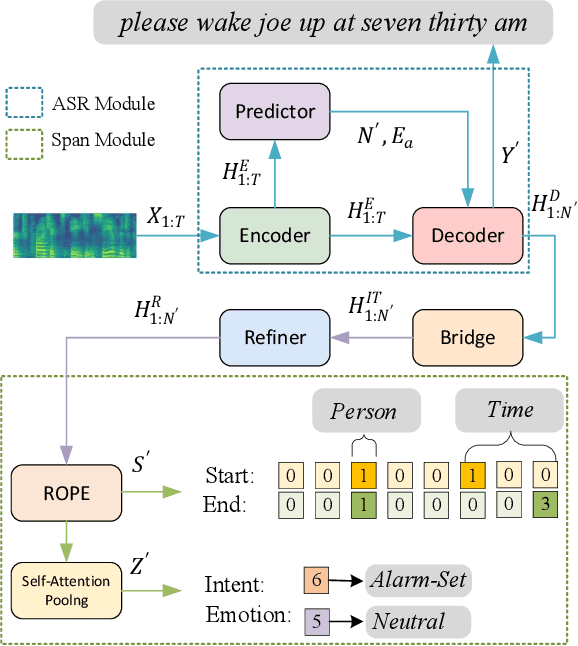
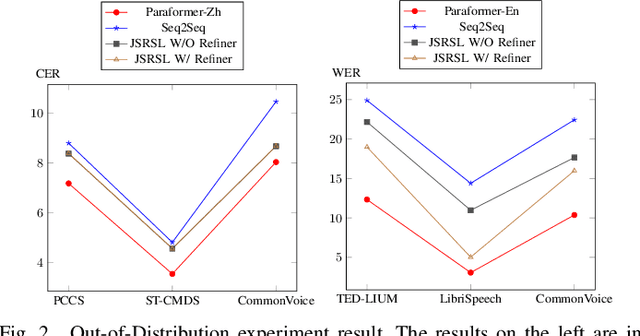


Spoken language understanding (SLU) is a structure prediction task in the field of speech. Recently, many works on SLU that treat it as a sequence-to-sequence task have achieved great success. However, This method is not suitable for simultaneous speech recognition and understanding. In this paper, we propose a joint speech recognition and structure learning framework (JSRSL), an end-to-end SLU model based on span, which can accurately transcribe speech and extract structured content simultaneously. We conduct experiments on name entity recognition and intent classification using the Chinese dataset AISHELL-NER and the English dataset SLURP. The results show that our proposed method not only outperforms the traditional sequence-to-sequence method in both transcription and extraction capabilities but also achieves state-of-the-art performance on the two datasets.
VHASR: A Multimodal Speech Recognition System With Vision Hotwords
Oct 01, 2024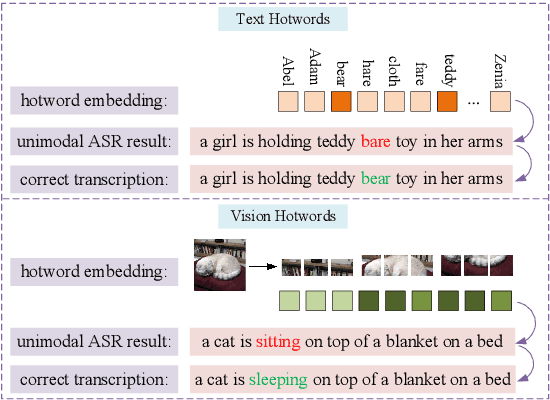


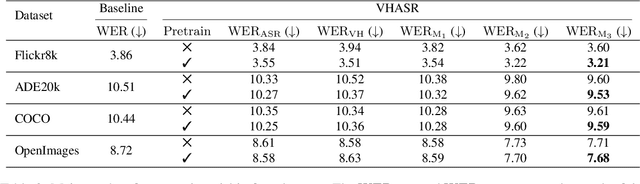
The image-based multimodal automatic speech recognition (ASR) model enhances speech recognition performance by incorporating audio-related image. However, some works suggest that introducing image information to model does not help improving ASR performance. In this paper, we propose a novel approach effectively utilizing audio-related image information and set up VHASR, a multimodal speech recognition system that uses vision as hotwords to strengthen the model's speech recognition capability. Our system utilizes a dual-stream architecture, which firstly transcribes the text on the two streams separately, and then combines the outputs. We evaluate the proposed model on four datasets: Flickr8k, ADE20k, COCO, and OpenImages. The experimental results show that VHASR can effectively utilize key information in images to enhance the model's speech recognition ability. Its performance not only surpasses unimodal ASR, but also achieves SOTA among existing image-based multimodal ASR.