 Add to Chrome
 Add to Firefox
 Add to Edge
Recommendation as Generation: Unifying Personalized Video Generation and Recommendation at Industrial Scale
Jun 24, 2026
Traditional short-video recommendation systems match user interest to a fixed pool of pre-produced videos, which limits their ability to capture fine-grained and dynamic preferences. We propose Recommendation-as-Generation (RaG), a new paradigm that generates personalized videos on demand from inferred user interest. Our framework unifies generative recommendation and video generation through shared semantic IDs (SIDs), which disentangle video representation into content semantics and creative style semantics, enabling both fine-grained modeling of user interest and controllable generation of interest-aligned videos. We further develop Video Generation Agents (VGAs) that are conditioned on inferred SIDs to drive hierarchical planning and refinement for video creation, including visual composition, audio alignment, and artistic effect enhancement. To optimize the framework, we effectively introduce a synergistic cross-domain reward learning mechanism that jointly enforces interest alignment, user feedback, and video quality assessment. We deploy RaG on an industrial-scale platform with over 400 million daily active users and evaluate it in a revenue-critical advertising scenario. Online A/B tests show up to 1.87% ad revenue improvement compared to a strong production GRM baseline, demonstrating its effectiveness in driving further revenue gains beyond generative recommendation. Our results highlight a closed-loop generative system as a promising paradigm for integrating personalized video generation into recommendation.

Generative Recommendation for Large-Scale Advertising
Feb 26, 2026Generative recommendation has recently attracted widespread attention in industry due to its potential for scaling and stronger model capacity. However, deploying real-time generative recommendation in large-scale advertising requires designs beyond large-language-model (LLM)-style training and serving recipes. We present a production-oriented generative recommender co-designed across architecture, learning, and serving, named GR4AD (Generative Recommendation for ADdvertising). As for tokenization, GR4AD proposes UA-SID (Unified Advertisement Semantic ID) to capture complicated business information. Furthermore, GR4AD introduces LazyAR, a lazy autoregressive decoder that relaxes layer-wise dependencies for short, multi-candidate generation, preserving effectiveness while reducing inference cost, which facilitates scaling under fixed serving budgets. To align optimization with business value, GR4AD employs VSL (Value-Aware Supervised Learning) and proposes RSPO (Ranking-Guided Softmax Preference Optimization), a ranking-aware, list-wise reinforcement learning algorithm that optimizes value-based rewards under list-level metrics for continual online updates. For online inference, we further propose dynamic beam serving, which adapts beam width across generation levels and online load to control compute. Large-scale online A/B tests show up to 4.2% ad revenue improvement over an existing DLRM-based stack, with consistent gains from both model scaling and inference-time scaling. GR4AD has been fully deployed in Kuaishou advertising system with over 400 million users and achieves high-throughput real-time serving.
Teaching-Inspired Integrated Prompting Framework: A Novel Approach for Enhancing Reasoning in Large Language Models
Oct 10, 2024
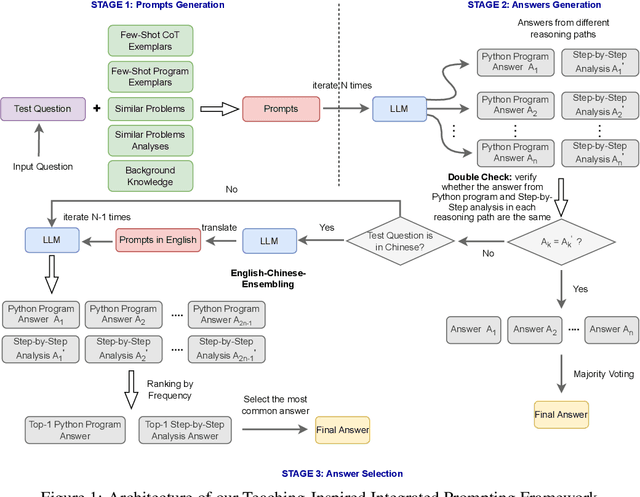

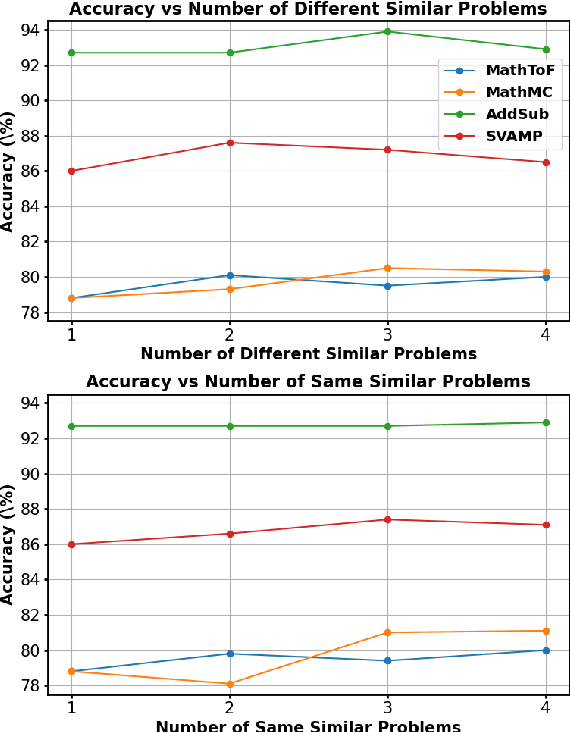
Large Language Models (LLMs) exhibit impressive performance across various domains but still struggle with arithmetic reasoning tasks. Recent work shows the effectiveness of prompt design methods in enhancing reasoning capabilities. However, these approaches overlook crucial requirements for prior knowledge of specific concepts, theorems, and tricks to tackle most arithmetic reasoning problems successfully. To address this issue, we propose a novel and effective Teaching-Inspired Integrated Framework, which emulates the instructional process of a teacher guiding students. This method equips LLMs with essential concepts, relevant theorems, and similar problems with analogous solution approaches, facilitating the enhancement of reasoning abilities. Additionally, we introduce two new Chinese datasets, MathMC and MathToF, both with detailed explanations and answers. Experiments are conducted on nine benchmarks which demonstrates that our approach improves the reasoning accuracy of LLMs. With GPT-4 and our framework, we achieve new state-of-the-art performance on four math benchmarks (AddSub, SVAMP, Math23K and AQuA) with accuracies of 98.2% (+3.3%), 93.9% (+0.2%), 94.3% (+7.2%) and 81.1% (+1.2%). Our data and code are available at https://github.com/SallyTan13/Teaching-Inspired-Prompting.