 Add to Chrome
 Add to Firefox
 Add to Edge
ASDA: Automated Skill Distillation and Adaptation for Financial Reasoning
Mar 17, 2026
Adapting large language models (LLMs) to specialized financial reasoning typically requires expensive fine-tuning that produces model-locked expertise. Training-free alternatives have emerged, yet our experiments show that leading methods (GEPA and ACE) achieve only marginal gains on the FAMMA financial reasoning benchmark, exposing the limits of unstructured text optimization for complex, multi-step domain reasoning. We introduce Automated Skill Distillation and Adaptation (ASDA), a framework that automatically generates structured skill artifacts through iterative error-corrective learning without modifying model weights. A teacher model analyzes a student model's failures on financial reasoning tasks, clusters errors by subfield and error type, and synthesizes skill files containing reasoning procedures, code templates, and worked examples, which are dynamically injected during inference. Evaluated on FAMMA, ASDA achieves up to +17.33% improvement on arithmetic reasoning and +5.95% on non-arithmetic reasoning, substantially outperforming all training-free baselines. The resulting skill artifacts are human-readable, version-controlled, and compatible with the Agent Skills open standard, offering any organization with a labeled domain dataset a practical and auditable path to domain adaptation without weight access or retraining.

Teaching-Inspired Integrated Prompting Framework: A Novel Approach for Enhancing Reasoning in Large Language Models
Oct 10, 2024
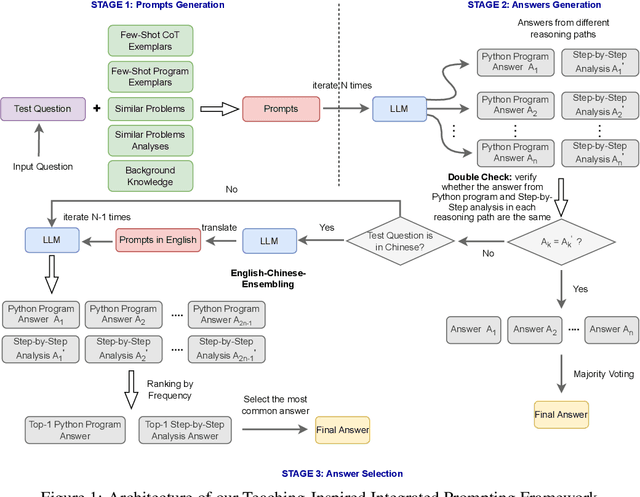

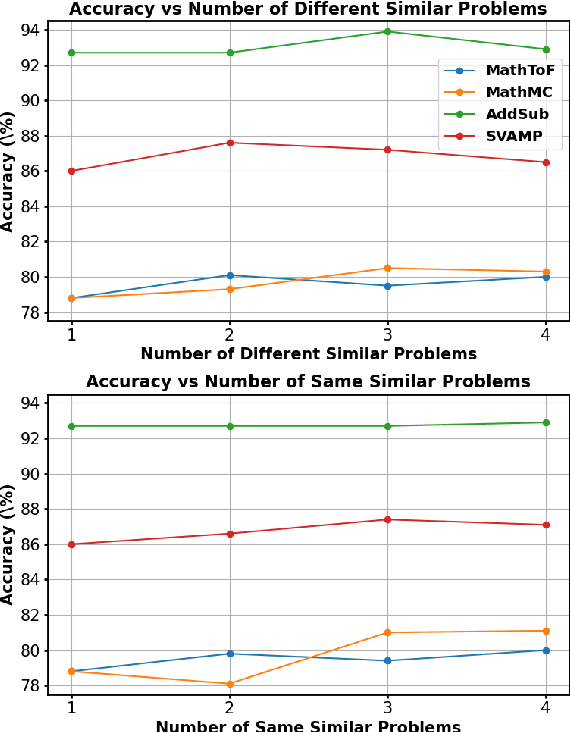
Large Language Models (LLMs) exhibit impressive performance across various domains but still struggle with arithmetic reasoning tasks. Recent work shows the effectiveness of prompt design methods in enhancing reasoning capabilities. However, these approaches overlook crucial requirements for prior knowledge of specific concepts, theorems, and tricks to tackle most arithmetic reasoning problems successfully. To address this issue, we propose a novel and effective Teaching-Inspired Integrated Framework, which emulates the instructional process of a teacher guiding students. This method equips LLMs with essential concepts, relevant theorems, and similar problems with analogous solution approaches, facilitating the enhancement of reasoning abilities. Additionally, we introduce two new Chinese datasets, MathMC and MathToF, both with detailed explanations and answers. Experiments are conducted on nine benchmarks which demonstrates that our approach improves the reasoning accuracy of LLMs. With GPT-4 and our framework, we achieve new state-of-the-art performance on four math benchmarks (AddSub, SVAMP, Math23K and AQuA) with accuracies of 98.2% (+3.3%), 93.9% (+0.2%), 94.3% (+7.2%) and 81.1% (+1.2%). Our data and code are available at https://github.com/SallyTan13/Teaching-Inspired-Prompting.