 Add to Chrome
 Add to Firefox
 Add to Edge
VaseMuseum: Digital Intelligent Museum for Ancient Greek Pottery
Jul 07, 2026
Vision-language models (VLMs) have made interactive digital museums increasingly feasible by connecting 3D digitization with natural-language artifact exploration. However, in cultural heritage domains such as ancient Greek pottery, reliable VLM assistance is limited by two challenges. First, open-ended interpretation requires grounding fine-grained 2D/3D visual evidence in specialized curatorial knowledge, yet the retrieval process may introduce weak sources and unverifiable references. Second, when the available evidence is incomplete, noisy, or ambiguous, VLMs often produce confident but unsupported answers instead of calibrated uncertainty. To address these challenges, we propose VaseMuseum, a lightweight and modular multimodal agent framework for intelligent digital museums of ancient Greek pottery. VaseMuseum combines an interactive virtual museum with VaseAgent, which supports both 2D images and 3D artifacts through multimodal perception, 3D-aware reasoning, external knowledge retrieval, and inference-time reliability control. Specifically, VaseAgent retrieves evidence from authoritative web and museum knowledge sources, and source-level control selects diverse and verifiable evidence before generation. Meanwhile, response-level control checks generated claims against the evidence pool and encourages neutral, evidence-bounded answers when support is insufficient or conflicting. Moreover, a training-free GRPO-style selection mechanism favors responses with valid references and calibrated confidence without updating the VLM backbone. Experiments in a realistic digital museum simulation show that VaseMuseum improves citation validity, reduces hallucinations on knowledge-intensive queries, and produces more neutral answers under ambiguity compared with search-enabled VLM baselines.

VaseVQA-3D: Benchmarking 3D VLMs on Ancient Greek Pottery
Oct 06, 2025
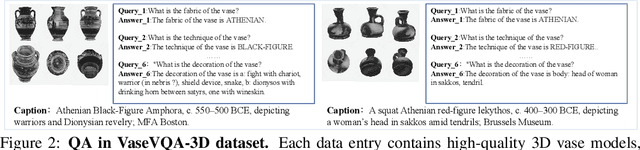
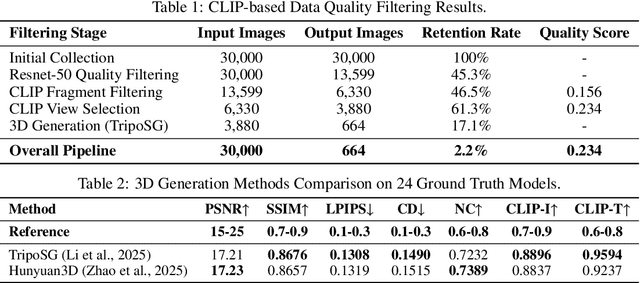
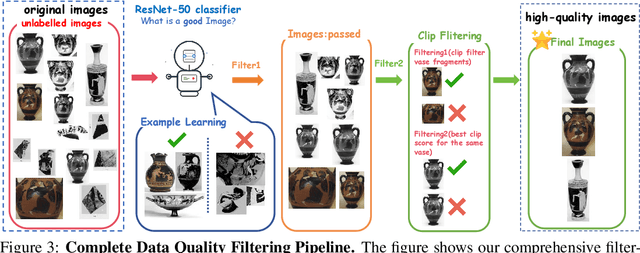
Vision-Language Models (VLMs) have achieved significant progress in multimodal understanding tasks, demonstrating strong capabilities particularly in general tasks such as image captioning and visual reasoning. However, when dealing with specialized cultural heritage domains like 3D vase artifacts, existing models face severe data scarcity issues and insufficient domain knowledge limitations. Due to the lack of targeted training data, current VLMs struggle to effectively handle such culturally significant specialized tasks. To address these challenges, we propose the VaseVQA-3D dataset, which serves as the first 3D visual question answering dataset for ancient Greek pottery analysis, collecting 664 ancient Greek vase 3D models with corresponding question-answer data and establishing a complete data construction pipeline. We further develop the VaseVLM model, enhancing model performance in vase artifact analysis through domain-adaptive training. Experimental results validate the effectiveness of our approach, where we improve by 12.8% on R@1 metrics and by 6.6% on lexical similarity compared with previous state-of-the-art on the VaseVQA-3D dataset, significantly improving the recognition and understanding of 3D vase artifacts, providing new technical pathways for digital heritage preservation research.