 Add to Chrome
 Add to Firefox
 Add to Edge
OutLangSplat: 3D Language Gaussian Splatting for UAV Outdoor Scenes
Aug 05, 2026
3D Language Gaussian Splatting embeds open-vocabulary language features into 3D Gaussian Splatting, providing an efficient explicit representation for text-driven 3D scene understanding. However, existing methods are limited to indoor or small-scale scenes, and tend to fail in Unmanned Aerial Vehicle (UAV) outdoor scenes, where severe occlusions and long distance viewpoints often lead to incorrect semantic activations and missing target responses. In this paper, we present OutLangSplat which adapts language Gaussian representations to UAV outdoor scenes by improving feature representation and aggregation reliability. For the feature representation, a 2D-3D dual-branch representation with region-based alignment and fusion is designed to improve spatial consistency, reducing incomplete target responses and background misactivations. For the feature aggregation, we introduce a training-free contribution and consistency-aware Gaussian feature aggregation strategy that leverages pixel contribution reliability and cross-view semantic consistency to suppress unreliable responses from noisy viewpoints. A new dataset is provided by manually annotating various objects on four real-world public UAV outdoor scene datasets. To the best of our knowledge, it is the first accessible dataset of open-vocabulary 3D scene understanding for UAV outdoor scenes. Quantitative evaluations and ablation studies demonstrate that OutLangSplat outperforms SOTA methods on both open-vocabulary semantic segmentation and instance localization tasks. The datasets and codes will be open-sourced.

S$^3$-Diff: Structural Semantic Synergy Diffusion Model for High Fidelity Super Resolution of Pathological Images
Aug 04, 2026Digital pathology relies on high-resolution whole slide images for accurate diagnosis, yet limitations in imaging devices, storage, and transmission often make lower-resolution pathology images more common in clinical workflows. Current super-resolution techniques often tend to smooth diagnostically relevant morphology, leading to over-smoothed textures and semantic drift that compromise downstream clinical interpretation. To this end, we develop the Structural Semantic Synergy Diffusion Model (S3-Diff), a diffusion framework for high-fidelity super-resolution of pathological images. The core of S3-Diff is Specimen-aware Structural Anchoring (SSA), which combines prognosis-aware tissue support extracted by a fixed SAM with LR-HR gradient discrepancies to generate a specimen-specific structural anchor to preserve pathological morphology. Concurrently, we introduce Structure-guided Semantic Fidelity Tuning (SSFT) to adapt DINOv3 representations using SSA-derived structural supervision. SSFT combines the adapted semantic energy with LR-derived edge and grayscale cues. The resulting control guides denoising to suppress stochastic artifacts and maintain structural consistency. Extensive experimental results demonstrate that S3-Diff consistently outperforms state-of-the-art methods in both reconstruction quality and downstream survival analysis performance. The source code will be made public.
Morphology-Aware Implicit Super-Resolution Network for Pathological Images
Aug 04, 2026Accurate diagnosis in Digital Pathology (DP) relies on high-resolution whole-slide images, yet clinical deployment is often limited by hardware costs. Super-Resolution (SR) offers a promising alternative by computationally enhancing low-resolution acquisitions. However, existing SR methods frequently struggle to preserve fine-grained cellular morphology, leading to texture oversmoothing and blurred structural boundaries under complex tissue variability. To address this issue, we propose Morph-ISR, a morphology-aware implicit super-resolution framework for DP that restores diagnostically relevant details with sub-pixel precision. Morph-ISR reformulates SR as a continuous coordinate-based reconstruction problem and integrates an Implicit Position-aware Kernel Generator (IPKG) to adaptively model spatially varying tissue morphology. To further enhance structural fidelity, a Morphological Fidelity Prior (MFP) is introduced, leveraging semantic guidance from a pre-trained cell segmentation network to enforce boundary-preserving and region-aware reconstruction, thereby improving the representation of critical cellular boundaries and nuclear textures. Experiments on TCGA and SurGen datasets show that Morph-ISR achieves the best LPIPS and ST-LPIPS among the evaluated methods, reducing them by up to 38.37% and 39.55%, respectively, over the second-best methods while maintaining strong PSNR and SSIM. These results demonstrate superior preservation of diagnostically relevant cellular boundaries and nuclear textures, while compact parameterization and high throughput support efficient edge deployment. Code and trained models will be released upon publication.
TIBR4D: Tracing-Guided Iterative Boundary Refinement for Efficient 4D Gaussian Segmentation
Feb 09, 2026Object-level segmentation in dynamic 4D Gaussian scenes remains challenging due to complex motion, occlusions, and ambiguous boundaries. In this paper, we present an efficient learning-free 4D Gaussian segmentation framework that lifts video segmentation masks to 4D spaces, whose core is a two-stage iterative boundary refinement, TIBR4D. The first stage is an Iterative Gaussian Instance Tracing (IGIT) at the temporal segment level. It progressively refines Gaussian-to-instance probabilities through iterative tracing, and extracts corresponding Gaussian point clouds that better handle occlusions and preserve completeness of object structures compared to existing one-shot threshold-based methods. The second stage is a frame-wise Gaussian Rendering Range Control (RCC) via suppressing highly uncertain Gaussians near object boundaries while retaining their core contributions for more accurate boundaries. Furthermore, a temporal segmentation merging strategy is proposed for IGIT to balance identity consistency and dynamic awareness. Longer segments enforce stronger multi-frame constraints for stable identities, while shorter segments allow identity changes to be captured promptly. Experiments on HyperNeRF and Neu3D demonstrate that our method produces accurate object Gaussian point clouds with clearer boundaries and higher efficiency compared to SOTA methods.
MMFL-Net: Multi-scale and Multi-granularity Feature Learning for Cross-domain Fashion Retrieval
Oct 27, 2022Instance-level image retrieval in fashion is a challenging issue owing to its increasing importance in real-scenario visual fashion search. Cross-domain fashion retrieval aims to match the unconstrained customer images as queries for photographs provided by retailers; however, it is a difficult task due to a wide range of consumer-to-shop (C2S) domain discrepancies and also considering that clothing image is vulnerable to various non-rigid deformations. To this end, we propose a novel multi-scale and multi-granularity feature learning network (MMFL-Net), which can jointly learn global-local aggregation feature representations of clothing images in a unified framework, aiming to train a cross-domain model for C2S fashion visual similarity. First, a new semantic-spatial feature fusion part is designed to bridge the semantic-spatial gap by applying top-down and bottom-up bidirectional multi-scale feature fusion. Next, a multi-branch deep network architecture is introduced to capture global salient, part-informed, and local detailed information, and extracting robust and discrimination feature embedding by integrating the similarity learning of coarse-to-fine embedding with the multiple granularities. Finally, the improved trihard loss, center loss, and multi-task classification loss are adopted for our MMFL-Net, which can jointly optimize intra-class and inter-class distance and thus explicitly improve intra-class compactness and inter-class discriminability between its visual representations for feature learning. Furthermore, our proposed model also combines the multi-task attribute recognition and classification module with multi-label semantic attributes and product ID labels. Experimental results demonstrate that our proposed MMFL-Net achieves significant improvement over the state-of-the-art methods on the two datasets, DeepFashion-C2S and Street2Shop.
* 27 pages, 12 figures, Published by <Multimedia Tools and Applications>
3D Instance Segmentation of MVS Buildings
Dec 18, 2021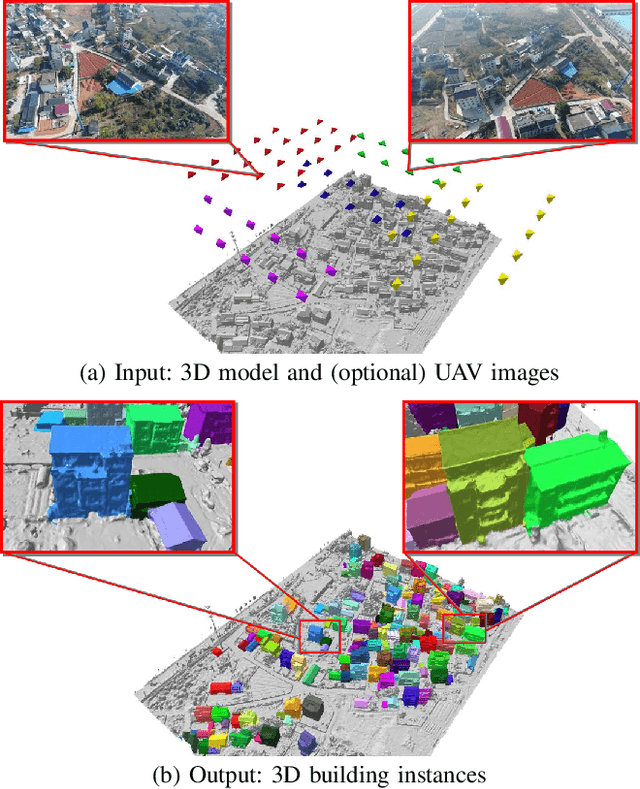
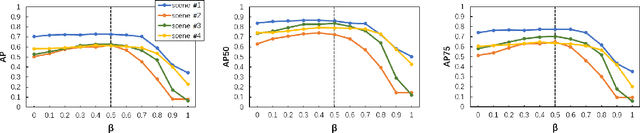
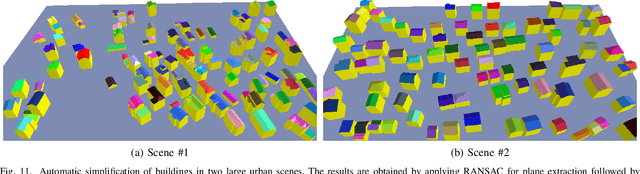
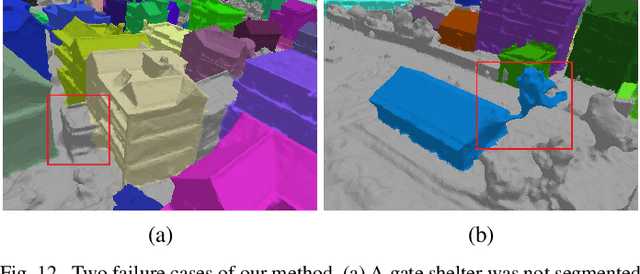
We present a novel framework for instance segmentation of 3D buildings from Multi-view Stereo (MVS) urban scenes. Unlike existing works focusing on semantic segmentation of an urban scene, the emphasis of this work lies in detecting and segmenting 3D building instances even if they are attached and embedded in a large and imprecise 3D surface model. Multi-view RGB images are first enhanced to RGBH images by adding a heightmap and are segmented to obtain all roof instances using a fine-tuned 2D instance segmentation neural network. Roof instance masks from different multi-view images are then clustered into global masks. Our mask clustering accounts for spatial occlusion and overlapping, which can eliminate segmentation ambiguities among multi-view images. Based on these global masks, 3D roof instances are segmented out by mask back-projections and extended to the entire building instances through a Markov random field (MRF) optimization. Quantitative evaluations and ablation studies have shown the effectiveness of all major steps of the method. A dataset for the evaluation of instance segmentation of 3D building models is provided as well. To the best of our knowledge, it is the first dataset for 3D urban buildings on the instance segmentation level.
Integrating Tensor Similarity to Enhance Clustering Performance
May 10, 2019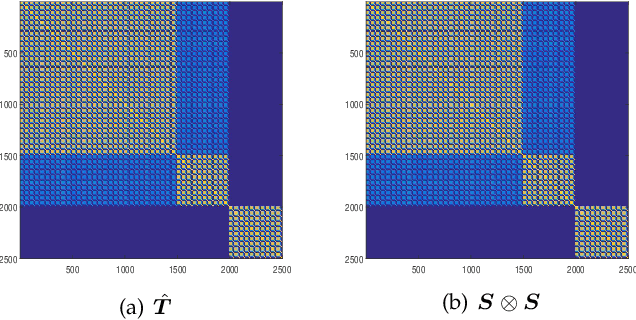
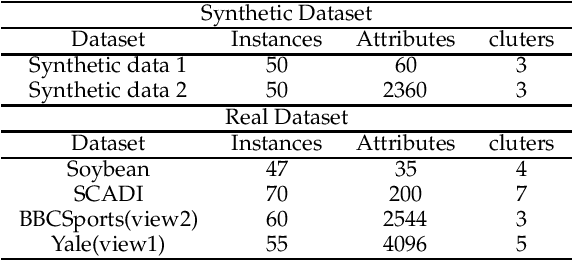
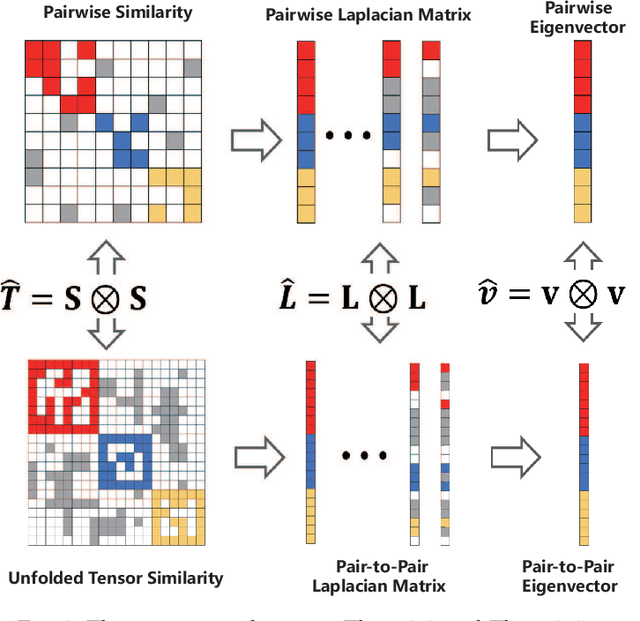

Clustering aims to separate observed data into different categories. The performance of popular clustering models relies on the sample-to-sample similarity. However, the pairwise similarity is prone to be corrupted by noise or outliers and thus deteriorates the subsequent clustering. A high-order relationship among samples-to-samples may elaborate the local manifold of the data and thus provide complementary information to guide the clustering. However, few studies have investigated the connection between high-order similarity and usual pairwise similarity. To fill this gap, we first define a high-order tensor similarity to exploit the samples-to-samples affinity relationship. We then establish the connection between tensor similarity and pairwise similarity, proving that the decomposable tensor similarity is the Kronecker product of the usual pairwise similarity and the non-decomposable tensor similarity is generalized to provide complementary information, which pairwise similarity fails to regard. Finally, the high-order tensor similarity and pairwise similarity (IPS2) were integrated collaboratively to enhance clustering performance by enjoying their merits. The proposed IPS2 is shown to perform superior or competitive to state-of-the-art methods on synthetic and real-world datasets. Extensive experiments demonstrated that tensor similarity is capable to boost the performance of the classical clustering method.