 Add to Chrome
 Add to Firefox
 Add to Edge
OutLangSplat: 3D Language Gaussian Splatting for UAV Outdoor Scenes
Aug 05, 2026
3D Language Gaussian Splatting embeds open-vocabulary language features into 3D Gaussian Splatting, providing an efficient explicit representation for text-driven 3D scene understanding. However, existing methods are limited to indoor or small-scale scenes, and tend to fail in Unmanned Aerial Vehicle (UAV) outdoor scenes, where severe occlusions and long distance viewpoints often lead to incorrect semantic activations and missing target responses. In this paper, we present OutLangSplat which adapts language Gaussian representations to UAV outdoor scenes by improving feature representation and aggregation reliability. For the feature representation, a 2D-3D dual-branch representation with region-based alignment and fusion is designed to improve spatial consistency, reducing incomplete target responses and background misactivations. For the feature aggregation, we introduce a training-free contribution and consistency-aware Gaussian feature aggregation strategy that leverages pixel contribution reliability and cross-view semantic consistency to suppress unreliable responses from noisy viewpoints. A new dataset is provided by manually annotating various objects on four real-world public UAV outdoor scene datasets. To the best of our knowledge, it is the first accessible dataset of open-vocabulary 3D scene understanding for UAV outdoor scenes. Quantitative evaluations and ablation studies demonstrate that OutLangSplat outperforms SOTA methods on both open-vocabulary semantic segmentation and instance localization tasks. The datasets and codes will be open-sourced.

TIBR4D: Tracing-Guided Iterative Boundary Refinement for Efficient 4D Gaussian Segmentation
Feb 09, 2026Object-level segmentation in dynamic 4D Gaussian scenes remains challenging due to complex motion, occlusions, and ambiguous boundaries. In this paper, we present an efficient learning-free 4D Gaussian segmentation framework that lifts video segmentation masks to 4D spaces, whose core is a two-stage iterative boundary refinement, TIBR4D. The first stage is an Iterative Gaussian Instance Tracing (IGIT) at the temporal segment level. It progressively refines Gaussian-to-instance probabilities through iterative tracing, and extracts corresponding Gaussian point clouds that better handle occlusions and preserve completeness of object structures compared to existing one-shot threshold-based methods. The second stage is a frame-wise Gaussian Rendering Range Control (RCC) via suppressing highly uncertain Gaussians near object boundaries while retaining their core contributions for more accurate boundaries. Furthermore, a temporal segmentation merging strategy is proposed for IGIT to balance identity consistency and dynamic awareness. Longer segments enforce stronger multi-frame constraints for stable identities, while shorter segments allow identity changes to be captured promptly. Experiments on HyperNeRF and Neu3D demonstrate that our method produces accurate object Gaussian point clouds with clearer boundaries and higher efficiency compared to SOTA methods.
3D Instance Segmentation of MVS Buildings
Dec 18, 2021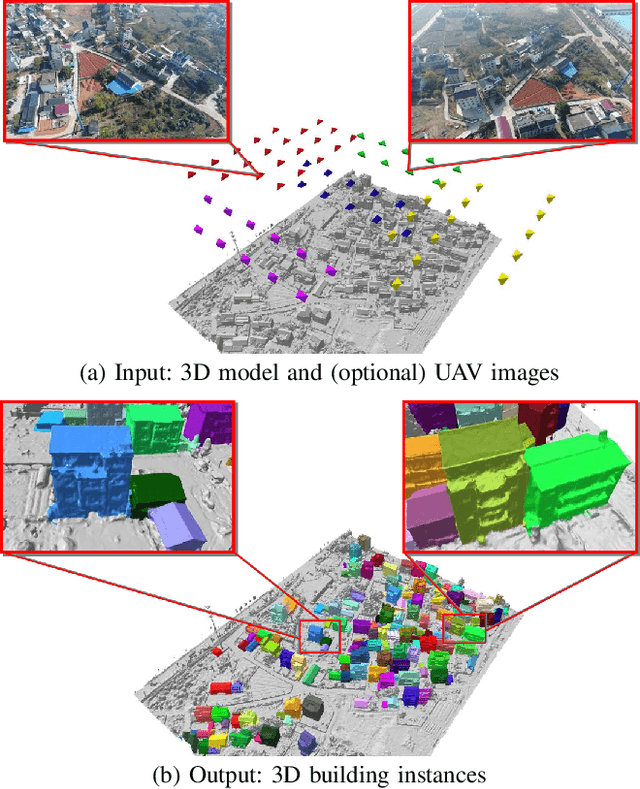
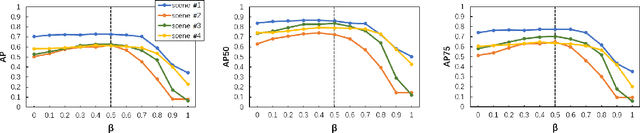
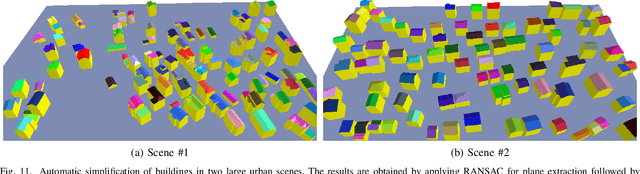
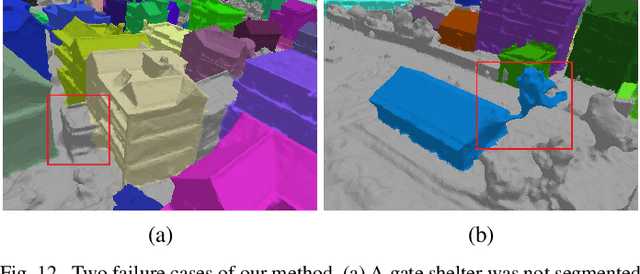
We present a novel framework for instance segmentation of 3D buildings from Multi-view Stereo (MVS) urban scenes. Unlike existing works focusing on semantic segmentation of an urban scene, the emphasis of this work lies in detecting and segmenting 3D building instances even if they are attached and embedded in a large and imprecise 3D surface model. Multi-view RGB images are first enhanced to RGBH images by adding a heightmap and are segmented to obtain all roof instances using a fine-tuned 2D instance segmentation neural network. Roof instance masks from different multi-view images are then clustered into global masks. Our mask clustering accounts for spatial occlusion and overlapping, which can eliminate segmentation ambiguities among multi-view images. Based on these global masks, 3D roof instances are segmented out by mask back-projections and extended to the entire building instances through a Markov random field (MRF) optimization. Quantitative evaluations and ablation studies have shown the effectiveness of all major steps of the method. A dataset for the evaluation of instance segmentation of 3D building models is provided as well. To the best of our knowledge, it is the first dataset for 3D urban buildings on the instance segmentation level.