 Add to Chrome
 Add to Firefox
 Add to Edge
Evidential learning driven Breast Tumor Segmentation with Stage-divided Vision-Language Interaction
Mar 11, 2026
Breast cancer is one of the most common causes of death among women worldwide, with millions of fatalities annually. Magnetic Resonance Imaging (MRI) can provide various sequences for characterizing tumor morphology and internal patterns, and becomes an effective tool for detection and diagnosis of breast tumors. However, previous deep-learning based tumor segmentation methods have limitations in accurately locating tumor contours due to the challenge of low contrast between cancer and normal areas and blurred boundaries. Leveraging text prompt information holds promise in ameliorating tumor segmentation effect by delineating segmentation regions. Inspired by this, we propose text-guided Breast Tumor Segmentation model (TextBCS) with stage-divided vision-language interaction and evidential learning. Specifically, the proposed stage-divided vision-language interaction facilitates information mutual between visual and text features at each stage of down-sampling, further exerting the advantages of text prompts to assist in locating lesion areas in low contrast scenarios. Moreover, the evidential learning is adopted to quantify the segmentation uncertainty of the model for blurred boundary. It utilizes the variational Dirichlet to characterize the distribution of the segmentation probabilities, addressing the segmentation uncertainties of the boundaries. Extensive experiments validate the superiority of our TextBCS over other segmentation networks, showcasing the best breast tumor segmentation performance on publicly available datasets.

Differentiable Soft Quantization: Bridging Full-Precision and Low-Bit Neural Networks
Aug 14, 2019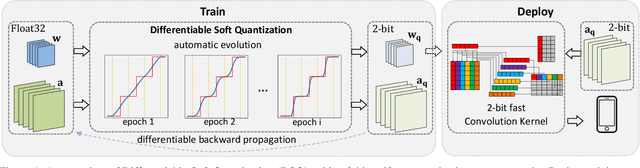
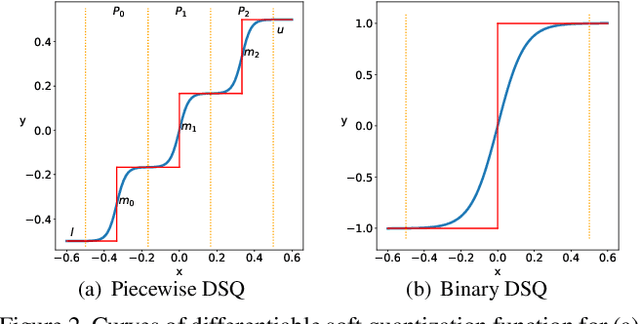
Hardware-friendly network quantization (e.g., binary/uniform quantization) can efficiently accelerate the inference and meanwhile reduce memory consumption of the deep neural networks, which is crucial for model deployment on resource-limited devices like mobile phones. However, due to the discreteness of low-bit quantization, existing quantization methods often face the unstable training process and severe performance degradation. To address this problem, in this paper we propose Differentiable Soft Quantization (DSQ) to bridge the gap between the full-precision and low-bit networks. DSQ can automatically evolve during training to gradually approximate the standard quantization. Owing to its differentiable property, DSQ can help pursue the accurate gradients in backward propagation, and reduce the quantization loss in forward process with an appropriate clipping range. Extensive experiments over several popular network structures show that training low-bit neural networks with DSQ can consistently outperform state-of-the-art quantization methods. Besides, our first efficient implementation for deploying 2 to 4-bit DSQ on devices with ARM architecture achieves up to 1.7$\times$ speed up, compared with the open-source 8-bit high-performance inference framework NCNN. [31]