Abstract:The emerging threat of AR-LLM-based Social Engineering (AR-LLM-SE) attacks (e.g. SEAR) poses a significant risk to real-world social interactions. In such an attack, a malicious actor uses Augmented Reality (AR) glasses to capture a target visual and vocal data. A Large Language Model (LLM) then analyzes this data to identify the individual and generate a detailed social profile. Subsequently, LLM-powered agents employ social engineering strategies, providing real-time conversation suggestions, to gain the target trust and ultimately execute phishing or other malicious acts. Despite its potential, the practical application of AR-LLM-SE faces two major bottlenecks, (1) Cold-start personalization, Current Retrieval-Augmented Generation (RAG) methods introduce critical delays in the earliest turns, slowing initial profile formation and disrupting real-time interaction, (2) Static Attack Strategies, Existing approaches rely on fixed-stage, handcrafted social engineering tactics that lack foundation in established psychological theory. To address these limitations, we propose PhySE, a novel framework with two core innovations, (1) VLM-Based SocialContext Training, To eliminate profiling delays, we efficiently pre-train a Visual Language Model (VLM) with social-context data, enabling rapid, on-the-fly profile generation, (2) Adaptive Psychological Agent, We introduce a psychological LLM that dynamically deploys distinct classes of psychological strategies based on target response, moving beyond static, handcrafted scripts. We evaluated PhySE through an IRB-approved user study with 60 participants, collecting a novel dataset of 360 annotated conversations across diverse social scenarios.


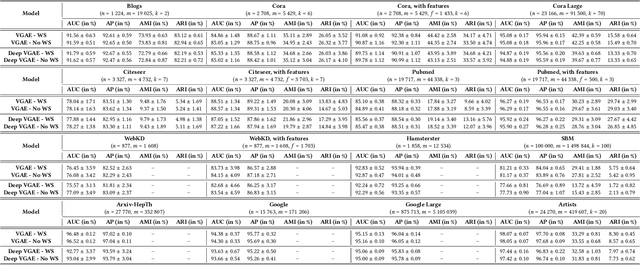
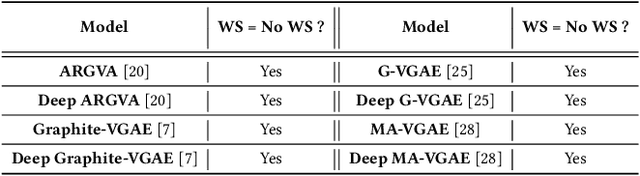
Abstract:This paper investigates the understudied practice of weight sharing (WS) in variational graph autoencoders (VGAE). WS presents both benefits and drawbacks for VGAE model design and node embedding learning, leaving its overall relevance unclear and the question of whether it should be adopted unresolved. We rigorously analyze its implications and, through extensive experiments on a wide range of graphs and VGAE variants, demonstrate that the benefits of WS consistently outweigh its drawbacks. Based on our findings, we recommend WS as an effective approach to optimize, regularize, and simplify VGAE models without significant performance loss.