 Add to Chrome
 Add to Firefox
 Add to Edge
Structured Prompt Optimization for Few-Shot Text Classification via Semantic Alignment in Latent Space
Feb 27, 2026
This study addresses the issues of semantic entanglement, unclear label structure, and insufficient feature representation in few-shot text classification, and proposes an optimization framework based on structured prompts to enhance semantic understanding and task adaptation under low-resource conditions. The framework first uses a pretrained language model to encode the input text and obtain basic semantic representations. It then introduces structured prompts composed of multi-dimensional semantic factors and integrates them with text features through a learnable combination mechanism, which forms task-related representations with clear boundaries in the latent space. To further strengthen the consistency between text representations and label semantics, the method constructs a structured label embedding matrix and employs a cross-space alignment mechanism to ensure stable matching between textual features and label attributes. In addition, the model applies prompt orthogonality constraints and a joint optimization objective to maintain independence across different semantic factors in the prompts, allowing the structured prompts to provide transparent and controllable guidance for classification decisions. Three types of sensitivity experiments, including learning rate sensitivity, prompt length sensitivity, and data scale sensitivity, are designed to evaluate the stability and robustness of the framework under different conditions. Experimental results show that the proposed structured prompt optimization framework effectively alleviates semantic conflicts and label ambiguity in few-shot text classification. It significantly improves performance on accuracy, precision, recall, and AUC, and demonstrates strong cross-task applicability.

Contrastive Knowledge Transfer and Robust Optimization for Secure Alignment of Large Language Models
Oct 31, 2025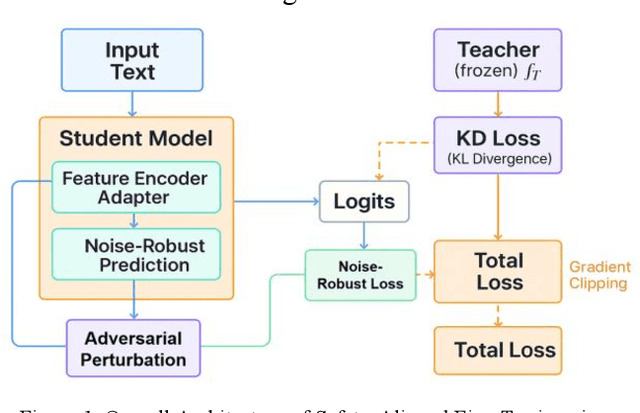
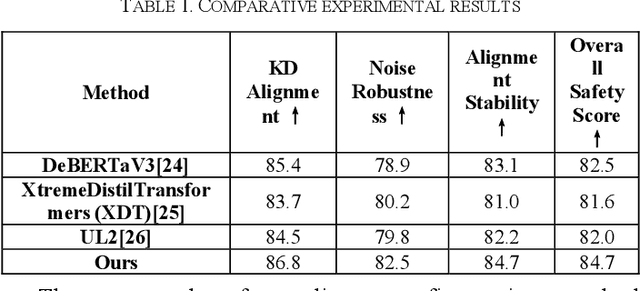
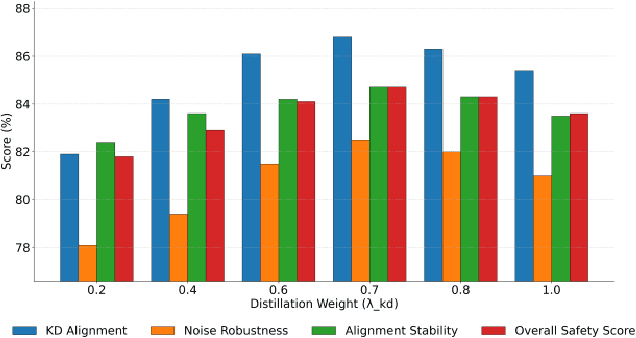
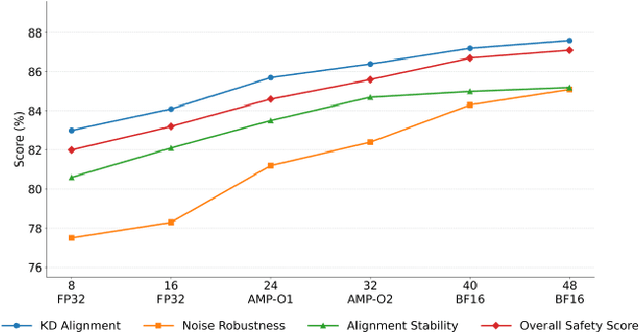
This paper addresses the limitations of large-scale language models in safety alignment and robustness by proposing a fine-tuning method that combines contrastive distillation with noise-robust training. The method freezes the backbone model and transfers the knowledge boundaries of the teacher model to the student model through distillation, thereby improving semantic consistency and alignment accuracy. At the same time, noise perturbations and robust optimization constraints are introduced during training to ensure that the model maintains stable predictive outputs under noisy and uncertain inputs. The overall framework consists of distillation loss, robustness loss, and a regularization term, forming a unified optimization objective that balances alignment ability with resistance to interference. To systematically validate its effectiveness, the study designs experiments from multiple perspectives, including distillation weight sensitivity, stability analysis under computation budgets and mixed-precision environments, and the impact of data noise and distribution shifts on model performance. Results show that the method significantly outperforms existing baselines in knowledge transfer, robustness, and overall safety, achieving the best performance across several key metrics. This work not only enriches the theoretical system of parameter-efficient fine-tuning but also provides a new solution for building safer and more trustworthy alignment mechanisms.
Resilient Load Restoration in Microgrids Considering Mobile Energy Storage Fleets: A Deep Reinforcement Learning Approach
Nov 06, 2019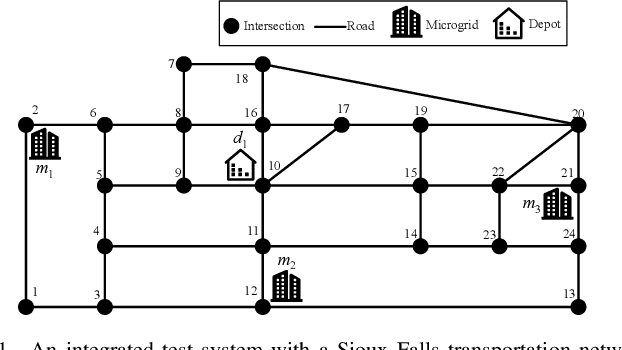
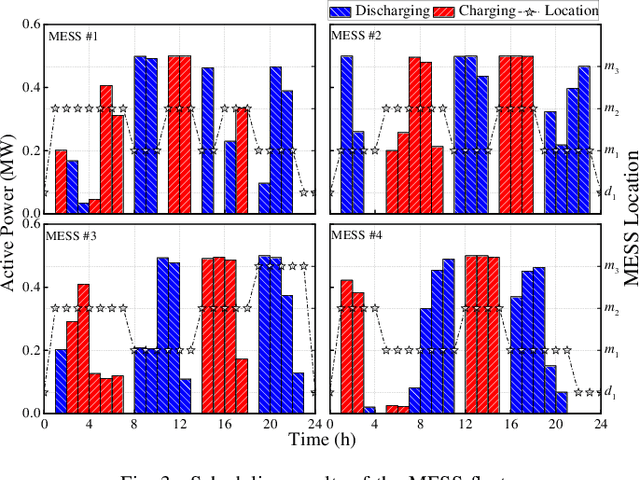
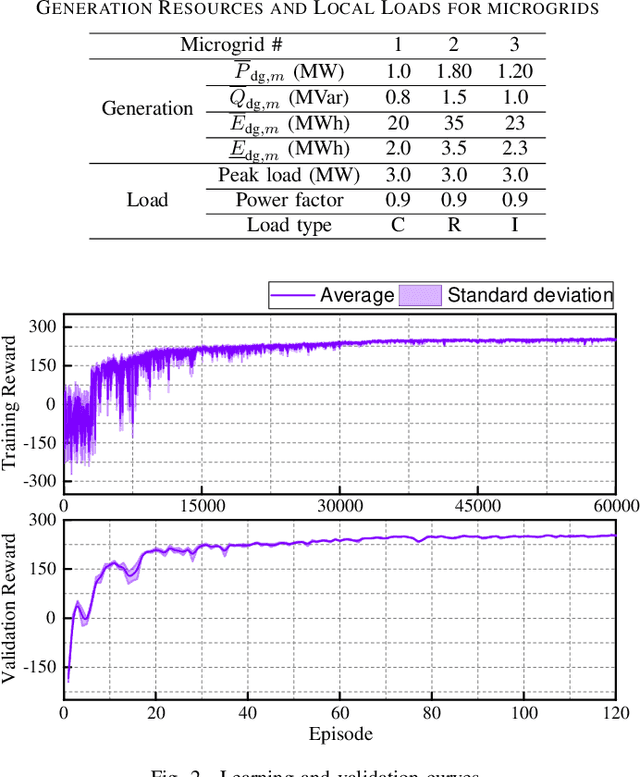
Mobile energy storage systems (MESSs) provide mobility and flexibility to enhance distribution system resilience. The paper proposes a Markov decision process (MDP) formulation for an integrated service restoration strategy that coordinates the scheduling of MESSs and resource dispatching of microgrids. The uncertainties in load consumption are taken into account. The deep reinforcement learning (DRL) algorithm is utilized to solve the MDP for optimal scheduling. Specifically, the twin delayed deep deterministic policy gradient (TD3) is applied to train the deep Q-network and policy network, then the well trained policy can be deployed in on-line manner to perform multiple actions simultaneously. The proposed model is demonstrated on an integrated test system with three microgrids connected by Sioux Falls transportation network. The simulation results indicate that mobile and stationary energy resources can be well coordinated to improve system resilience.