 Add to Chrome
 Add to Firefox
 Add to Edge
Large-scale EM Benchmark for Multi-Organelle Instance Segmentation in the Wild
Jan 18, 2026
Accurate instance-level segmentation of organelles in electron microscopy (EM) is critical for quantitative analysis of subcellular morphology and inter-organelle interactions. However, current benchmarks, based on small, curated datasets, fail to capture the inherent heterogeneity and large spatial context of in-the-wild EM data, imposing fundamental limitations on current patch-based methods. To address these limitations, we developed a large-scale, multi-source benchmark for multi-organelle instance segmentation, comprising over 100,000 2D EM images across variety cell types and five organelle classes that capture real-world variability. Dataset annotations were generated by our designed connectivity-aware Label Propagation Algorithm (3D LPA) with expert refinement. We further benchmarked several state-of-the-art models, including U-Net, SAM variants, and Mask2Former. Our results show several limitations: current models struggle to generalize across heterogeneous EM data and perform poorly on organelles with global, distributed morphologies (e.g., Endoplasmic Reticulum). These findings underscore the fundamental mismatch between local-context models and the challenge of modeling long-range structural continuity in the presence of real-world variability. The benchmark dataset and labeling tool will be publicly released soon.

RFAssigner: A Generic Label Assignment Strategy for Dense Object Detection
Jan 03, 2026Label assignment is a critical component in training dense object detectors. State-of-the-art methods typically assign each training sample a positive and a negative weight, optimizing the assignment scheme during training. However, these strategies often assign an insufficient number of positive samples to small objects, leading to a scale imbalance during training. To address this limitation, we introduce RFAssigner, a novel assignment strategy designed to enhance the multi-scale learning capabilities of dense detectors. RFAssigner first establishes an initial set of positive samples using a point-based prior. It then leverages a Gaussian Receptive Field (GRF) distance to measure the similarity between the GRFs of unassigned candidate locations and the ground-truth objects. Based on this metric, RFAssigner adaptively selects supplementary positive samples from the unassigned pool, promoting a more balanced learning process across object scales. Comprehensive experiments on three datasets with distinct object scale distributions validate the effectiveness and generalizability of our method. Notably, a single FCOS-ResNet-50 detector equipped with RFAssigner achieves state-of-the-art performance across all object scales, consistently outperforming existing strategies without requiring auxiliary modules or heuristics.
Feature-oriented Deep Learning Framework for Pulmonary Cone-beam CT (CBCT) Enhancement with Multi-task Customized Perceptual Loss
Nov 01, 2023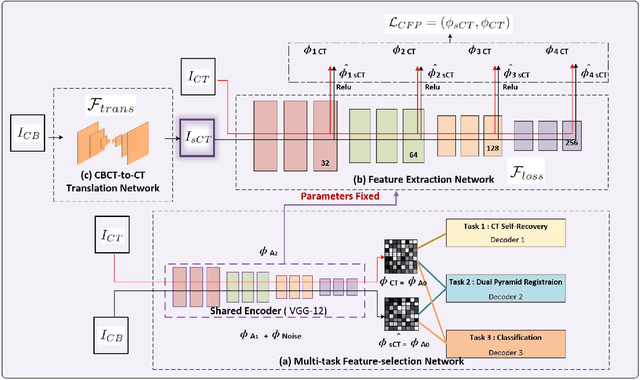
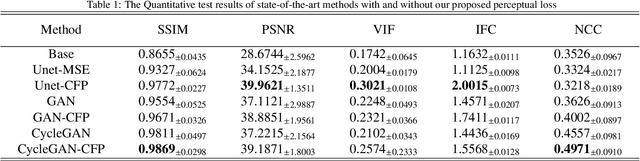
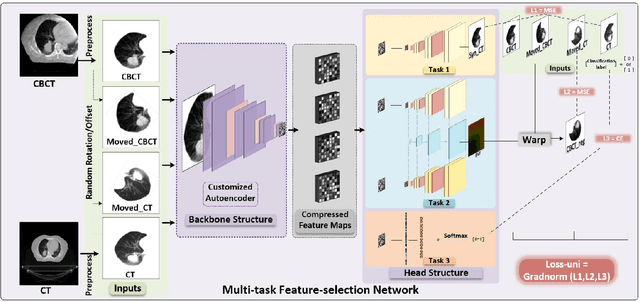
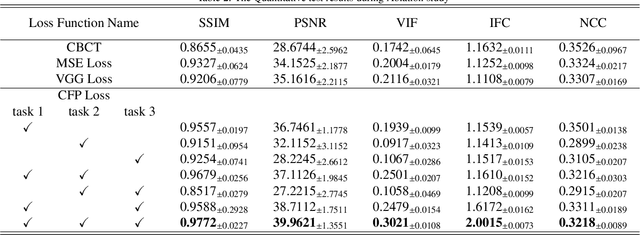
Cone-beam computed tomography (CBCT) is routinely collected during image-guided radiation therapy (IGRT) to provide updated patient anatomy information for cancer treatments. However, CBCT images often suffer from streaking artifacts and noise caused by under-rate sampling projections and low-dose exposure, resulting in low clarity and information loss. While recent deep learning-based CBCT enhancement methods have shown promising results in suppressing artifacts, they have limited performance on preserving anatomical details since conventional pixel-to-pixel loss functions are incapable of describing detailed anatomy. To address this issue, we propose a novel feature-oriented deep learning framework that translates low-quality CBCT images into high-quality CT-like imaging via a multi-task customized feature-to-feature perceptual loss function. The framework comprises two main components: a multi-task learning feature-selection network(MTFS-Net) for customizing the perceptual loss function; and a CBCT-to-CT translation network guided by feature-to-feature perceptual loss, which uses advanced generative models such as U-Net, GAN and CycleGAN. Our experiments showed that the proposed framework can generate synthesized CT (sCT) images for the lung that achieved a high similarity to CT images, with an average SSIM index of 0.9869 and an average PSNR index of 39.9621. The sCT images also achieved visually pleasing performance with effective artifacts suppression, noise reduction, and distinctive anatomical details preservation. Our experiment results indicate that the proposed framework outperforms the state-of-the-art models for pulmonary CBCT enhancement. This framework holds great promise for generating high-quality anatomical imaging from CBCT that is suitable for various clinical applications.
Visual-Linguistic Causal Intervention for Radiology Report Generation
Mar 16, 2023
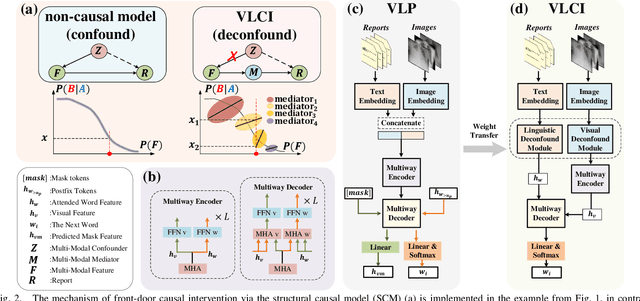


Automatic radiology report generation is essential for computer-aided diagnosis and medication guidance. Importantly, automatic radiology report generation (RRG) can relieve the heavy burden of radiologists by generating medical reports automatically from visual-linguistic data relations. However, due to the spurious correlations within image-text data induced by visual and linguistic biases, it is challenging to generate accurate reports that reliably describe abnormalities. Besides, the cross-modal confounder is usually unobservable and difficult to be eliminated explicitly. In this paper, we mitigate the cross-modal data bias for RRG from a new perspective, i.e., visual-linguistic causal intervention, and propose a novel Visual-Linguistic Causal Intervention (VLCI) framework for RRG, which consists of a visual deconfounding module (VDM) and a linguistic deconfounding module (LDM), to implicitly deconfound the visual-linguistic confounder by causal front-door intervention. Specifically, the VDM explores and disentangles the visual confounder from the patch-based local and global features without object detection due to the absence of universal clinic semantic extraction. Simultaneously, the LDM eliminates the linguistic confounder caused by salient visual features and high-frequency context without constructing specific dictionaries. Extensive experiments on IU-Xray and MIMIC-CXR datasets show that our VLCI outperforms the state-of-the-art RRG methods significantly. Source code and models are available at https://github.com/WissingChen/VLCI.