 Add to Chrome
 Add to Firefox
 Add to Edge
WM-Cov: Test Adequacy for Interactive World-Model-Style Autonomous Driving Simulation
Jul 31, 2026
World models and generative simulators are emerging as interactive testing infrastructure for autonomous driving because they can react to the ego planner and produce counterfactual, rare, and safety-critical rollouts. This changes a test scenario from a fixed replayed trajectory into an interactive scenario family whose realized evolution depends on the planner under test. The unresolved question is therefore not only whether dangerous rollouts can be generated, but what valid closed-loop evidence is enough to support a specified testing intent and stopping decision. This paper formulates interactive world-model-style testing adequacy and introduces WM-Cov, a provider-agnostic evaluation layer that converts raw provider outputs into requested, realized, and valid evidence. WM-Cov reports adequacy through coverage growth, valid-failure discovery, failure-mode diversity, realism, artifact suppression, duplicate accounting, and valid-evidence precision. Studies on executed TeraSim/SUMO events, WM-like mixed trace pools, and a real DriveArena TrafficManager--WorldDreamer matrix show that dangerous-looking events can include valid ADS failures, duplicates, partial realizations, and artifacts. The DriveArena matrix evaluates two planners, two horizons, six prompt conditions, and 360 ego-route requests; 304 attempts become fully realized evidence and 56 remain partial. A disjoint 80-request route-slice check yields 74 fully realized and 6 partial attempts. The results support evaluating world-model-style testing by convergence of valid interactive evidence under budget, rather than by raw generated failures or prompt coverage alone.

K-Gen: A Multimodal Language-Conditioned Approach for Interpretable Keypoint-Guided Trajectory Generation
Mar 05, 2026Generating realistic and diverse trajectories is a critical challenge in autonomous driving simulation. While Large Language Models (LLMs) show promise, existing methods often rely on structured data like vectorized maps, which fail to capture the rich, unstructured visual context of a scene. To address this, we propose K-Gen, an interpretable keypoint-guided multimodal framework that leverages Multimodal Large Language Models (MLLMs) to unify rasterized BEV map inputs with textual scene descriptions. Instead of directly predicting full trajectories, K-Gen generates interpretable keypoints along with reasoning that reflects agent intentions, which are subsequently refined into accurate trajectories by a refinement module. To further enhance keypoint generation, we apply T-DAPO, a trajectory-aware reinforcement fine-tuning algorithm. Experiments on WOMD and nuPlan demonstrate that K-Gen outperforms existing baselines, highlighting the effectiveness of combining multimodal reasoning with keypoint-guided trajectory generation.
SaFeR: Safety-Critical Scenario Generation for Autonomous Driving Test via Feasibility-Constrained Token Resampling
Mar 04, 2026Safety-critical scenario generation is crucial for evaluating autonomous driving systems. However, existing approaches often struggle to balance three conflicting objectives: adversarial criticality, physical feasibility, and behavioral realism. To bridge this gap, we propose SaFeR: safety-critical scenario generation for autonomous driving test via feasibility-constrained token resampling. We first formulate traffic generation as a discrete next token prediction problem, employing a Transformer-based model as a realism prior to capture naturalistic driving distributions. To capture complex interactions while effectively mitigating attention noise, we propose a novel differential attention mechanism within the realism prior. Building on this prior, SaFeR implements a novel resampling strategy that induces adversarial behaviors within a high-probability trust region to maintain naturalism, while enforcing a feasibility constraint derived from the Largest Feasible Region (LFR). By approximating the LFR via offline reinforcement learning, SaFeR effectively prevents the generation of theoretically inevitable collisions. Closed-loop experiments on the Waymo Open Motion Dataset and nuPlan demonstrate that SaFeR significantly outperforms state-of-the-art baselines, achieving a higher solution rate and superior kinematic realism while maintaining strong adversarial effectiveness.
MetricAnything: Scaling Metric Depth Pretraining with Noisy Heterogeneous Sources
Jan 29, 2026Scaling has powered recent advances in vision foundation models, yet extending this paradigm to metric depth estimation remains challenging due to heterogeneous sensor noise, camera-dependent biases, and metric ambiguity in noisy cross-source 3D data. We introduce Metric Anything, a simple and scalable pretraining framework that learns metric depth from noisy, diverse 3D sources without manually engineered prompts, camera-specific modeling, or task-specific architectures. Central to our approach is the Sparse Metric Prompt, created by randomly masking depth maps, which serves as a universal interface that decouples spatial reasoning from sensor and camera biases. Using about 20M image-depth pairs spanning reconstructed, captured, and rendered 3D data across 10000 camera models, we demonstrate-for the first time-a clear scaling trend in the metric depth track. The pretrained model excels at prompt-driven tasks such as depth completion, super-resolution and Radar-camera fusion, while its distilled prompt-free student achieves state-of-the-art results on monocular depth estimation, camera intrinsics recovery, single/multi-view metric 3D reconstruction, and VLA planning. We also show that using pretrained ViT of Metric Anything as a visual encoder significantly boosts Multimodal Large Language Model capabilities in spatial intelligence. These results show that metric depth estimation can benefit from the same scaling laws that drive modern foundation models, establishing a new path toward scalable and efficient real-world metric perception. We open-source MetricAnything at http://metric-anything.github.io/metric-anything-io/ to support community research.
UniCP: A Unified Caching and Pruning Framework for Efficient Video Generation
Feb 06, 2025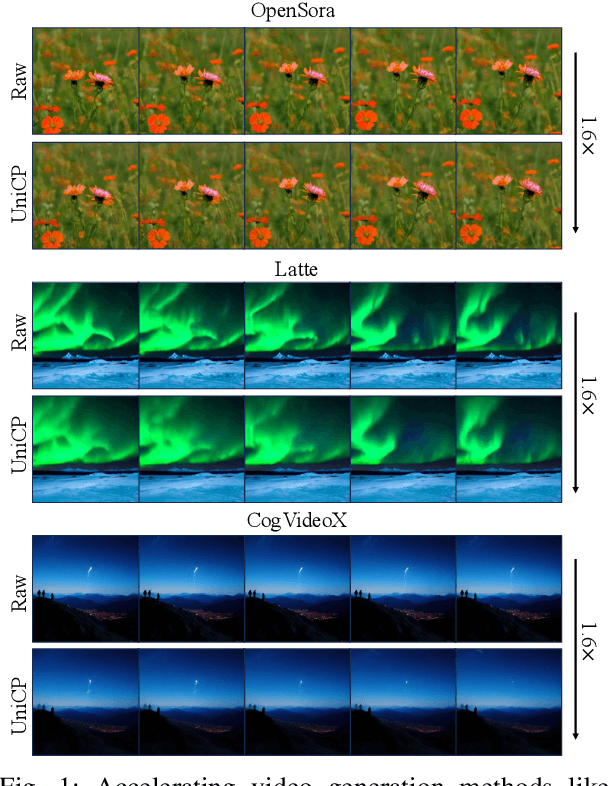

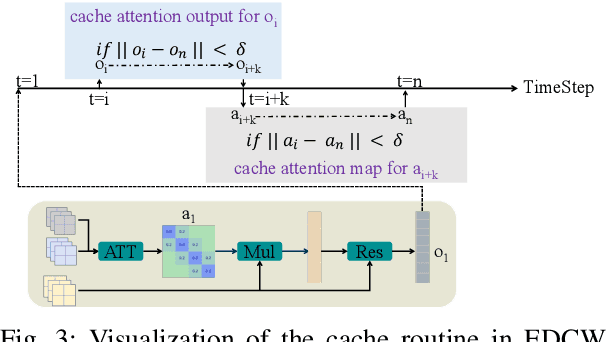
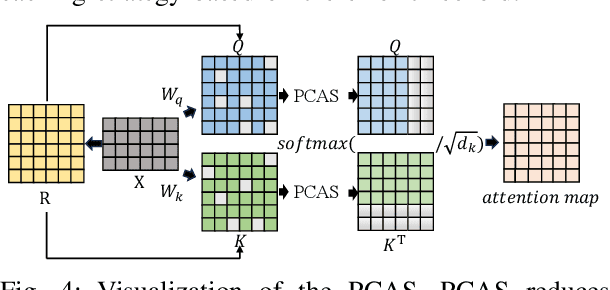
Diffusion Transformers (DiT) excel in video generation but encounter significant computational challenges due to the quadratic complexity of attention. Notably, attention differences between adjacent diffusion steps follow a U-shaped pattern. Current methods leverage this property by caching attention blocks, however, they still struggle with sudden error spikes and large discrepancies. To address these issues, we propose UniCP a unified caching and pruning framework for efficient video generation. UniCP optimizes both temporal and spatial dimensions through. Error Aware Dynamic Cache Window (EDCW): Dynamically adjusts cache window sizes for different blocks at various timesteps, adapting to abrupt error changes. PCA based Slicing (PCAS) and Dynamic Weight Shift (DWS): PCAS prunes redundant attention components, and DWS integrates caching and pruning by enabling dynamic switching between pruned and cached outputs. By adjusting cache windows and pruning redundant components, UniCP enhances computational efficiency and maintains video detail fidelity. Experimental results show that UniCP outperforms existing methods in both performance and efficiency.
UniAvatar: Taming Lifelike Audio-Driven Talking Head Generation with Comprehensive Motion and Lighting Control
Dec 26, 2024


Recently, animating portrait images using audio input is a popular task. Creating lifelike talking head videos requires flexible and natural movements, including facial and head dynamics, camera motion, realistic light and shadow effects. Existing methods struggle to offer comprehensive, multifaceted control over these aspects. In this work, we introduce UniAvatar, a designed method that provides extensive control over a wide range of motion and illumination conditions. Specifically, we use the FLAME model to render all motion information onto a single image, maintaining the integrity of 3D motion details while enabling fine-grained, pixel-level control. Beyond motion, this approach also allows for comprehensive global illumination control. We design independent modules to manage both 3D motion and illumination, permitting separate and combined control. Extensive experiments demonstrate that our method outperforms others in both broad-range motion control and lighting control. Additionally, to enhance the diversity of motion and environmental contexts in current datasets, we collect and plan to publicly release two datasets, DH-FaceDrasMvVid-100 and DH-FaceReliVid-200, which capture significant head movements during speech and various lighting scenarios.