 Add to Chrome
 Add to Firefox
 Add to Edge
SEED: Spectral Entropy-Guided Evaluation of SpatialTemporal Dependencies for Multivariate Time Series Forecasting
Dec 18, 2025
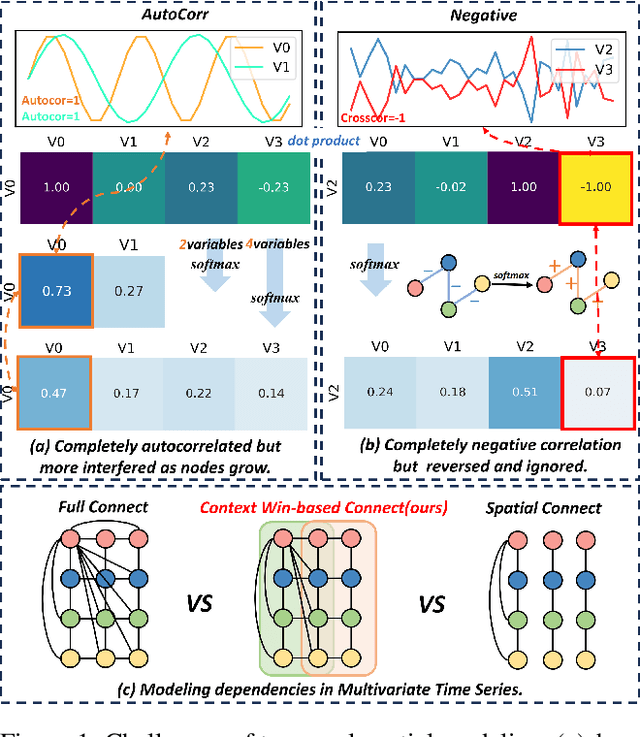
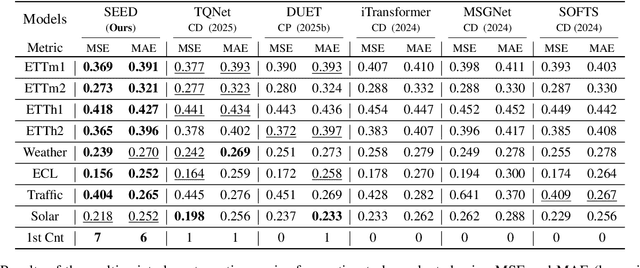
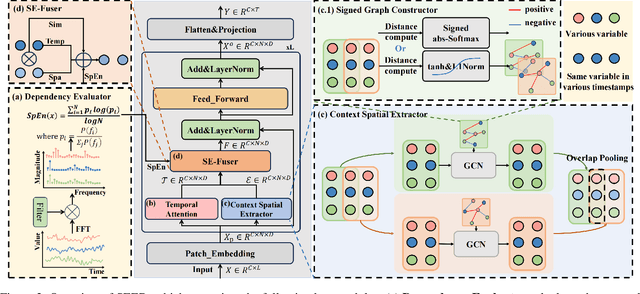
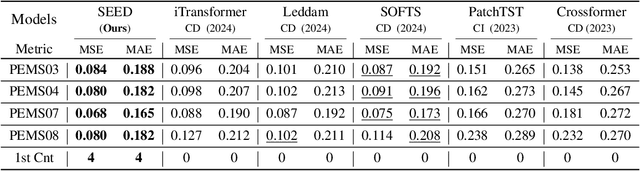
Effective multivariate time series forecasting often benefits from accurately modeling complex inter-variable dependencies. However, existing attention- or graph-based methods face three key issues: (a) strong temporal self-dependencies are often disrupted by irrelevant variables; (b) softmax normalization ignores and reverses negative correlations; (c) variables struggle to perceive their temporal positions. To address these, we propose \textbf{SEED}, a Spectral Entropy-guided Evaluation framework for spatial-temporal Dependency modeling. SEED introduces a Dependency Evaluator, a key innovation that leverages spectral entropy to dynamically provide a preliminary evaluation of the spatial and temporal dependencies of each variable, enabling the model to adaptively balance Channel Independence (CI) and Channel Dependence (CD) strategies. To account for temporal regularities originating from the influence of other variables rather than intrinsic dynamics, we propose Spectral Entropy-based Fuser to further refine the evaluated dependency weights, effectively separating this part. Moreover, to preserve negative correlations, we introduce a Signed Graph Constructor that enables signed edge weights, overcoming the limitations of softmax. Finally, to help variables perceive their temporal positions and thereby construct more comprehensive spatial features, we introduce the Context Spatial Extractor, which leverages local contextual windows to extract spatial features. Extensive experiments on 12 real-world datasets from various application domains demonstrate that SEED achieves state-of-the-art performance, validating its effectiveness and generality.

Quantum Mixed-State Self-Attention Network
Mar 05, 2024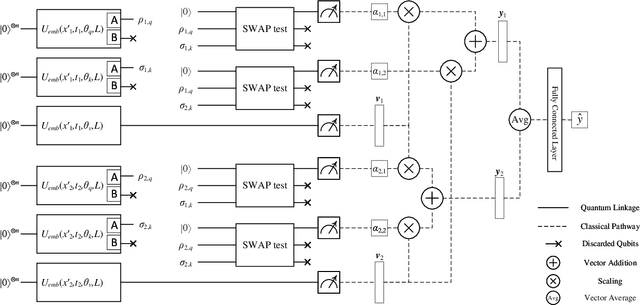
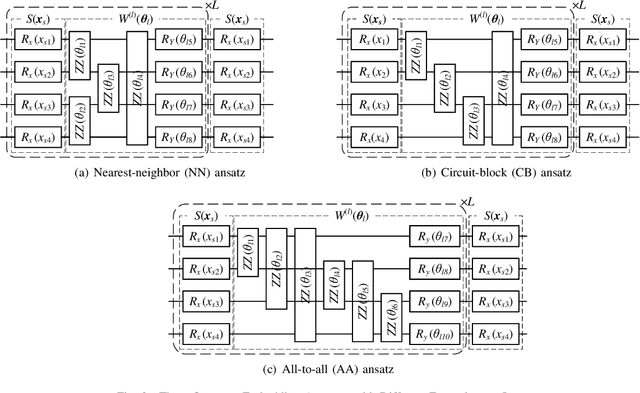
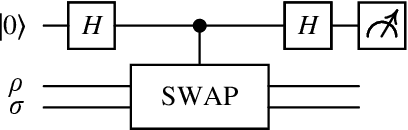
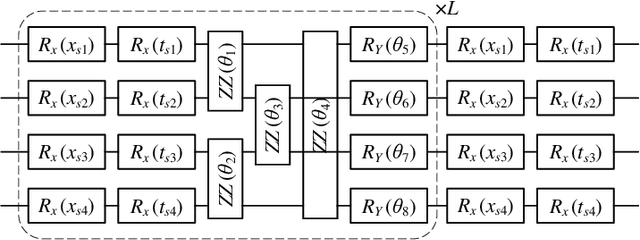
The rapid advancement of quantum computing has increasingly highlighted its potential in the realm of machine learning, particularly in the context of natural language processing (NLP) tasks. Quantum machine learning (QML) leverages the unique capabilities of quantum computing to offer novel perspectives and methodologies for complex data processing and pattern recognition challenges. This paper introduces a novel Quantum Mixed-State Attention Network (QMSAN), which integrates the principles of quantum computing with classical machine learning algorithms, especially self-attention networks, to enhance the efficiency and effectiveness in handling NLP tasks. QMSAN model employs a quantum attention mechanism based on mixed states, enabling efficient direct estimation of similarity between queries and keys within the quantum domain, leading to more effective attention weight acquisition. Additionally, we propose an innovative quantum positional encoding scheme, implemented through fixed quantum gates within the quantum circuit, to enhance the model's accuracy. Experimental validation on various datasets demonstrates that QMSAN model outperforms existing quantum and classical models in text classification, achieving significant performance improvements. QMSAN model not only significantly reduces the number of parameters but also exceeds classical self-attention networks in performance, showcasing its strong capability in data representation and information extraction. Furthermore, our study investigates the model's robustness in different quantum noise environments, showing that QMSAN possesses commendable robustness to low noise.
Uncertainty-inspired Open Set Learning for Retinal Anomaly Identification
Apr 08, 2023


Failure to recognize samples from the classes unseen during training is a major limit of artificial intelligence (AI) in real-world implementation of retinal anomaly classification. To resolve this obstacle, we propose an uncertainty-inspired open-set (UIOS) model which was trained with fundus images of 9 common retinal conditions. Besides the probability of each category, UIOS also calculates an uncertainty score to express its confidence. Our UIOS model with thresholding strategy achieved an F1 score of 99.55%, 97.01% and 91.91% for the internal testing set, external testing set and non-typical testing set, respectively, compared to the F1 score of 92.20%, 80.69% and 64.74% by the standard AI model. Furthermore, UIOS correctly predicted high uncertainty scores, which prompted the need for a manual check, in the datasets of rare retinal diseases, low-quality fundus images, and non-fundus images. This work provides a robust method for real-world screening of retinal anomalies.