 Add to Chrome
 Add to Firefox
 Add to Edge
Beyond Zooming: Learning Multi-Tool Visual Reasoning for Ultra-High-Resolution Remote Sensing
Jul 28, 2026
Ultra-high-resolution (UHR) remote-sensing (RS) imagery provides fine-grained Earth-observation evidence over city-scale scenes, but poses a fundamental challenge for multimodal large language models (MLLMs): task-relevant evidence is often sparse, local, and spatially dispersed across extremely large visual contexts. A natural solution is to equip MLLMs with zoom-in tools for active local inspection. However, through a pilot study on XLRS-Bench, we find that zoom-in is only partially effective: it resolves easy and medium-level tasks with locally recoverable evidence, but saturates on hard cases requiring global search, multi-region comparison, path planning, or dispersed-evidence reasoning. Motivated by this finding, we move beyond single-tool zoom-in and introduce GeoMTVR, a large-scale Geospatial Multi-Tool Visual Reasoning dataset built from wide-area satellite imagery. GeoMTVR contains 13K UHR VQA samples with interleaved reasoning trajectories, diverse visual tool calls, and returned visual observations, enabling models to learn question decomposition, tool selection, regional inspection, object-level grounding, auxiliary visual reasoning, and cross-tool evidence integration. Beyond supervised fine-tuning, we propose a tool-attention-focused reinforcement learning algorithm that concentrates optimization on critical tool-use decisions, including when to invoke tools, which tool to select, where to apply it, and how to interpret tool outputs. By combining SFT on GeoMTVR with our RL algorithm, we develop GeoLens, a multi-tool visual reasoning MLLM for UHR RS. Experiments show that GeoLens consistently outperforms direct reasoning and single-tool zoom-in baselines, achieving stronger accuracy, better evidence grounding, and more efficient tool-use trajectories.

LTU Attacker for Membership Inference
Feb 04, 2022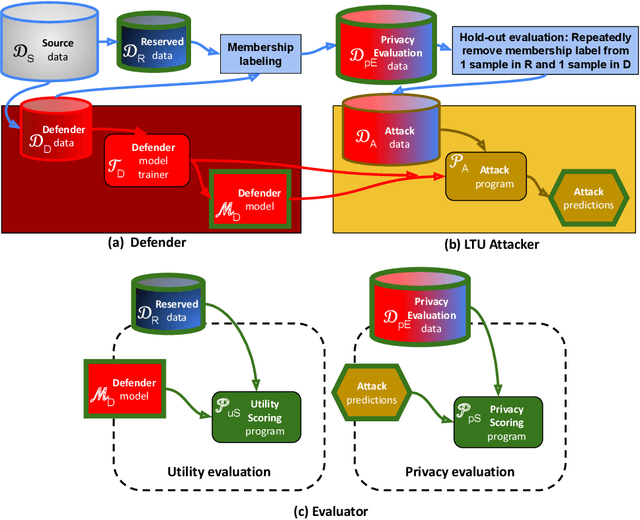
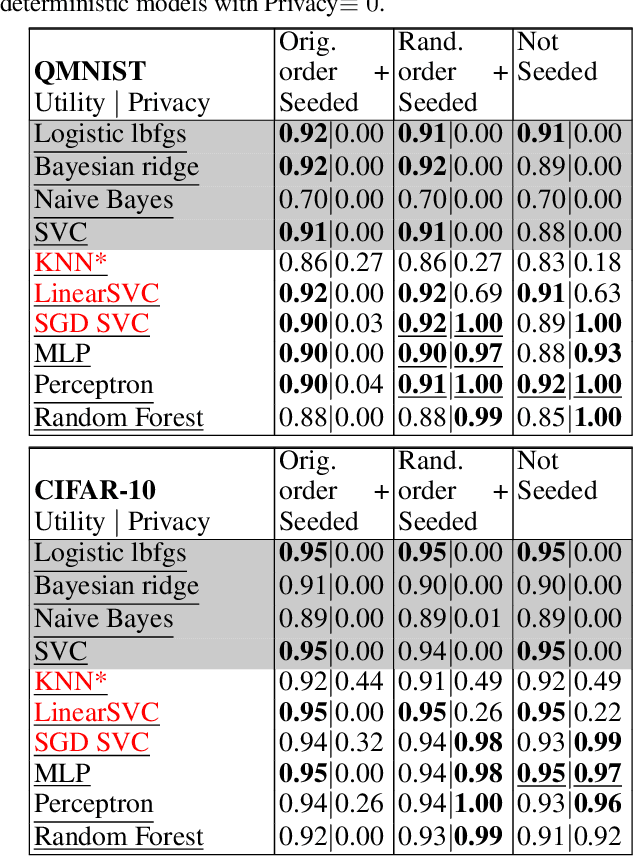
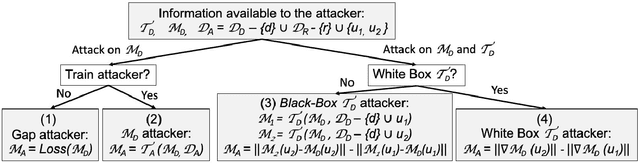
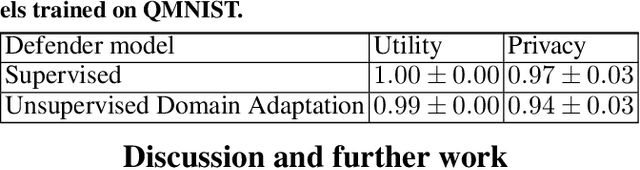
We address the problem of defending predictive models, such as machine learning classifiers (Defender models), against membership inference attacks, in both the black-box and white-box setting, when the trainer and the trained model are publicly released. The Defender aims at optimizing a dual objective: utility and privacy. Both utility and privacy are evaluated with an external apparatus including an Attacker and an Evaluator. On one hand, Reserved data, distributed similarly to the Defender training data, is used to evaluate Utility; on the other hand, Reserved data, mixed with Defender training data, is used to evaluate membership inference attack robustness. In both cases classification accuracy or error rate are used as the metric: Utility is evaluated with the classification accuracy of the Defender model; Privacy is evaluated with the membership prediction error of a so-called "Leave-Two-Unlabeled" LTU Attacker, having access to all of the Defender and Reserved data, except for the membership label of one sample from each. We prove that, under certain conditions, even a "na\"ive" LTU Attacker can achieve lower bounds on privacy loss with simple attack strategies, leading to concrete necessary conditions to protect privacy, including: preventing over-fitting and adding some amount of randomness. However, we also show that such a na\"ive LTU Attacker can fail to attack the privacy of models known to be vulnerable in the literature, demonstrating that knowledge must be complemented with strong attack strategies to turn the LTU Attacker into a powerful means of evaluating privacy. Our experiments on the QMNIST and CIFAR-10 datasets validate our theoretical results and confirm the roles of over-fitting prevention and randomness in the algorithms to protect against privacy attacks.