 Add to Chrome
 Add to Firefox
 Add to Edge
CMTFormer: Marrying Transformer with Hierarchical Information Interaction for RGB-Event Object Detection
Jun 28, 2026
Event cameras capture sparse brightness changes with high temporal resolution and high dynamic range, compensating for the deficiencies of the conventional RGB frames. However, previous multi-modal fusion techniques typically fail to handle the inherent heterogeneity between RGB frames and event streams, thus easily leading to noise amplification or redundant feature integration during cross-modal fusion. In this paper, we propose a Cross-Modal information inTeraction transFormer, coined as CMTFormer, which hierarchically integrates RGB and event information to achieve efficient and stable multimodal collaboration. Specifically, we design a shallow-to-deep information interaction scheme. In the shallow stage, we present the Shallow Alignment Module (SAM) to achieve an efficient fusion of RGB and event low-level features, which mitigates attribute disparities and prevents noisy information. In the middle stage, we devise the Cross-modal Enhancement Module (CEM) that utilizes texture and edge information to produce mutually reinforced middle-level features. In the deep stage, we present the Learnable Deep Fusion Module (LDFM) which performs high-level information aggregation through learnable weights, thus enabling the network to adaptively fuse RGB and event clues. A Spatial Prior Module is further designed to utilize global spatial information to enhance localization accuracy. Extensive experiments are conducted on two prevalent event-based object detection benchmarks, i.e., DSEC-Detection and PKU-DAVIS-SOD. Our CMTFormer consistently surpasses the detection counterparts in both uni-modal and multi-modal settings, strongly demonstrating the effectiveness of our paradigm. Codes will be available upon publication.

Cross Domain Object Detection via Multi-Granularity Confidence Alignment based Mean Teacher
Jul 10, 2024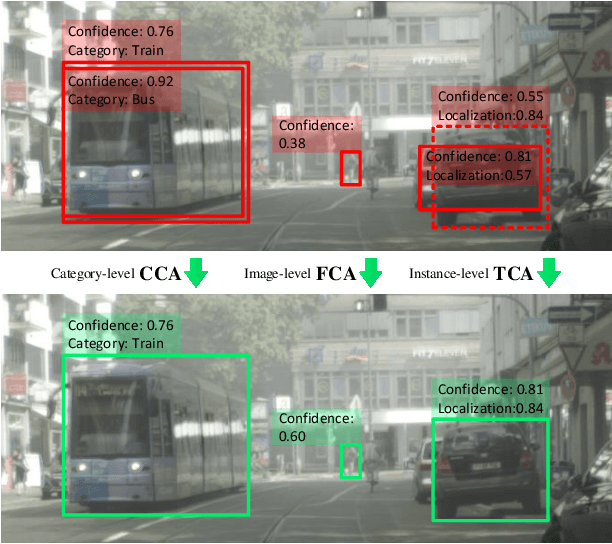
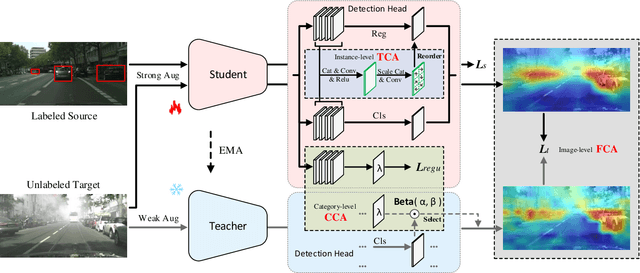
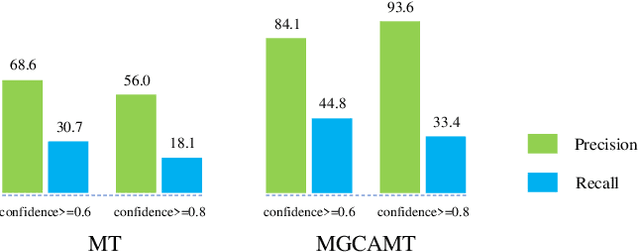
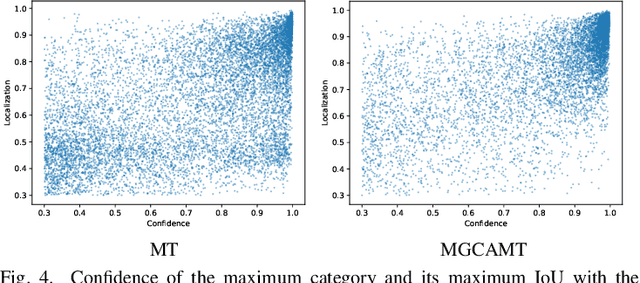
Cross domain object detection learns an object detector for an unlabeled target domain by transferring knowledge from an annotated source domain. Promising results have been achieved via Mean Teacher, however, pseudo labeling which is the bottleneck of mutual learning remains to be further explored. In this study, we find that confidence misalignment of the predictions, including category-level overconfidence, instance-level task confidence inconsistency, and image-level confidence misfocusing, leading to the injection of noisy pseudo label in the training process, will bring suboptimal performance on the target domain. To tackle this issue, we present a novel general framework termed Multi-Granularity Confidence Alignment Mean Teacher (MGCAMT) for cross domain object detection, which alleviates confidence misalignment across category-, instance-, and image-levels simultaneously to obtain high quality pseudo supervision for better teacher-student learning. Specifically, to align confidence with accuracy at category level, we propose Classification Confidence Alignment (CCA) to model category uncertainty based on Evidential Deep Learning (EDL) and filter out the category incorrect labels via an uncertainty-aware selection strategy. Furthermore, to mitigate the instance-level misalignment between classification and localization, we design Task Confidence Alignment (TCA) to enhance the interaction between the two task branches and allow each classification feature to adaptively locate the optimal feature for the regression. Finally, we develop imagery Focusing Confidence Alignment (FCA) adopting another way of pseudo label learning, i.e., we use the original outputs from the Mean Teacher network for supervised learning without label assignment to concentrate on holistic information in the target image. These three procedures benefit from each other from a cooperative learning perspective.