 Add to Chrome
 Add to Firefox
 Add to Edge
Knowledge-Data Dually Driven Paradigm for Accurate Landslide Susceptibility Prediction under Data-Scarce Conditions Using Geomorphic Priors and Tabular Foundation Model
Apr 28, 2026
Landslide susceptibility prediction is critical for geohazard risk assessment and mitigation. Conventional data-driven paradigm achieves high predictive accuracy but require sufficient conditioning factors and large-scale landslide inventories. However, in practical engineering applications across mountainous and plateau regions, data-scarce conditions are commonly observed, where such data requirements are rarely satisfied, rendering conventional data-driven paradigm inapplicable. To address this issue, we propose a knowledge-data dually driven paradigm for accurate landslide susceptibility prediction under data-scarce conditions. The essential idea behind the proposed novel paradigm is the integration of the geomorphic prior knowledge with scarce landslide data. To validate the proposed paradigm, we first applied it to a data-rich region in central Italy, where a conventional data-driven paradigm trained on the full dataset served as the baseline. By utilizing only 30% of the available landslide data, the proposed paradigm achieved comparable predictive accuracy to the baseline, demonstrating its effectiveness under data-scarce conditions. The paradigm was further evaluated in a genuinely data-scarce environment for application, the Qilian Permafrost Region of the Tibetan Plateau, where it also yielded reliable susceptibility predictions, confirming its applicability under data-scarce conditions.

Accurate and Robust Generative Approach for Overcoming Data Sparsity and Imbalance in Landslide Modeling with A Tabular Foundation Model
Apr 28, 2026Landslide investigation relies on sufficient and well-balanced observational data influenced by geological, hydrological, and anthropogenic factors. Available landslide inventories are often sparse and imbalanced, which limits understanding of triggering conditions and failure mechanisms. Data generation provides an effective approach to help capture feature dependencies from limited landslide observations. However, existing generation approaches for landslides often struggle to capture complex relationships among features and lack robustness across multiple scenarios and interacting factors. Here, we propose an accurate and robust approach for generating multi-feature landslide datasets by utilizing a tabular foundation model. By leveraging the capacity to learn from limited observations, the proposed approach effectively preserves the multivariate dependencies and statistical characteristics inherent in landslide occurrences. Comparative experiments on 20 landslide inventories demonstrate that the generated datasets closely align with observed distributions, maintain realistic feature dependencies, and exhibit robustness across different environmental contexts. This work provides an effective approach to overcome data sparsity and imbalance and strengthens landslide susceptibility modeling and risk assessment under limited observations.
Statistically Accurate and Robust Generative Prediction of Rock Discontinuities with A Tabular Foundation Model
Nov 17, 2025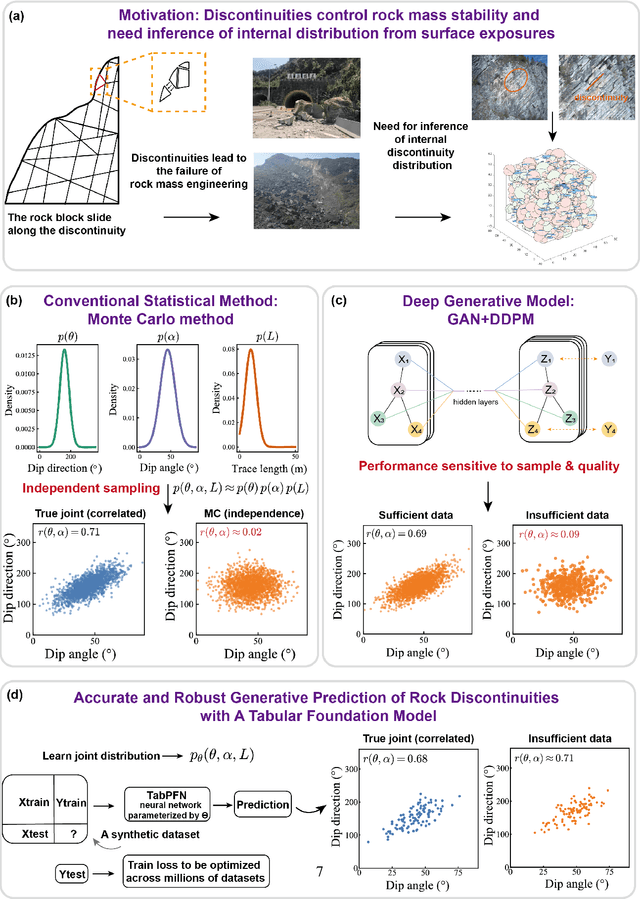
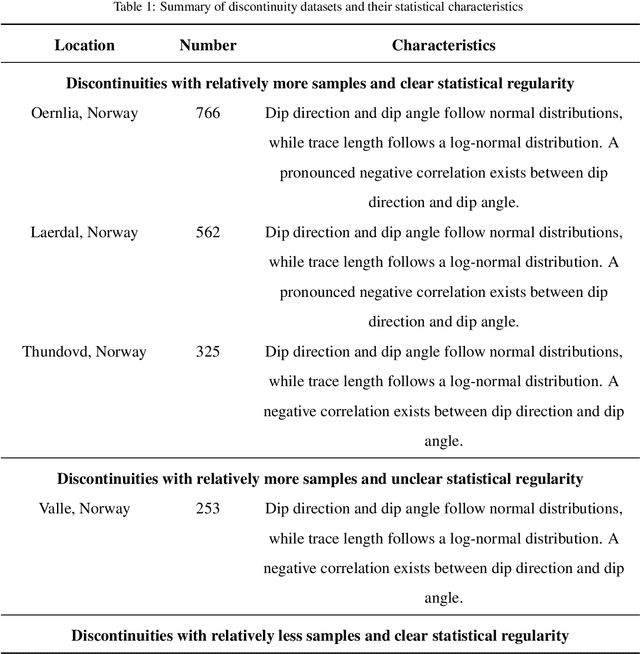

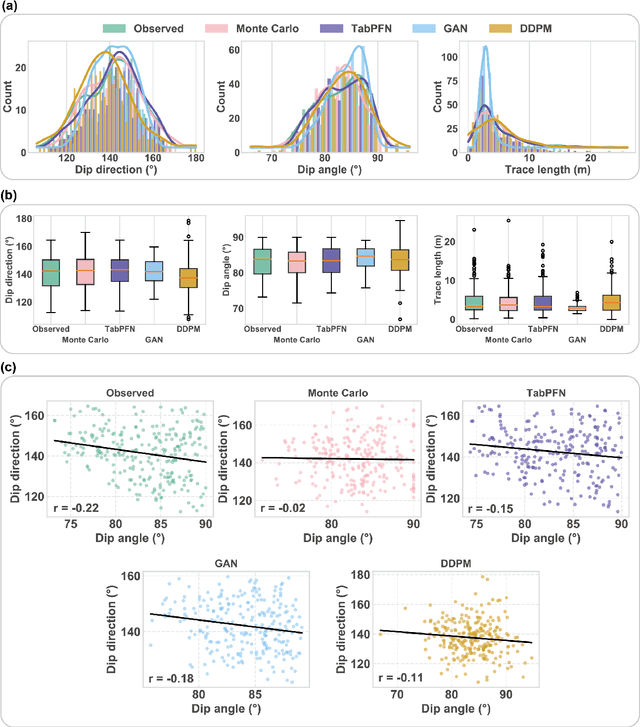
Rock discontinuities critically govern the mechanical behavior and stability of rock masses. Their internal distributions remain largely unobservable and are typically inferred from surface-exposed discontinuities using generative prediction approaches. However, surface-exposed observations are inherently sparse, and existing generative prediction approaches either fail to capture the underlying complex distribution patterns or lack robustness under data-sparse conditions. Here, we proposed a simple yet robust approach for statistically accurate generative prediction of rock discontinuities by utilizing a tabular foundation model. By leveraging the powerful sample learning capability of the foundation model specifically designed for small data, our approach can effectively capture the underlying complex distribution patterns within limited measured discontinuities. Comparative experiments on ten datasets with diverse scales and distribution patterns of discontinuities demonstrate superior accuracy and robustness over conventional statistical models and deep generative approaches. This work advances quantitative characterization of rock mass structures, supporting safer and more reliable data-driven geotechnical design.
Hunyuan3D 2.0: Scaling Diffusion Models for High Resolution Textured 3D Assets Generation
Jan 21, 2025


We present Hunyuan3D 2.0, an advanced large-scale 3D synthesis system for generating high-resolution textured 3D assets. This system includes two foundation components: a large-scale shape generation model -- Hunyuan3D-DiT, and a large-scale texture synthesis model -- Hunyuan3D-Paint. The shape generative model, built on a scalable flow-based diffusion transformer, aims to create geometry that properly aligns with a given condition image, laying a solid foundation for downstream applications. The texture synthesis model, benefiting from strong geometric and diffusion priors, produces high-resolution and vibrant texture maps for either generated or hand-crafted meshes. Furthermore, we build Hunyuan3D-Studio -- a versatile, user-friendly production platform that simplifies the re-creation process of 3D assets. It allows both professional and amateur users to manipulate or even animate their meshes efficiently. We systematically evaluate our models, showing that Hunyuan3D 2.0 outperforms previous state-of-the-art models, including the open-source models and closed-source models in geometry details, condition alignment, texture quality, and etc. Hunyuan3D 2.0 is publicly released in order to fill the gaps in the open-source 3D community for large-scale foundation generative models. The code and pre-trained weights of our models are available at: https://github.com/Tencent/Hunyuan3D-2