 Add to Chrome
 Add to Firefox
 Add to Edge
Accurate and Robust Generative Approach for Overcoming Data Sparsity and Imbalance in Landslide Modeling with A Tabular Foundation Model
Apr 28, 2026
Landslide investigation relies on sufficient and well-balanced observational data influenced by geological, hydrological, and anthropogenic factors. Available landslide inventories are often sparse and imbalanced, which limits understanding of triggering conditions and failure mechanisms. Data generation provides an effective approach to help capture feature dependencies from limited landslide observations. However, existing generation approaches for landslides often struggle to capture complex relationships among features and lack robustness across multiple scenarios and interacting factors. Here, we propose an accurate and robust approach for generating multi-feature landslide datasets by utilizing a tabular foundation model. By leveraging the capacity to learn from limited observations, the proposed approach effectively preserves the multivariate dependencies and statistical characteristics inherent in landslide occurrences. Comparative experiments on 20 landslide inventories demonstrate that the generated datasets closely align with observed distributions, maintain realistic feature dependencies, and exhibit robustness across different environmental contexts. This work provides an effective approach to overcome data sparsity and imbalance and strengthens landslide susceptibility modeling and risk assessment under limited observations.

Statistically Accurate and Robust Generative Prediction of Rock Discontinuities with A Tabular Foundation Model
Nov 17, 2025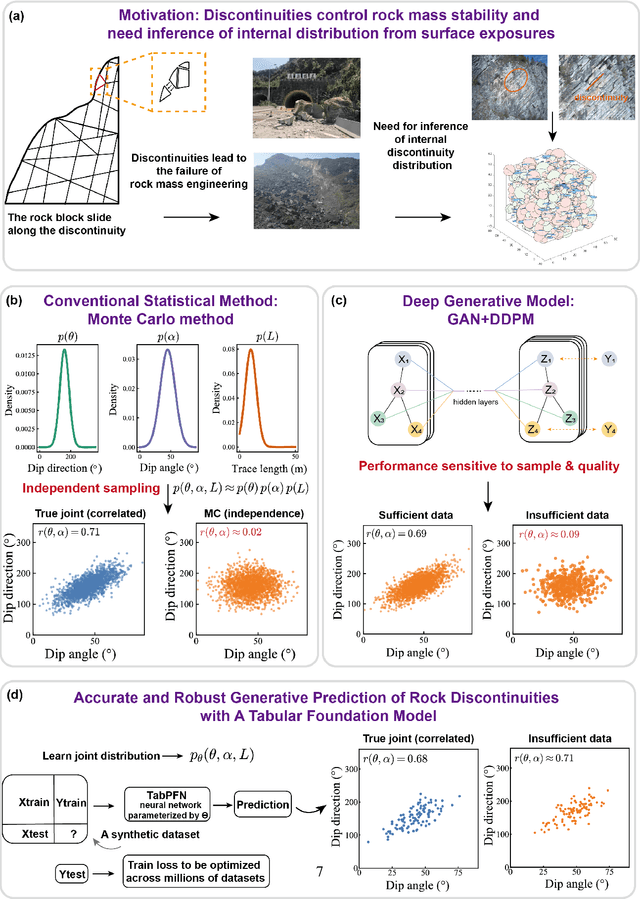
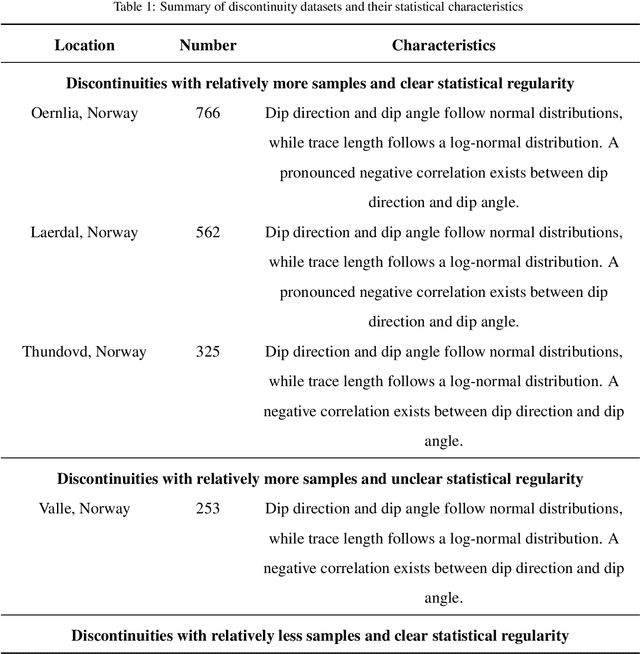

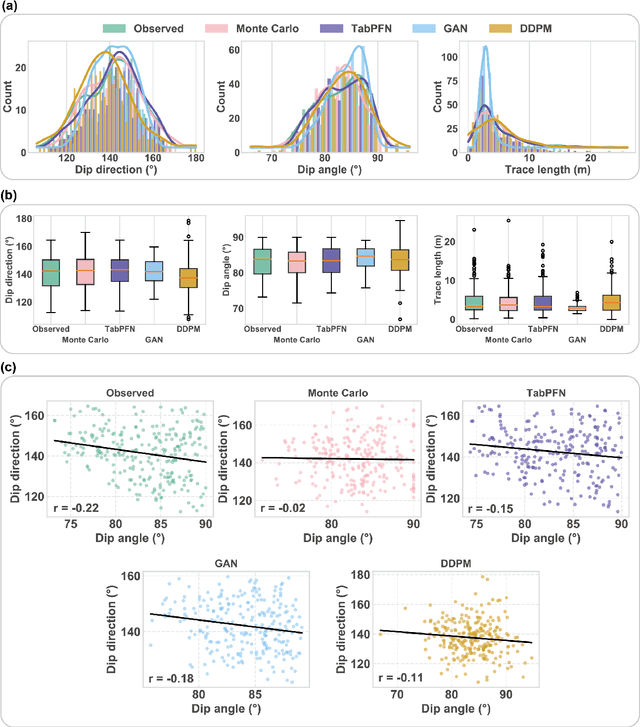
Rock discontinuities critically govern the mechanical behavior and stability of rock masses. Their internal distributions remain largely unobservable and are typically inferred from surface-exposed discontinuities using generative prediction approaches. However, surface-exposed observations are inherently sparse, and existing generative prediction approaches either fail to capture the underlying complex distribution patterns or lack robustness under data-sparse conditions. Here, we proposed a simple yet robust approach for statistically accurate generative prediction of rock discontinuities by utilizing a tabular foundation model. By leveraging the powerful sample learning capability of the foundation model specifically designed for small data, our approach can effectively capture the underlying complex distribution patterns within limited measured discontinuities. Comparative experiments on ten datasets with diverse scales and distribution patterns of discontinuities demonstrate superior accuracy and robustness over conventional statistical models and deep generative approaches. This work advances quantitative characterization of rock mass structures, supporting safer and more reliable data-driven geotechnical design.