 Add to Chrome
 Add to Firefox
 Add to Edge
RankVR: Low-Rank Structure Perception and Value Recalibration for Robust Composed Image Retrieval
Jun 10, 2026
Composed Image Retrieval (CIR) constitutes a pivotal paradigm requiring models to perform joint reasoning on reference images and modification texts. However, the prevalence of Noisy Triplet Correspondence (NTC) in large-scale datasets severely constrains model performance. Existing denoising methods either target binary mismatches or rely on scalar-based point-wise estimation, neglecting rich global structural correlations among sample populations and dynamic value variations during training, thereby yielding suboptimal results. This paper identifies two critical unresolved challenges: Global Structural Inconsistency of Semantic Correlations and Hard Sample Discrimination Uncertainty. To address these, we propose RankVR, a framework designed to construct a robust CIR model via global structure consistency and dynamic value perception. Specifically, we introduce the Global Structure Consistency Perception (GSCP) module, which utilizes the Effective Rank of the Correlation Matrix to decouple clean samples from structural noise. By measuring rank difference, GSCP identifies samples disrupting macroscopic semantic symmetry. Furthermore, we develop the Adaptive Semantic Value Calibration (ASVC) module to distinguish high-value hard clean samples. By integrating training potential and reliability, it dynamically quantifies the semantic value of each triplet, ensuring effective utilization of hard samples while suppressing noise characterized by logical conflicts. Extensive experiments on the FashionIQ and CIRR benchmark datasets demonstrate that RankVR significantly outperforms existing state-of-the-art methods, validating its superior robustness in noisy environments.

IMAGINE: Adaptive Schema-Imagery Enhanced Composition for Composed Video Retrieval
Jun 06, 2026Composed Video Retrieval (CVR) is designed to retrieve a target video that matches a reference video modified by a modification text. While existing methods explore cross-modal correspondences, they often assume modified objects appear directly in videos. However, modification texts frequently describe concepts not explicitly presented but implicitly expressed through semantically related visual cues (e.g., "cake" implying "birthday party"). Current approaches typically rely on aligning explicit feature representations within the concrete space, neglecting critical latent associations. To address this, we propose an adaptIve scheMa-ImAGery enhanced composItional NEtwork (IMAGINE). Unlike standard explicit matching, IMAGINE materializes implicit semantics (termed schema imagery) via dynamic multimodal prototypes. These prototypes capture shared latent concepts to adaptively modulate visual features, effectively injecting implicit guidance into the retrieval process. By bridging the gap between explicit visual contents and implicit retrieval intentions, IMAGINE achieves state-of-the-art performance in both CVR and Composed Image Retrieval (CIR) across three widely used benchmarks.
INTENT: Invariance and Discrimination-aware Noise Mitigation for Robust Composed Image Retrieval
Apr 20, 2026Composed Image Retrieval (CIR) is a challenging image retrieval paradigm that enables to retrieve target images based on multimodal queries consisting of reference images and modification texts. Although substantial progress has been made in recent years, existing methods assume that all samples are correctly matched. However, in real-world scenarios, due to high triplet annotation costs, CIR datasets inevitably contain annotation errors, resulting in incorrectly matched triplets. To address this issue, the problem of Noisy Triplet Correspondence (NTC) has attracted growing attention. We argue that noise in CIR can be categorized into two types: cross-modal correspondence noise and modality-inherent noise. The former arises from mismatches across modalities, whereas the latter originates from intra-modal background interference or visual factors irrelevant to the coarse-grained modification annotations. However, modality-inherent noise is often overlooked, and research on cross-modal correspondence noise remains nascent. To tackle above issues, we propose the Invariance and discrimiNaTion-awarE Noise neTwork (INTENT), comprising two components: Visual Invariant Composition and Bi-Objective Discriminative Learning, specifically designed to handle the two-aspect noise. The former applies causal intervention on the visual side via Fast Fourier Transform (FFT) to generate intervened composed features, enforcing visual invariance and enabling the model to ignore modality-inherent noise during composition. The latter adopts collaborative optimization with both positive and negative samples, and constructs a scalable decision boundary that dynamically adjusts decisions based on the loyalty degree, enabling robust correspondence discrimination. Extensive experiments on two widely used benchmark datasets demonstrate the superiority and robustness of INTENT.
LongCat-Image Technical Report
Dec 08, 2025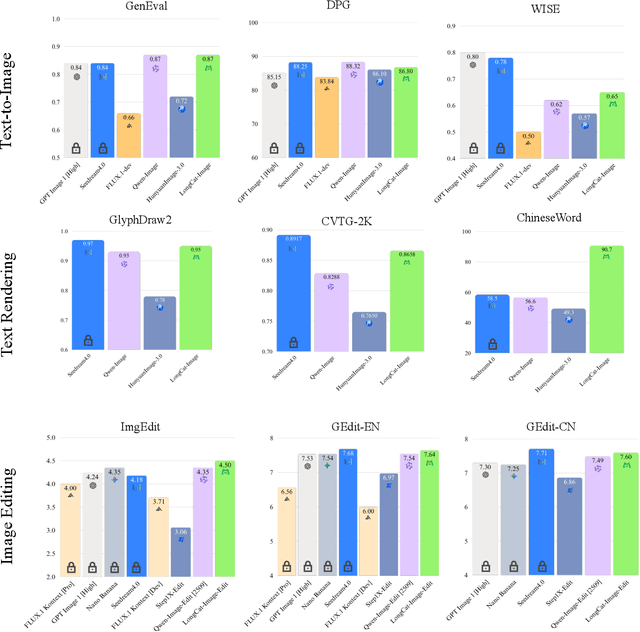
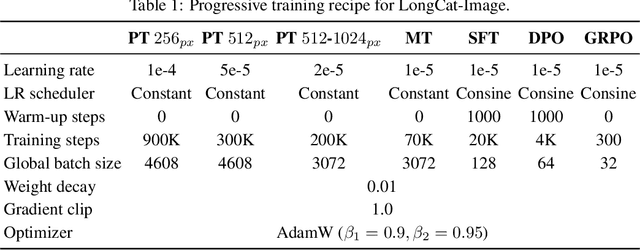

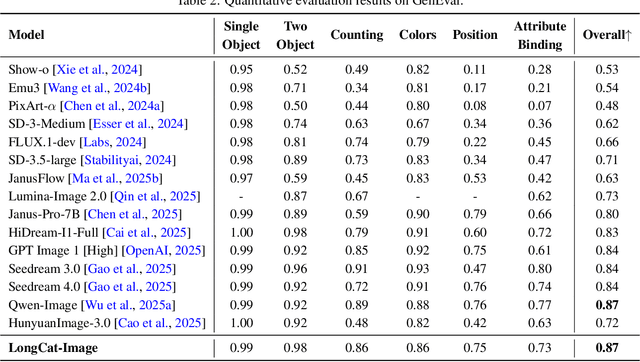
We introduce LongCat-Image, a pioneering open-source and bilingual (Chinese-English) foundation model for image generation, designed to address core challenges in multilingual text rendering, photorealism, deployment efficiency, and developer accessibility prevalent in current leading models. 1) We achieve this through rigorous data curation strategies across the pre-training, mid-training, and SFT stages, complemented by the coordinated use of curated reward models during the RL phase. This strategy establishes the model as a new state-of-the-art (SOTA), delivering superior text-rendering capabilities and remarkable photorealism, and significantly enhancing aesthetic quality. 2) Notably, it sets a new industry standard for Chinese character rendering. By supporting even complex and rare characters, it outperforms both major open-source and commercial solutions in coverage, while also achieving superior accuracy. 3) The model achieves remarkable efficiency through its compact design. With a core diffusion model of only 6B parameters, it is significantly smaller than the nearly 20B or larger Mixture-of-Experts (MoE) architectures common in the field. This ensures minimal VRAM usage and rapid inference, significantly reducing deployment costs. Beyond generation, LongCat-Image also excels in image editing, achieving SOTA results on standard benchmarks with superior editing consistency compared to other open-source works. 4) To fully empower the community, we have established the most comprehensive open-source ecosystem to date. We are releasing not only multiple model versions for text-to-image and image editing, including checkpoints after mid-training and post-training stages, but also the entire toolchain of training procedure. We believe that the openness of LongCat-Image will provide robust support for developers and researchers, pushing the frontiers of visual content creation.
MADiff: Text-Guided Fashion Image Editing with Mask Prediction and Attention-Enhanced Diffusion
Dec 28, 2024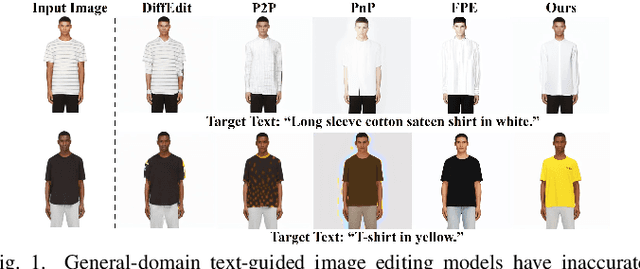
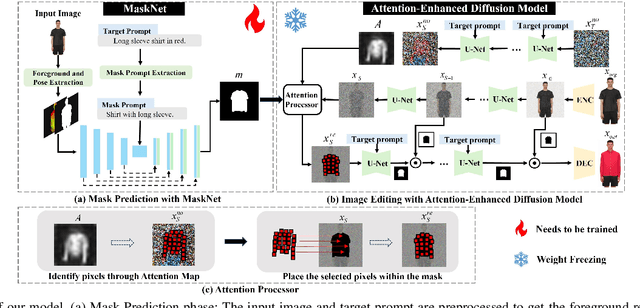
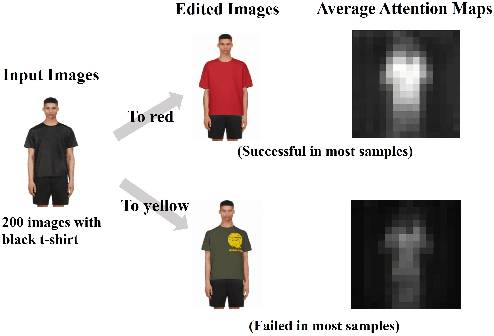
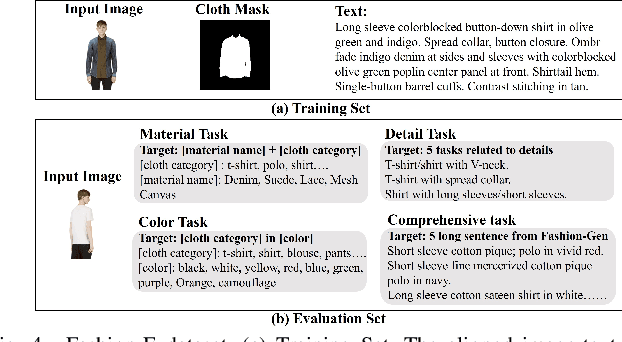
Text-guided image editing model has achieved great success in general domain. However, directly applying these models to the fashion domain may encounter two issues: (1) Inaccurate localization of editing region; (2) Weak editing magnitude. To address these issues, the MADiff model is proposed. Specifically, to more accurately identify editing region, the MaskNet is proposed, in which the foreground region, densepose and mask prompts from large language model are fed into a lightweight UNet to predict the mask for editing region. To strengthen the editing magnitude, the Attention-Enhanced Diffusion Model is proposed, where the noise map, attention map, and the mask from MaskNet are fed into the proposed Attention Processor to produce a refined noise map. By integrating the refined noise map into the diffusion model, the edited image can better align with the target prompt. Given the absence of benchmarks in fashion image editing, we constructed a dataset named Fashion-E, comprising 28390 image-text pairs in the training set, and 2639 image-text pairs for four types of fashion tasks in the evaluation set. Extensive experiments on Fashion-E demonstrate that our proposed method can accurately predict the mask of editing region and significantly enhance editing magnitude in fashion image editing compared to the state-of-the-art methods.
FashionFAE: Fine-grained Attributes Enhanced Fashion Vision-Language Pre-training
Dec 28, 2024Large-scale Vision-Language Pre-training (VLP) has demonstrated remarkable success in the general domain. However, in the fashion domain, items are distinguished by fine-grained attributes like texture and material, which are crucial for tasks such as retrieval. Existing models often fail to leverage these fine-grained attributes from both text and image modalities. To address the above issues, we propose a novel approach for the fashion domain, Fine-grained Attributes Enhanced VLP (FashionFAE), which focuses on the detailed characteristics of fashion data. An attribute-emphasized text prediction task is proposed to predict fine-grained attributes of the items. This forces the model to focus on the salient attributes from the text modality. Additionally, a novel attribute-promoted image reconstruction task is proposed, which further enhances the fine-grained ability of the model by leveraging the representative attributes from the image modality. Extensive experiments show that FashionFAE significantly outperforms State-Of-The-Art (SOTA) methods, achieving 2.9% and 5.2% improvements in retrieval on sub-test and full test sets, respectively, and a 1.6% average improvement in recognition tasks.
Zero-shot Compound Expression Recognition with Visual Language Model at the 6th ABAW Challenge
Mar 18, 2024


Conventional approaches to facial expression recognition primarily focus on the classification of six basic facial expressions. Nevertheless, real-world situations present a wider range of complex compound expressions that consist of combinations of these basics ones due to limited availability of comprehensive training datasets. The 6th Workshop and Competition on Affective Behavior Analysis in-the-wild (ABAW) offered unlabeled datasets containing compound expressions. In this study, we propose a zero-shot approach for recognizing compound expressions by leveraging a pretrained visual language model integrated with some traditional CNN networks.