 Add to Chrome
 Add to Firefox
 Add to Edge
InternVLA-A1.5: Unifying Understanding, Latent Foresight, and Action for Compositional Generalization
Jul 06, 2026
Unified models for robot manipulation aim to equip one policy with both the semantic priors of pretrained VLMs and the physical dynamics learned through future prediction. In practice, existing designs tend to erode the semantics of the pretrained backbone, suffer interference among heterogeneous objectives, and learn future prediction from scratch in pixel space, leaving the dynamics priors of pretrained video generators unexploited. We present InternVLA-A1.5, which builds the policy on a native VLM backbone that keeps training on VQA and subtask prediction, and attaches a lightweight unified expert for continuous action generation. Future prediction is recast as a latent-querying problem, where a small set of learnable foresight tokens condenses the task-relevant future into a compact latent code under the supervision of a frozen pretrained video generation model, so the policy inherits world-model dynamics priors without ever learning pixel-level generation. The video branch is discarded at inference, keeping real-time control. Pretrained on 1.2M robot episodes and 3M multimodal samples, InternVLA-A1.5 achieves the best overall results on all six simulation benchmarks. In the real world, the preserved semantics deliver the strongest compositional generalization on held-out instruction bindings, and the two designs together sustain long-horizon execution.

WSA$_1$: a 3D-Centric World-Spatial-Action Model for Generalizable Robot Control
Jul 04, 2026Recent advances in embodied AI have established robot foundation models (RFMs) as the dominant approach for generalist robotic systems to date. By leveraging imitation learning on extensive robot demonstrations, RFMs have achieved impressive capabilities in mapping visual observations and language instructions to continuous robotic actions. However, current RFMs lack an inherent ability to reason about physical dynamics and the causal effects of robot behaviors on the 3D physical world. This creates a fundamental mismatch between 2D-centric visual perception and 3D-centric embodied interaction, severely limiting the generalization ability of RFMs in real-world tasks.To address this gap, we present WSA$_1$, a novel RFM built upon proposed 3D-Centric World-Spatial-Action modeling paradigm. It not only learns 3D world-aware visual thought for future robot behaviors, but also models mutual constraints between 3D world state transitions and robotic actions to enhance behavior generalization. Notably, WSA$_1$ achieves highly data-efficient pre-training with 6k hours of expert demonstration data (only 1k hours from real robot), while delivering competitive manipulation performance (93% success rate) on RoboTwin2.0 simulation benchmark and achieving +20% average boosted performance over state-of-the-art RFMs on real-world robot control tasks. These results reveal that generalizable RFM can be attained without large-scale real robot data when paired with 3D-centric world-action joint modeling, which offers a practical and affordable pathway to generalist robotic systems.
MiVLA: Towards Generalizable Vision-Language-Action Model with Human-Robot Mutual Imitation Pre-training
Dec 19, 2025While leveraging abundant human videos and simulated robot data poses a scalable solution to the scarcity of real-world robot data, the generalization capability of existing vision-language-action models (VLAs) remains limited by mismatches in camera views, visual appearance, and embodiment morphologies. To overcome this limitation, we propose MiVLA, a generalizable VLA empowered by human-robot mutual imitation pre-training, which leverages inherent behavioral similarity between human hands and robotic arms to build a foundation of strong behavioral priors for both human actions and robotic control. Specifically, our method utilizes kinematic rules with left/right hand coordinate systems for bidirectional alignment between human and robot action spaces. Given human or simulated robot demonstrations, MiVLA is trained to forecast behavior trajectories for one embodiment, and imitate behaviors for another one unseen in the demonstration. Based on this mutual imitation, it integrates the behavioral fidelity of real-world human data with the manipulative diversity of simulated robot data into a unified model, thereby enhancing the generalization capability for downstream tasks. Extensive experiments conducted on both simulation and real-world platforms with three robots (ARX, PiPer and LocoMan), demonstrate that MiVLA achieves strong improved generalization capability, outperforming state-of-the-art VLAs (e.g., $\boldsymbolπ_{0}$, $\boldsymbolπ_{0.5}$ and H-RDT) by 25% in simulation, and 14% in real-world robot control tasks.
Towards Better IncomLDL: We Are Unaware of Hidden Labels in Advance
Nov 16, 2025Label distribution learning (LDL) is a novel paradigm that describe the samples by label distribution of a sample. However, acquiring LDL dataset is costly and time-consuming, which leads to the birth of incomplete label distribution learning (IncomLDL). All the previous IncomLDL methods set the description degrees of "missing" labels in an instance to 0, but remains those of other labels unchanged. This setting is unrealistic because when certain labels are missing, the degrees of the remaining labels will increase accordingly. We fix this unrealistic setting in IncomLDL and raise a new problem: LDL with hidden labels (HidLDL), which aims to recover a complete label distribution from a real-world incomplete label distribution where certain labels in an instance are omitted during annotation. To solve this challenging problem, we discover the significance of proportional information of the observed labels and capture it by an innovative constraint to utilize it during the optimization process. We simultaneously use local feature similarity and the global low-rank structure to reveal the mysterious veil of hidden labels. Moreover, we theoretically give the recovery bound of our method, proving the feasibility of our method in learning from hidden labels. Extensive recovery and predictive experiments on various datasets prove the superiority of our method to state-of-the-art LDL and IncomLDL methods.
BEVNav: Robot Autonomous Navigation Via Spatial-Temporal Contrastive Learning in Bird's-Eye View
Sep 03, 2024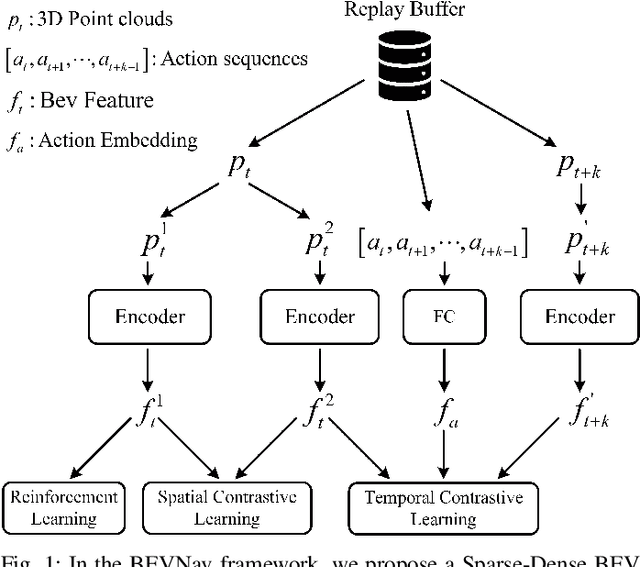
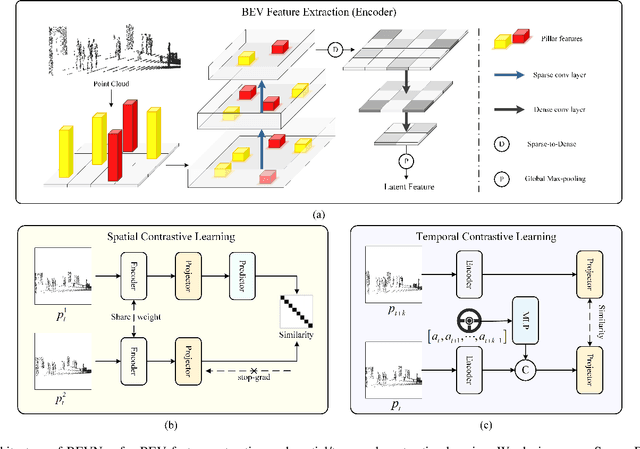
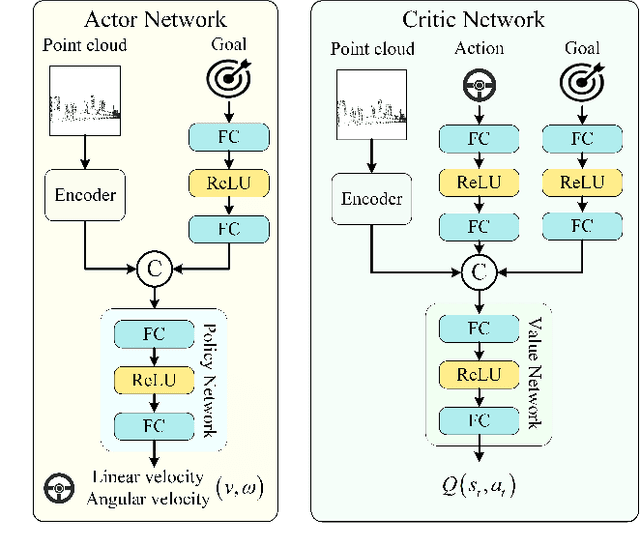
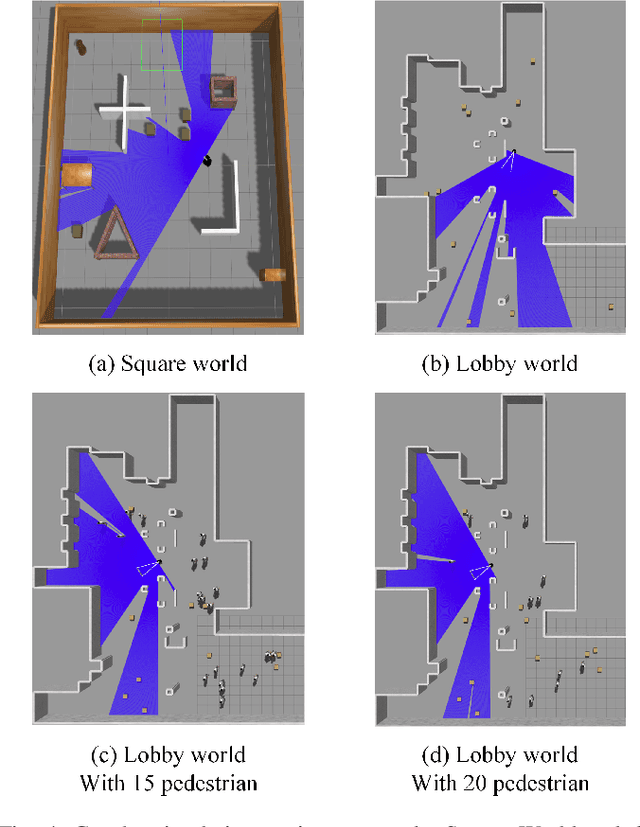
Goal-driven mobile robot navigation in map-less environments requires effective state representations for reliable decision-making. Inspired by the favorable properties of Bird's-Eye View (BEV) in point clouds for visual perception, this paper introduces a novel navigation approach named BEVNav. It employs deep reinforcement learning to learn BEV representations and enhance decision-making reliability. First, we propose a self-supervised spatial-temporal contrastive learning approach to learn BEV representations. Spatially, two randomly augmented views from a point cloud predict each other, enhancing spatial features. Temporally, we combine the current observation with consecutive frames' actions to predict future features, establishing the relationship between observation transitions and actions to capture temporal cues. Then, incorporating this spatial-temporal contrastive learning in the Soft Actor-Critic reinforcement learning framework, our BEVNav offers a superior navigation policy. Extensive experiments demonstrate BEVNav's robustness in environments with dense pedestrians, outperforming state-of-the-art methods across multiple benchmarks. \rev{The code will be made publicly available at https://github.com/LanrenzzzZ/BEVNav.
Label Distribution Learning from Logical Label
Mar 13, 2023


Label distribution learning (LDL) is an effective method to predict the label description degree (a.k.a. label distribution) of a sample. However, annotating label distribution (LD) for training samples is extremely costly. So recent studies often first use label enhancement (LE) to generate the estimated label distribution from the logical label and then apply external LDL algorithms on the recovered label distribution to predict the label distribution for unseen samples. But this step-wise manner overlooks the possible connections between LE and LDL. Moreover, the existing LE approaches may assign some description degrees to invalid labels. To solve the above problems, we propose a novel method to learn an LDL model directly from the logical label, which unifies LE and LDL into a joint model, and avoids the drawbacks of the previous LE methods. Extensive experiments on various datasets prove that the proposed approach can construct a reliable LDL model directly from the logical label, and produce more accurate label distribution than the state-of-the-art LE methods.