 Add to Chrome
 Add to Firefox
 Add to Edge
BonnBeetClouds3D: A Dataset Towards Point Cloud-based Organ-level Phenotyping of Sugar Beet Plants under Field Conditions
Dec 22, 2023
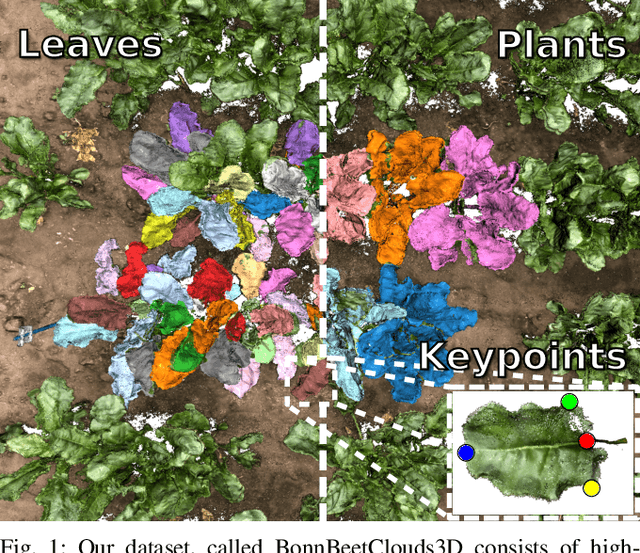
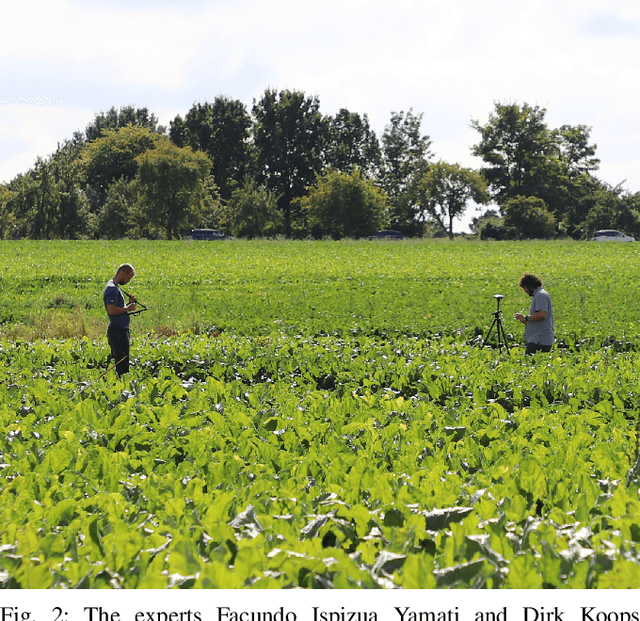
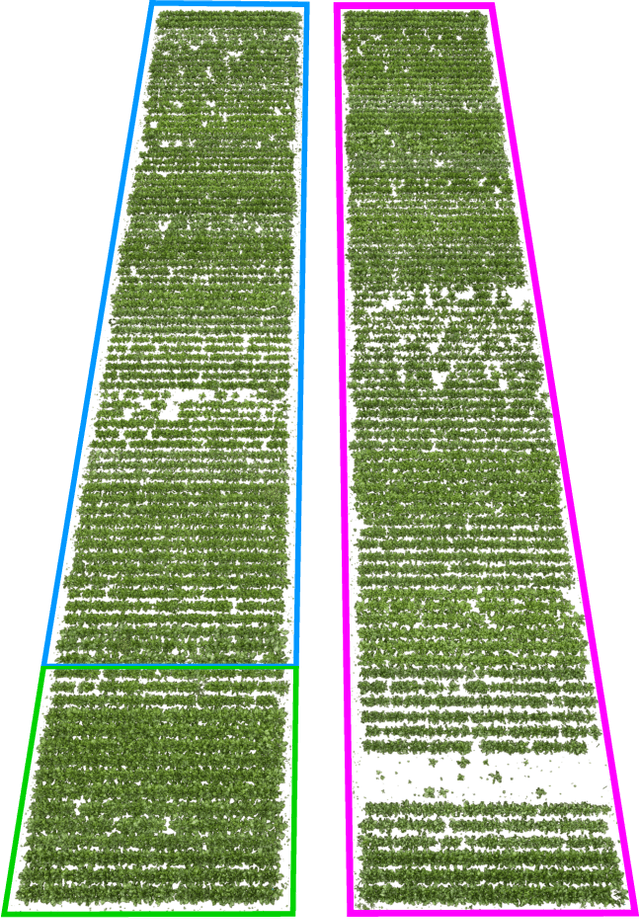
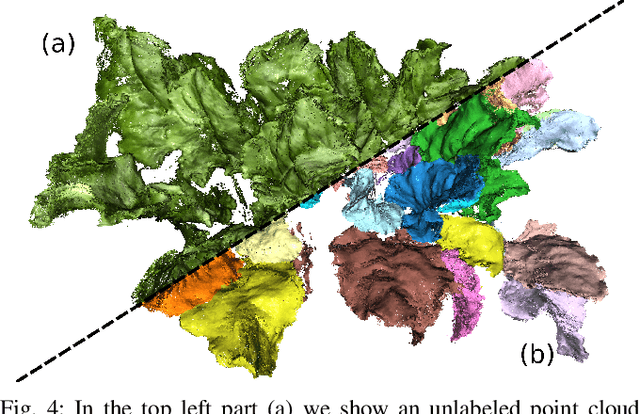
Agricultural production is facing severe challenges in the next decades induced by climate change and the need for sustainability, reducing its impact on the environment. Advancements in field management through non-chemical weeding by robots in combination with monitoring of crops by autonomous unmanned aerial vehicles (UAVs) and breeding of novel and more resilient crop varieties are helpful to address these challenges. The analysis of plant traits, called phenotyping, is an essential activity in plant breeding, it however involves a great amount of manual labor. With this paper, we address the problem of automatic fine-grained organ-level geometric analysis needed for precision phenotyping. As the availability of real-world data in this domain is relatively scarce, we propose a novel dataset that was acquired using UAVs capturing high-resolution images of a real breeding trial containing 48 plant varieties and therefore covering great morphological and appearance diversity. This enables the development of approaches for autonomous phenotyping that generalize well to different varieties. Based on overlapping high-resolution images from multiple viewing angles, we compute photogrammetric dense point clouds and provide detailed and accurate point-wise labels for plants, leaves, and salient points as the tip and the base. Additionally, we include measurements of phenotypic traits performed by experts from the German Federal Plant Variety Office on the real plants, allowing the evaluation of new approaches not only on segmentation and keypoint detection but also directly on the downstream tasks. The provided labeled point clouds enable fine-grained plant analysis and support further progress in the development of automatic phenotyping approaches, but also enable further research in surface reconstruction, point cloud completion, and semantic interpretation of point clouds.

Radar Instance Transformer: Reliable Moving Instance Segmentation in Sparse Radar Point Clouds
Sep 28, 2023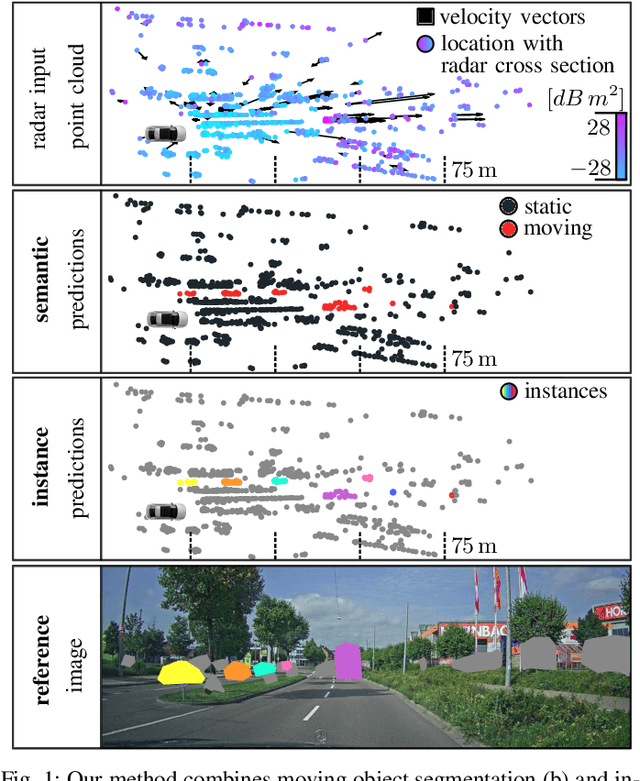


The perception of moving objects is crucial for autonomous robots performing collision avoidance in dynamic environments. LiDARs and cameras tremendously enhance scene interpretation but do not provide direct motion information and face limitations under adverse weather. Radar sensors overcome these limitations and provide Doppler velocities, delivering direct information on dynamic objects. In this paper, we address the problem of moving instance segmentation in radar point clouds to enhance scene interpretation for safety-critical tasks. Our Radar Instance Transformer enriches the current radar scan with temporal information without passing aggregated scans through a neural network. We propose a full-resolution backbone to prevent information loss in sparse point cloud processing. Our instance transformer head incorporates essential information to enhance segmentation but also enables reliable, class-agnostic instance assignments. In sum, our approach shows superior performance on the new moving instance segmentation benchmarks, including diverse environments, and provides model-agnostic modules to enhance scene interpretation. The benchmark is based on the RadarScenes dataset and will be made available upon acceptance.
Building Volumetric Beliefs for Dynamic Environments Exploiting Map-Based Moving Object Segmentation
Jul 17, 2023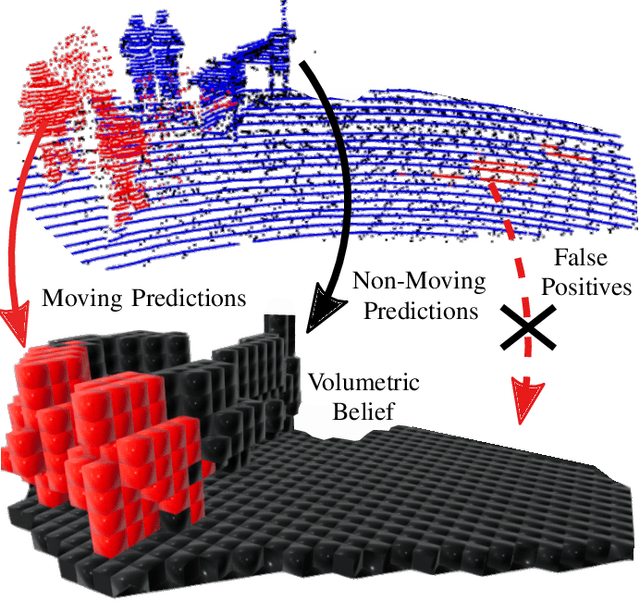
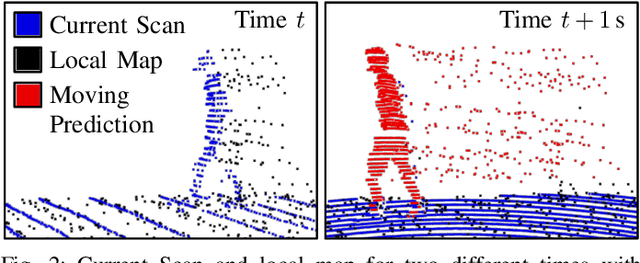
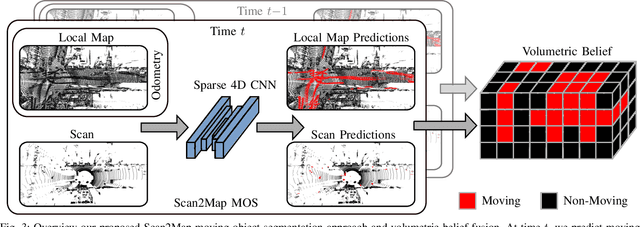
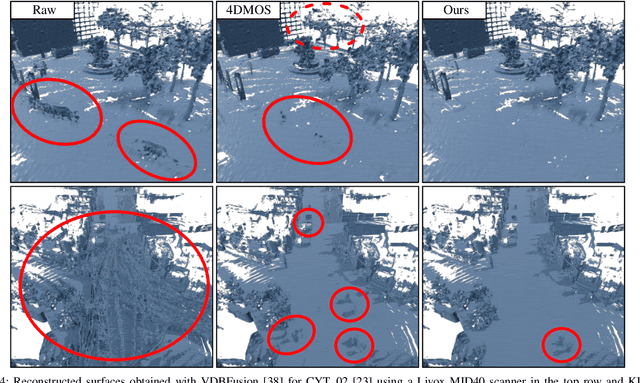
Mobile robots that navigate in unknown environments need to be constantly aware of the dynamic objects in their surroundings for mapping, localization, and planning. It is key to reason about moving objects in the current observation and at the same time to also update the internal model of the static world to ensure safety. In this paper, we address the problem of jointly estimating moving objects in the current 3D LiDAR scan and a local map of the environment. We use sparse 4D convolutions to extract spatio-temporal features from scan and local map and segment all 3D points into moving and non-moving ones. Additionally, we propose to fuse these predictions in a probabilistic representation of the dynamic environment using a Bayes filter. This volumetric belief models, which parts of the environment can be occupied by moving objects. Our experiments show that our approach outperforms existing moving object segmentation baselines and even generalizes to different types of LiDAR sensors. We demonstrate that our volumetric belief fusion can increase the precision and recall of moving object segmentation and even retrieve previously missed moving objects in an online mapping scenario.
PhenoBench -- A Large Dataset and Benchmarks for Semantic Image Interpretation in the Agricultural Domain
Jun 07, 2023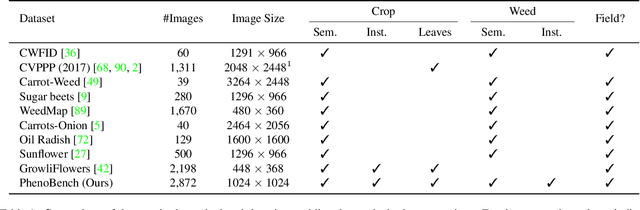
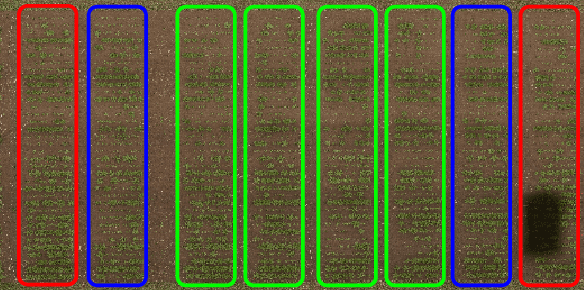
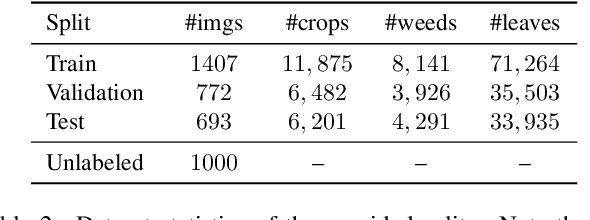
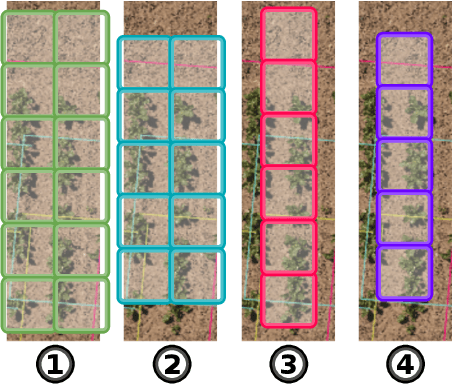
The production of food, feed, fiber, and fuel is a key task of agriculture. Especially crop production has to cope with a multitude of challenges in the upcoming decades caused by a growing world population, climate change, the need for sustainable production, lack of skilled workers, and generally the limited availability of arable land. Vision systems could help cope with these challenges by offering tools to make better and more sustainable field management decisions and support the breeding of new varieties of crops by allowing temporally dense and reproducible measurements. Recently, tackling perception tasks in the agricultural domain got increasing interest in the computer vision and robotics community since agricultural robotics are one promising solution for coping with the lack of workers and enable a more sustainable agricultural production at the same time. While large datasets and benchmarks in other domains are readily available and have enabled significant progress toward more reliable vision systems, agricultural datasets and benchmarks are comparably rare. In this paper, we present a large dataset and benchmarks for the semantic interpretation of images of real agricultural fields. Our dataset recorded with a UAV provides high-quality, dense annotations of crops and weeds, but also fine-grained labels of crop leaves at the same time, which enable the development of novel algorithms for visual perception in the agricultural domain. Together with the labeled data, we provide novel benchmarks for evaluating different visual perception tasks on a hidden test set comprised of different fields: known fields covered by the training data and a completely unseen field. The tasks cover semantic segmentation, panoptic segmentation of plants, leaf instance segmentation, detection of plants and leaves, and hierarchical panoptic segmentation for jointly identifying plants and leaves.
On Domain-Specific Pre-Training for Effective Semantic Perception in Agricultural Robotics
Mar 22, 2023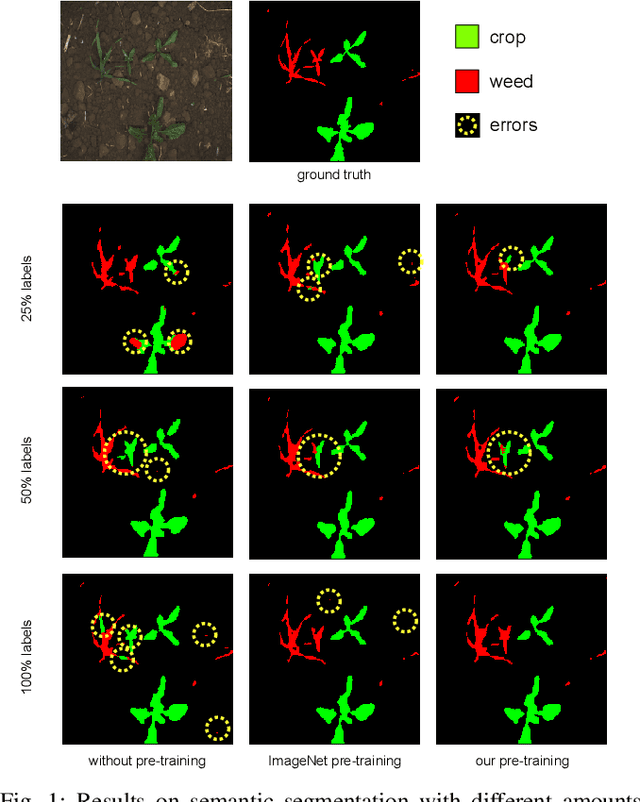



Agricultural robots have the prospect to enable more efficient and sustainable agricultural production of food, feed, and fiber. Perception of crops and weeds is a central component of agricultural robots that aim to monitor fields and assess the plants as well as their growth stage in an automatic manner. Semantic perception mostly relies on deep learning using supervised approaches, which require time and qualified workers to label fairly large amounts of data. In this paper, we look into the problem of reducing the amount of labels without compromising the final segmentation performance. For robots operating in the field, pre-training networks in a supervised way is already a popular method to reduce the number of required labeled images. We investigate the possibility of pre-training in a self-supervised fashion using data from the target domain. To better exploit this data, we propose a set of domain-specific augmentation strategies. We evaluate our pre-training on semantic segmentation and leaf instance segmentation, two important tasks in our domain. The experimental results suggest that pre-training with domain-specific data paired with our data augmentation strategy leads to superior performance compared to commonly used pre-trainings. Furthermore, the pre-trained networks obtain similar performance to the fully supervised with less labeled data.
Long-Term Indoor Localization with Metric-Semantic Mapping using a Floor Plan Prior
Mar 20, 2023Object-based maps are relevant for scene understanding since they integrate geometric and semantic information of the environment, allowing autonomous robots to robustly localize and interact with on objects. In this paper, we address the task of constructing a metric-semantic map for the purpose of long-term object-based localization. We exploit 3D object detections from monocular RGB frames for both, the object-based map construction, and for globally localizing in the constructed map. To tailor the approach to a target environment, we propose an efficient way of generating 3D annotations to finetune the 3D object detection model. We evaluate our map construction in an office building, and test our long-term localization approach on challenging sequences recorded in the same environment over nine months. The experiments suggest that our approach is suitable for constructing metric-semantic maps, and that our localization approach is robust to long-term changes. Both, the mapping algorithm and the localization pipeline can run online on an onboard computer. We will release an open-source C++/ROS implementation of our approach.
Panoptic Mapping with Fruit Completion and Pose Estimation for Horticultural Robots
Mar 15, 2023Monitoring plants and fruits at high resolution play a key role in the future of agriculture. Accurate 3D information can pave the way to a diverse number of robotic applications in agriculture ranging from autonomous harvesting to precise yield estimation. Obtaining such 3D information is non-trivial as agricultural environments are often repetitive and cluttered, and one has to account for the partial observability of fruit and plants. In this paper, we address the problem of jointly estimating complete 3D shapes of fruit and their pose in a 3D multi-resolution map built by a mobile robot. To this end, we propose an online multi-resolution panoptic mapping system where regions of interest are represented with a higher resolution. We exploit data to learn a general fruit shape representation that we use at inference time together with an occlusion-aware differentiable rendering pipeline to complete partial fruit observations and estimate the 7 DoF pose of each fruit in the map. The experiments presented in this paper, evaluated both in the controlled environment and in a commercial greenhouse, show that our novel algorithm yields higher completion and pose estimation accuracy than existing methods, with an improvement of 41% in completion accuracy and 52% in pose estimation accuracy while keeping a low inference time of 0.6s in average.
Gaussian Radar Transformer for Semantic Segmentation in Noisy Radar Data
Dec 07, 2022


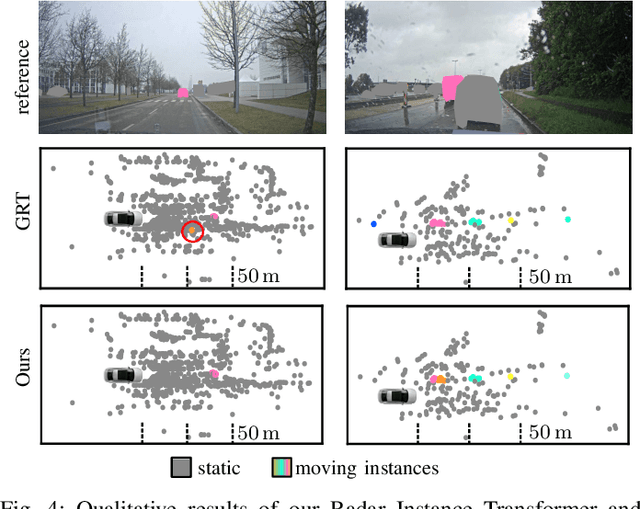
Scene understanding is crucial for autonomous robots in dynamic environments for making future state predictions, avoiding collisions, and path planning. Camera and LiDAR perception made tremendous progress in recent years, but face limitations under adverse weather conditions. To leverage the full potential of multi-modal sensor suites, radar sensors are essential for safety critical tasks and are already installed in most new vehicles today. In this paper, we address the problem of semantic segmentation of moving objects in radar point clouds to enhance the perception of the environment with another sensor modality. Instead of aggregating multiple scans to densify the point clouds, we propose a novel approach based on the self-attention mechanism to accurately perform sparse, single-scan segmentation. Our approach, called Gaussian Radar Transformer, includes the newly introduced Gaussian transformer layer, which replaces the softmax normalization by a Gaussian function to decouple the contribution of individual points. To tackle the challenge of the transformer to capture long-range dependencies, we propose our attentive up- and downsampling modules to enlarge the receptive field and capture strong spatial relations. We compare our approach to other state-of-the-art methods on the RadarScenes data set and show superior segmentation quality in diverse environments, even without exploiting temporal information.
Fully On-board Low-Power Localization with Multizone Time-of-Flight Sensors on Nano-UAVs
Nov 25, 2022Nano-size unmanned aerial vehicles (UAVs) hold enormous potential to perform autonomous operations in complex environments, such as inspection, monitoring or data collection. Moreover, their small size allows safe operation close to humans and agile flight. An important part of autonomous flight is localization, which is a computationally intensive task especially on a nano-UAV that usually has strong constraints in sensing, processing and memory. This work presents a real-time localization approach with low element-count multizone range sensors for resource-constrained nano-UAVs. The proposed approach is based on a novel miniature 64-zone time-of-flight sensor from ST Microelectronics and a RISC-V-based parallel ultra low-power processor, to enable accurate and low latency Monte Carlo Localization on-board. Experimental evaluation using a nano-UAV open platform demonstrated that the proposed solution is capable of localizing on a 31.2m$\boldsymbol{^2}$ map with 0.15m accuracy and an above 95% success rate. The achieved accuracy is sufficient for localization in common indoor environments. We analyze tradeoffs in using full and half-precision floating point numbers as well as a quantized map and evaluate the accuracy and memory footprint across the design space. Experimental evaluation shows that parallelizing the execution for 8 RISC-V cores brings a 7x speedup and allows us to execute the algorithm on-board in real-time with a latency of 0.2-30ms (depending on the number of particles), while only increasing the overall drone power consumption by 3-7%. Finally, we provide an open-source implementation of our approach.
Wheel-SLAM: Simultaneous Localization and Terrain Mapping Using One Wheel-mounted IMU
Nov 06, 2022A reliable pose estimator robust to environmental disturbances is desirable for mobile robots. To this end, inertial measurement units (IMUs) play an important role because they can perceive the full motion state of the vehicle independently. However, it suffers from accumulative error due to inherent noise and bias instability, especially for low-cost sensors. In our previous studies on Wheel-INS \cite{niu2021, wu2021}, we proposed to limit the error drift of the pure inertial navigation system (INS) by mounting an IMU to the wheel of the robot to take advantage of rotation modulation. However, it still drifted over a long period of time due to the lack of external correction signals. In this letter, we propose to exploit the environmental perception ability of Wheel-INS to achieve simultaneous localization and mapping (SLAM) with only one IMU. To be specific, we use the road bank angles (mirrored by the robot roll angles estimated by Wheel-INS) as terrain features to enable the loop closure with a Rao-Blackwellized particle filter. The road bank angle is sampled and stored according to the robot position in the grid maps maintained by the particles. The weights of the particles are updated according to the difference between the currently estimated roll sequence and the terrain map. Field experiments suggest the feasibility of the idea to perform SLAM in Wheel-INS using the robot roll angle estimates. In addition, the positioning accuracy is improved significantly (more than 30\%) over Wheel-INS. Source code of our implementation is publicly available (https://github.com/i2Nav-WHU/Wheel-SLAM).