 Add to Chrome
 Add to Firefox
 Add to Edge
GenAI for Systems: Recurring Challenges and Design Principles from Software to Silicon
Feb 16, 2026
Generative AI is reshaping how computing systems are designed, optimized, and built, yet research remains fragmented across software, architecture, and chip design communities. This paper takes a cross-stack perspective, examining how generative models are being applied from code generation and distributed runtimes through hardware design space exploration to RTL synthesis, physical layout, and verification. Rather than reviewing each layer in isolation, we analyze how the same structural difficulties and effective responses recur across the stack. Our central finding is one of convergence. Despite the diversity of domains and tools, the field keeps encountering five recurring challenges (the feedback loop crisis, the tacit knowledge problem, trust and validation, co-design across boundaries, and the shift from determinism to dynamism) and keeps arriving at five design principles that independently emerge as effective responses (embracing hybrid approaches, designing for continuous feedback, separating concerns by role, matching methods to problem structure, and building on decades of systems knowledge). We organize these into a challenge--principle map that serves as a diagnostic and design aid, showing which principles have proven effective for which challenges across layers. Through concrete cross-stack examples, we show how systems navigate this map as they mature, and argue that the field needs shared engineering methodology, including common vocabularies, cross-layer benchmarks, and systematic design practices, so that progress compounds across communities rather than being rediscovered in each one. Our analysis covers more than 275 papers spanning eleven application areas across three layers of the computing stack, and distills open research questions that become visible only from a cross-layer vantage point.

SWE-fficiency: Can Language Models Optimize Real-World Repositories on Real Workloads?
Nov 11, 2025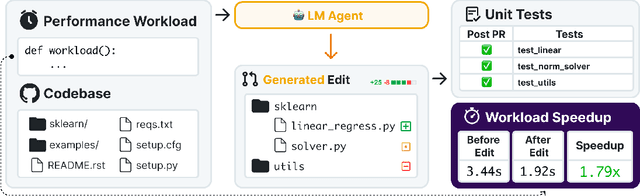
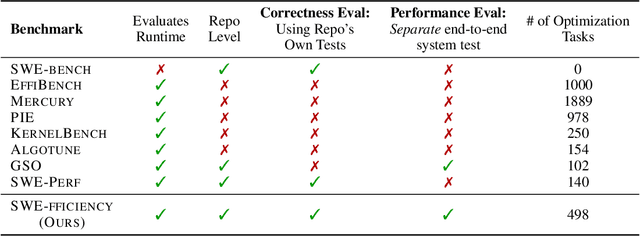
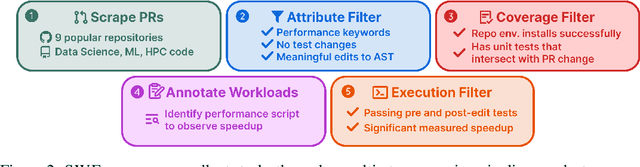
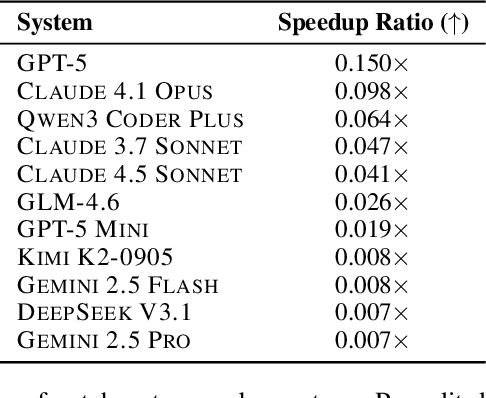
Optimizing the performance of large-scale software repositories demands expertise in code reasoning and software engineering (SWE) to reduce runtime while preserving program correctness. However, most benchmarks emphasize what to fix rather than how to fix code. We introduce SWE-fficiency, a benchmark for evaluating repository-level performance optimization on real workloads. Our suite contains 498 tasks across nine widely used data-science, machine-learning, and HPC repositories (e.g., numpy, pandas, scipy): given a complete codebase and a slow workload, an agent must investigate code semantics, localize bottlenecks and relevant tests, and produce a patch that matches or exceeds expert speedup while passing the same unit tests. To enable this how-to-fix evaluation, our automated pipeline scrapes GitHub pull requests for performance-improving edits, combining keyword filtering, static analysis, coverage tooling, and execution validation to both confirm expert speedup baselines and identify relevant repository unit tests. Empirical evaluation of state-of-the-art agents reveals significant underperformance. On average, agents achieve less than 0.15x the expert speedup: agents struggle in localizing optimization opportunities, reasoning about execution across functions, and maintaining correctness in proposed edits. We release the benchmark and accompanying data pipeline to facilitate research on automated performance engineering and long-horizon software reasoning.