 Add to Chrome
 Add to Firefox
 Add to Edge
Look Less, Think Faster: Joint Token-Compute Adaptation for Multimodal LLMs
Jul 22, 2026
Multimodal Large Language Models (MLLMs) have recently demonstrated strong performance across vision-language tasks. However, their high inference cost, arising from both the large number of input visual tokens and the heavy computation of the large language model (LLM), remains a key barrier to practical deployment. Recent work attempts to reduce the cost by adaptively optimizing individual dimensions, e.g., pruning redundant visual tokens or skipping LLM layers and heads. Nonetheless, prior approaches typically treat these dimensions independently and overlook a fundamental coupling: the available compute resources must be dynamically allocated across all dimensions based on the input content. To bridge the gap, we propose SmartVL, a unified adaptive inference framework that jointly controls vision token number and model compute capability in response to varying input contents and compute budgets. SmartVL introduces a vision-side token controller that dynamically selects informative visual tokens and an LLM-side compute controller that adaptively adjusts LLM computation. Importantly, these controllers are trained to coordinate with each other so that the overall inference cost satisfies a target budget. To allow this joint scheduling, we connect the controllers using a shared budget encoding and leverage a differentiable latency estimator for end-to-end training. This design enables SmartVL to learn cross-stage allocation strategies that adapt to both input complexity and runtime compute constraints. Experiments across multiple MLLM benchmarks demonstrate that, with joint scheduling, SmartVL consistently outperforms prior adaptive methods and achieves superior accuracy-efficiency Pareto frontiers. Project page: https://www.schaterji.io/publications/2026/jointtokencompute.

Virtuoso: Video-based Intelligence for real-time tuning on SOCs
Dec 24, 2021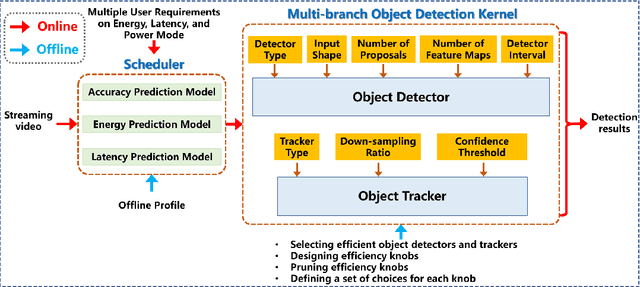
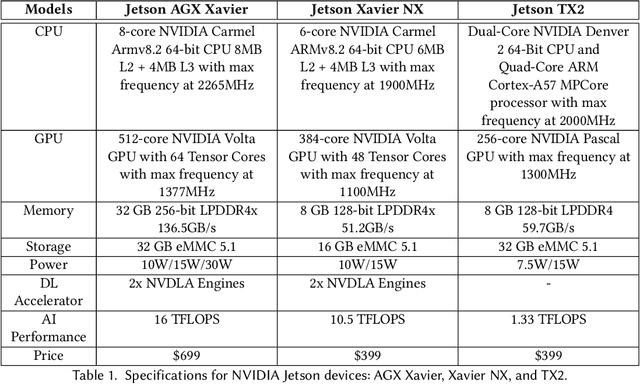
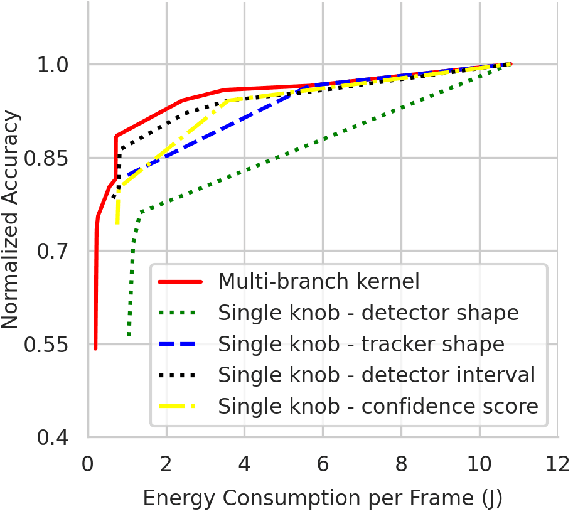
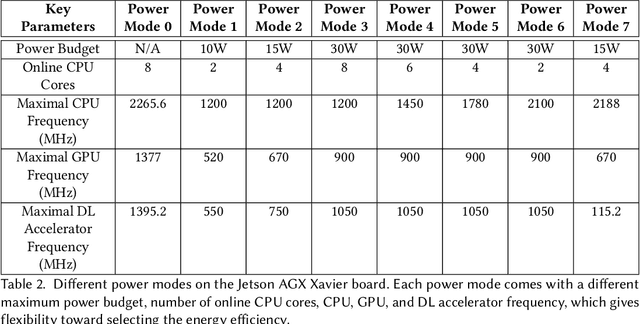
Efficient and adaptive computer vision systems have been proposed to make computer vision tasks, such as image classification and object detection, optimized for embedded or mobile devices. These solutions, quite recent in their origin, focus on optimizing the model (a deep neural network, DNN) or the system by designing an adaptive system with approximation knobs. In spite of several recent efforts, we show that existing solutions suffer from two major drawbacks. First, the system does not consider energy consumption of the models while making a decision on which model to run. Second, the evaluation does not consider the practical scenario of contention on the device, due to other co-resident workloads. In this work, we propose an efficient and adaptive video object detection system, Virtuoso, which is jointly optimized for accuracy, energy efficiency, and latency. Underlying Virtuoso is a multi-branch execution kernel that is capable of running at different operating points in the accuracy-energy-latency axes, and a lightweight runtime scheduler to select the best fit execution branch to satisfy the user requirement. To fairly compare with Virtuoso, we benchmark 15 state-of-the-art or widely used protocols, including Faster R-CNN (FRCNN), YOLO v3, SSD, EfficientDet, SELSA, MEGA, REPP, FastAdapt, and our in-house adaptive variants of FRCNN+, YOLO+, SSD+, and EfficientDet+ (our variants have enhanced efficiency for mobiles). With this comprehensive benchmark, Virtuoso has shown superiority to all the above protocols, leading the accuracy frontier at every efficiency level on NVIDIA Jetson mobile GPUs. Specifically, Virtuoso has achieved an accuracy of 63.9%, which is more than 10% higher than some of the popular object detection models, FRCNN at 51.1%, and YOLO at 49.5%.
ApproxDet: Content and Contention-Aware Approximate Object Detection for Mobiles
Oct 21, 2020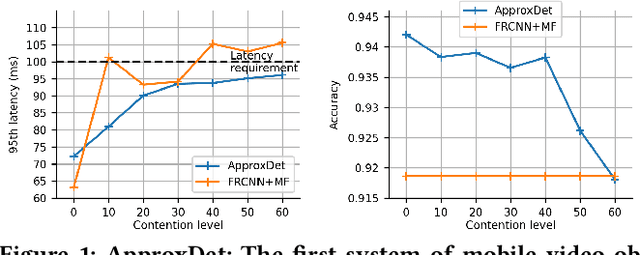
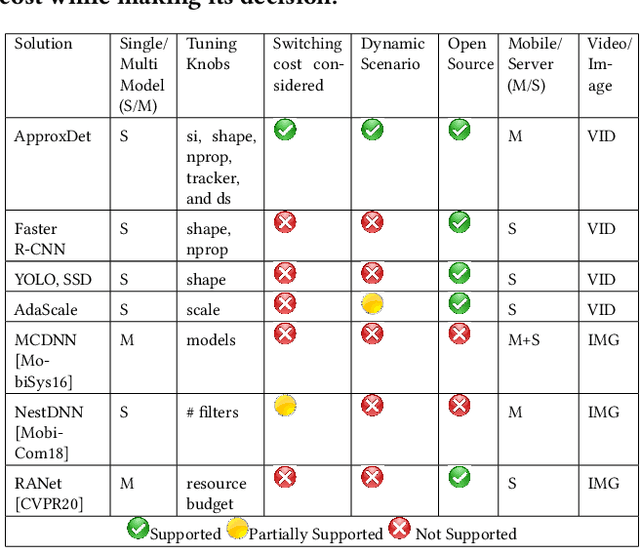
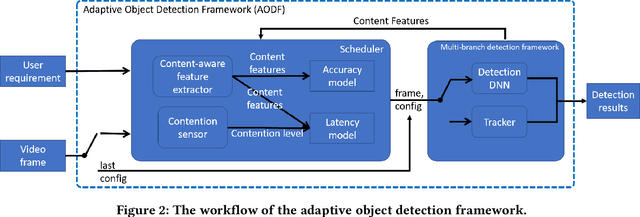

Advanced video analytic systems, including scene classification and object detection, have seen widespread success in various domains such as smart cities and autonomous transportation. With an ever-growing number of powerful client devices, there is incentive to move these heavy video analytics workloads from the cloud to mobile devices to achieve low latency and real-time processing and to preserve user privacy. However, most video analytic systems are heavyweight and are trained offline with some pre-defined latency or accuracy requirements. This makes them unable to adapt at runtime in the face of three types of dynamism -- the input video characteristics change, the amount of compute resources available on the node changes due to co-located applications, and the user's latency-accuracy requirements change. In this paper we introduce ApproxDet, an adaptive video object detection framework for mobile devices to meet accuracy-latency requirements in the face of changing content and resource contention scenarios. To achieve this, we introduce a multi-branch object detection kernel (layered on Faster R-CNN), which incorporates a data-driven modeling approach on the performance metrics, and a latency SLA-driven scheduler to pick the best execution branch at runtime. We couple this kernel with approximable video object tracking algorithms to create an end-to-end video object detection system. We evaluate ApproxDet on a large benchmark video dataset and compare quantitatively to AdaScale and YOLOv3. We find that ApproxDet is able to adapt to a wide variety of contention and content characteristics and outshines all baselines, e.g., it achieves 52% lower latency and 11.1% higher accuracy over YOLOv3.