 Add to Chrome
 Add to Firefox
 Add to Edge
HistoFID- Calibrating Frechet-distance evaluation across pathology foundation models
Jul 22, 2026
The Frechet Inception Distance (FID) compares two image sets by fitting a Gaussian to the features of a fixed network and measuring the distance between the two Gaussians. In digital pathology the Inception network is routinely replaced by a histology foundation model, on the assumption that a domain encoder gives a more meaningful score. We show that this choice changes the result. For one fixed pair of tile sets, the raw Frechet distance varies about thirty-fold across six common encoders, and the ordering does not follow embedding dimension, so a raw score cannot be read without naming the encoder. Using a held-out in-house cohort (about 500,000 H&E and immunohistochemistry tiles from 2,119 slides) and a public TCGA BRCA cohort (100 slides), we benchmark Inception-v3, Phikon-v2, CONCH, UNI2-h, Virchow2 and Prov-GigaPath across within-cohort baselines, cross-cohort drift, controlled perturbations, compression, stain normalization, and two generative models. Expressing each distance as a ratio to the encoder's own within-cohort floor restores comparability, cutting the across-encoder coefficient of variation by about 89% within cohort and 58% across cohorts. The encoders separate into a sensitive group (CONCH, Phikon-v2, Inception-v3) and an invariant group (UNI2-h, Virchow2, Prov-GigaPath), and this split decides which generative model is judged more realistic, so the encoder can change the conclusion of a generative evaluation. At the slide level, an attention-pooling encoder registers per-slide composition that a pooled patch distance cannot see, raising the distance about 320-fold on matched cohorts. Using the same protocol we evaluate TuroCompress, a proprietary pathology codec, which reaches the highest reconstruction fidelity at the smallest file size among codecs tested. We release the normalization protocol, the per-encoder perturbation panel, and the feature extracts.

MDD: A Dataset for Text-and-Music Conditioned Duet Dance Generation
Aug 23, 2025We introduce Multimodal DuetDance (MDD), a diverse multimodal benchmark dataset designed for text-controlled and music-conditioned 3D duet dance motion generation. Our dataset comprises 620 minutes of high-quality motion capture data performed by professional dancers, synchronized with music, and detailed with over 10K fine-grained natural language descriptions. The annotations capture a rich movement vocabulary, detailing spatial relationships, body movements, and rhythm, making MDD the first dataset to seamlessly integrate human motions, music, and text for duet dance generation. We introduce two novel tasks supported by our dataset: (1) Text-to-Duet, where given music and a textual prompt, both the leader and follower dance motion are generated (2) Text-to-Dance Accompaniment, where given music, textual prompt, and the leader's motion, the follower's motion is generated in a cohesive, text-aligned manner. We include baseline evaluations on both tasks to support future research.
A Survey on Human-AI Teaming with Large Pre-Trained Models
Mar 07, 2024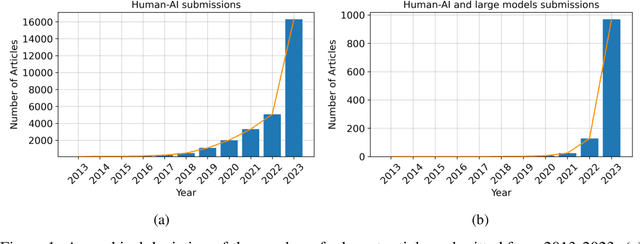
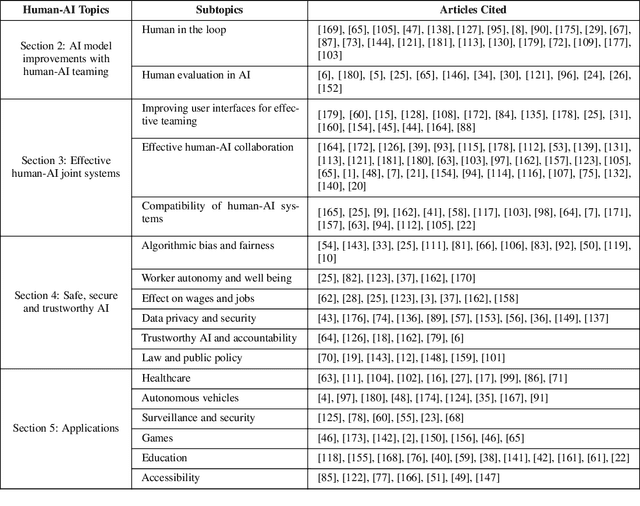
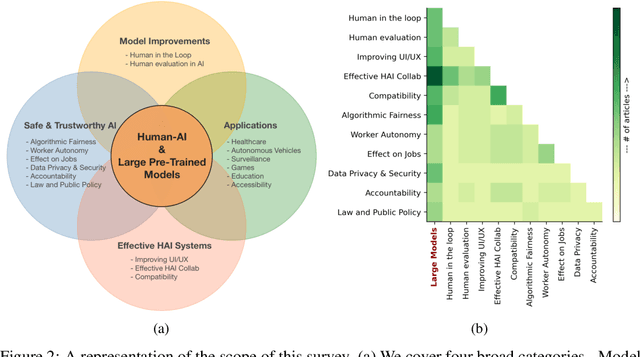
In the rapidly evolving landscape of artificial intelligence (AI), the collaboration between human intelligence and AI systems, known as Human-AI (HAI) Teaming, has emerged as a cornerstone for advancing problem-solving and decision-making processes. The advent of Large Pre-trained Models (LPtM) has significantly transformed this landscape, offering unprecedented capabilities by leveraging vast amounts of data to understand and predict complex patterns. This paper surveys the pivotal integration of LPtMs with HAI, emphasizing how these models enhance collaborative intelligence beyond traditional approaches. It examines the synergistic potential of LPtMs in augmenting human capabilities, discussing this collaboration for AI model improvements, effective teaming, ethical considerations, and their broad applied implications in various sectors. Through this exploration, the study sheds light on the transformative impact of LPtM-enhanced HAI Teaming, providing insights for future research, policy development, and strategic implementations aimed at harnessing the full potential of this collaboration for research and societal benefit.