 Add to Chrome
 Add to Firefox
 Add to Edge
VisRef: Visual Refocusing while Thinking Improves Test-Time Scaling in Multi-Modal Large Reasoning Models
Feb 27, 2026
Advances in large reasoning models have shown strong performance on complex reasoning tasks by scaling test-time compute through extended reasoning. However, recent studies observe that in vision-dependent tasks, extended textual reasoning at inference time can degrade performance as models progressively lose attention to visual tokens and increasingly rely on textual priors alone. To address this, prior works use reinforcement learning (RL)-based fine-tuning to route visual tokens or employ refocusing mechanisms during reasoning. While effective, these methods are computationally expensive, requiring large-scale data generation and policy optimization. To leverage the benefits of test-time compute without additional RL fine-tuning, we propose VisRef, a visually grounded test-time scaling framework. Our key idea is to actively guide the reasoning process by re-injecting a coreset of visual tokens that are semantically relevant to the reasoning context while remaining diverse and globally representative of the image, enabling more grounded multi-modal reasoning. Experiments on three visual reasoning benchmarks with state-of-the-art multi-modal large reasoning models demonstrate that, under fixed test-time compute budgets, VisRef consistently outperforms existing test-time scaling approaches by up to 6.4%.

FDB: Fraud Dataset Benchmark
Aug 31, 2022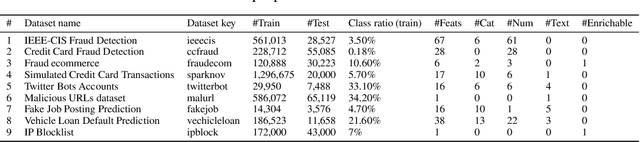
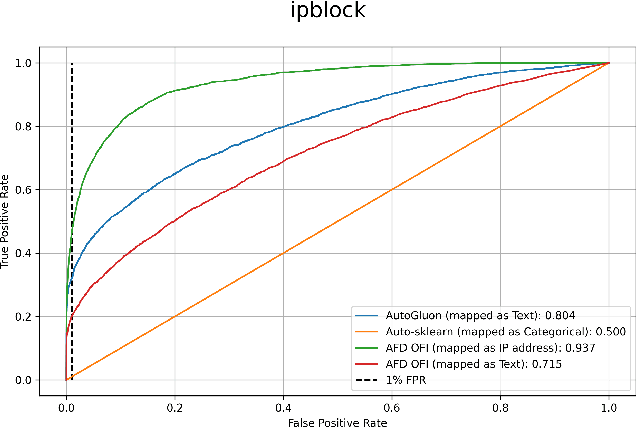
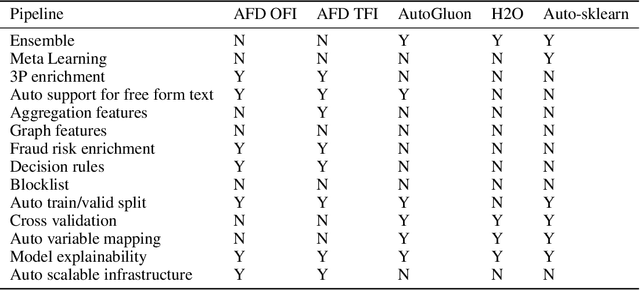

Standardized datasets and benchmarks have spurred innovations in computer vision, natural language processing, multi-modal and tabular settings. We note that, as compared to other well researched fields fraud detection has numerous differences. The differences include a high class imbalance, diverse feature types, frequently changing fraud patterns, and adversarial nature of the problem. Due to these differences, the modeling approaches that are designed for other classification tasks may not work well for the fraud detection. We introduce Fraud Dataset Benchmark (FDB), a compilation of publicly available datasets catered to fraud detection. FDB comprises variety of fraud related tasks, ranging from identifying fraudulent card-not-present transactions, detecting bot attacks, classifying malicious URLs, predicting risk of loan to content moderation. The Python based library from FDB provides consistent API for data loading with standardized training and testing splits. For reference, we also provide baseline evaluations of different modeling approaches on FDB. Considering the increasing popularity of Automated Machine Learning (AutoML) for various research and business problems, we used AutoML frameworks for our baseline evaluations. For fraud prevention, the organizations that operate with limited resources and lack ML expertise often hire a team of investigators, use blocklists and manual rules, all of which are inefficient and do not scale well. Such organizations can benefit from AutoML solutions that are easy to deploy in production and pass the bar of fraud prevention requirements. We hope that FDB helps in the development of customized fraud detection techniques catered to different fraud modus operandi (MOs) as well as in the improvement of AutoML systems that can work well for all datasets in the benchmark.