 Add to Chrome
 Add to Firefox
 Add to Edge
Coupling-Robust Accuracy in Multiphysics Physics Informed Neural Networks via Kronecker-Preconditioned Optimization
May 22, 2026
Physics-informed neural networks (PINNs) for coupled multiphysics systems suffer systematic accuracy degradation as inter-equation coupling strengthens. We provide a theoretical explanation for this phenomenon through neural tangent kernel (NTK) analysis: for linearly coupled systems, we prove that the standard NTK's spectral radius grows as $Ω(γ^2)$ with coupling strength $γ$, shrinking the stable learning rate, while block-diagonal Gauss--Newton (GN) preconditioning yields a preconditioned NTK $K_P = J H^{+} J^\top$ (where $H$ is the block-diagonal GN Hessian) whose spectral radius is bounded by $S$ ($S$ = number of networks), independent of $γ$. We verify the $Ω(γ^2)$ growth numerically across symmetric, asymmetric, and nonlinear coupled PDE systems, and confirm $λ_{\max}(K_P) = S$ with equality in all cases. Combining the Kronecker-preconditioned optimizer SOAP with inverse-gradient-norm loss balancing (SOAP+GN) yields coupling-robust accuracy: across 234 experiments spanning three 1D systems of increasing nonlinearity and a 2D electroosmotic flow benchmark, SOAP+GN maintains final-epoch $L_2$ degradation $\leq 1.1\times$ (ratio of strong- to weak-coupling error) even as coupling parameters vary over one to two orders of magnitude, compared with $> 10^2\times$ for Adam+GN. SOAP+GN further scales to a 2D, 6-PDE electroosmotic flow system at EDL-resolved conditions -- a regime that all prior PINN electrokinetics studies have avoided through simplified physics -- where Adam+GN fails entirely ($L_2 > 0.9$).

From Volume to Value: Preference-Aligned Memory Construction for On-Device RAG
May 18, 2026With the rapid emergence of personal AI agents based on Large Language Models (LLMs), implementing them on-device has become essential for privacy and responsiveness. To handle the inherently personal and context-dependent nature of real-world requests, such agents must ground their generation in device-resident personal context. However, under tight memory budgets, the core bottleneck is what to store so that retrieval remains aligned with the user. We propose EPIC (Efficient Preference-aligned Index Construction), which focuses on user preferences as a compact and stable form of personal context and integrates them throughout the RAG pipeline. EPIC selectively retains preference-relevant information from raw data and aligns retrieval toward preference-aligned contexts. Across four benchmarks covering conversations, debates, explanations, and recommendations, EPIC reduces indexing memory by 2,404 times, improves preference-following accuracy by 20.17 percentage points, and achieves 33.33 times lower retrieval latency over the best-performing baseline. In our on-device experiment, EPIC maintains a memory footprint under 1 MB with 29.35 ms/query latency in streaming updates.
Robust Ultra Low-Bit Post-Training Quantization via Stable Diagonal Curvature Estimate
Apr 15, 2026Large Language Models (LLMs) are widely used across many domains, but their scale makes deployment challenging. Post-Training Quantization (PTQ) reduces memory footprint without retraining by leveraging a small calibration set. Recent Hessian-based PTQ methods compensate quantization error via cross-channel dependencies, but such approaches degrade at low bit-widths due to noisy curvature estimates from limited calibration data. We propose DASH-Q, a robust PTQ framework using diagonal Hessian approximation and iterative weighted least squares. By discarding noise-prone dependencies, DASH-Q filters sampling noise while prioritizing the preservation of salient feature power. We outperform other PTQ baselines in ultra low-bit regime, improving zero-shot accuracy by 7.01% on average and up to 14.01% over the strongest baselines across five baseline LLM models, while showing robust and stable performance with very small calibration data.
Neuro-RIT: Neuron-Guided Instruction Tuning for Robust Retrieval-Augmented Language Model
Apr 02, 2026Retrieval-Augmented Language Models (RALMs) have demonstrated significant potential in knowledge-intensive tasks; however, they remain vulnerable to performance degradation when presented with irrelevant or noisy retrieved contexts. Existing approaches to enhance robustness typically operate via coarse-grained parameter updates at the layer or module level, often overlooking the inherent neuron-level sparsity of Large Language Models (LLMs). To address this limitation, we propose Neuro-RIT (Neuron-guided Robust Instruction Tuning), a novel framework that shifts the paradigm from dense adaptation to precision-driven neuron alignment. Our method explicitly disentangles neurons that are responsible for processing relevant versus irrelevant contexts using attribution-based neuron mining. Subsequently, we introduce a two-stage instruction tuning strategy that enforces a dual capability for noise robustness: achieving direct noise suppression by functionally deactivating neurons exclusive to irrelevant contexts, while simultaneously optimizing targeted layers for evidence distillation. Extensive experiments across diverse QA benchmarks demonstrate that Neuro-RIT consistently outperforms strong baselines and robustness-enhancing methods.
When Sinks Help or Hurt: Unified Framework for Attention Sink in Large Vision-Language Models
Apr 01, 2026Attention sinks are defined as tokens that attract disproportionate attention. While these have been studied in single modality transformers, their cross-modal impact in Large Vision-Language Models (LVLM) remains largely unexplored: are they redundant artifacts or essential global priors? This paper first categorizes visual sinks into two distinct categories: ViT-emerged sinks (V-sinks), which propagate from the vision encoder, and LLM-emerged sinks (L-sinks), which arise within deep LLM layers. Based on the new definition, our analysis reveals a fundamental performance trade-off: while sinks effectively encode global scene-level priors, their dominance can suppress the fine-grained visual evidence required for local perception. Furthermore, we identify specific functional layers where modulating these sinks most significantly impacts downstream performance. To leverage these insights, we propose Layer-wise Sink Gating (LSG), a lightweight, plug-and-play module that dynamically scales the attention contributions of V-sink and the rest visual tokens. LSG is trained via standard next-token prediction, requiring no task-specific supervision while keeping the LVLM backbone frozen. In most layers, LSG yields improvements on representative multimodal benchmarks, effectively balancing global reasoning and precise local evidence.
CLaD: Planning with Grounded Foresight via Cross-Modal Latent Dynamics
Mar 31, 2026Robotic manipulation involves kinematic and semantic transitions that are inherently coupled via underlying actions. However, existing approaches plan within either semantic or latent space without explicitly aligning these cross-modal transitions. To address this, we propose CLaD, a framework that models how proprioceptive and semantic states jointly evolve under actions through asymmetric cross-attention that allows kinematic transitions to query semantic ones. CLaD predicts grounded latent foresights via self-supervised objectives with EMA target encoders and auxiliary reconstruction losses, preventing representation collapse while anchoring predictions to observable states. Predicted foresights are modulated with observations to condition a diffusion policy for action generation. On LIBERO-LONG benchmark, CLaD achieves 94.7\% success rate, competitive with large VLAs with significantly fewer parameters.
Adaptive Guidance for Retrieval-Augmented Masked Diffusion Models
Mar 18, 2026Retrieval-Augmented Generation (RAG) improves factual grounding by incorporating external knowledge into language model generation. However, when retrieved context is noisy, unreliable, or inconsistent with the model's parametric knowledge, it introduces retrieval-prior conflicts that can degrade generation quality. While this problem has been studied in autoregressive language models, it remains largely unexplored in diffusion-based language models, where the iterative denoising process introduces unique challenges for integrating retrieved context. In this work, we propose Adaptive Retrieval-Augmented Masked Diffusion (ARAM), a training-free adaptive guidance framework for Masked Diffusion Models (MDMs) in RAG settings. ARAM dynamically calibrates the guidance scale during denoising according to the Signal-to-Noise Ratio (SNR) of the distributional shift induced by retrieved context. Intuitively, the model strengthens guidance when the retrieved context provides reliable corrective evidence and suppresses it when the contextual signal is noisy or non-supportive. Extensive experiments on multiple knowledge-intensive QA benchmarks show that ARAM improves overall QA performance over competitive RAG baselines.
DMD-augmented Unpaired Neural Schrödinger Bridge for Ultra-Low Field MRI Enhancement
Mar 05, 2026Ultra Low Field (64 mT) brain MRI improves accessibility but suffers from reduced image quality compared to 3 T. As paired 64 mT - 3 T scans are scarce, we propose an unpaired 64 mT $\rightarrow$ 3 T translation framework that enhances realism while preserving anatomy. Our method builds upon the Unpaired Neural Schrödinge Bridge (UNSB) with multi-step refinement. To strengthen target distribution alignment, we augment the adversarial objective with DMD2-style diffusion-guided distribution matching using a frozen 3T diffusion teacher. To explicitly constrain global structure beyond patch-level correspondence, we combine PatchNCE with an Anatomical Structure Preservation (ASP) regularizer that enforces soft foreground background consistency and boundary aware constraints. Evaluated on two disjoint cohorts, the proposed framework achieves an improved realism structure trade-off, enhancing distribution level realism on unpaired benchmarks while increasing structural fidelity on the paired cohort compared to unpaired baselines.
Dementia-R1: Reinforced Pretraining and Reasoning from Unstructured Clinical Notes for Real-World Dementia Prognosis
Jan 06, 2026While Large Language Models (LLMs) have shown strong performance on clinical text understanding, they struggle with longitudinal prediction tasks such as dementia prognosis, which require reasoning over complex, non-monotonic symptom trajectories across multiple visits. Standard supervised training lacks explicit annotations for symptom evolution, while direct Reinforcement Learning (RL) is hindered by sparse binary rewards. To address this challenge, we introduce Dementia-R1, an RL-based framework for longitudinal dementia prognosis from unstructured clinical notes. Our approach adopts a Cold-Start RL strategy that pre-trains the model to predict verifiable clinical indices extracted from patient histories, enhancing the capability to reason about disease progression before determining the final clinical status. Extensive experiments demonstrate that Dementia-R1 achieves an F1 score of 77.03% on real-world unstructured clinical datasets. Notably, on the ADNI benchmark, our 7B model rivals GPT-4o, effectively capturing fluctuating cognitive trajectories. Code is available at https://anonymous.4open.science/r/dementiar1-CDB5
Universal Reasoner: A Single, Composable Plug-and-Play Reasoner for Frozen LLMs
May 25, 2025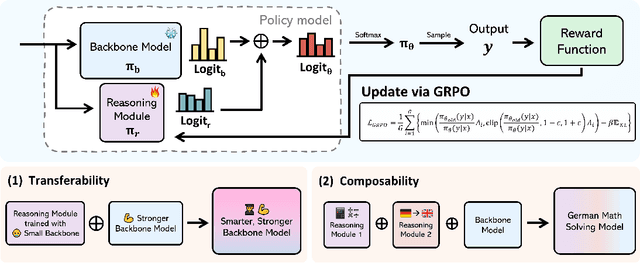
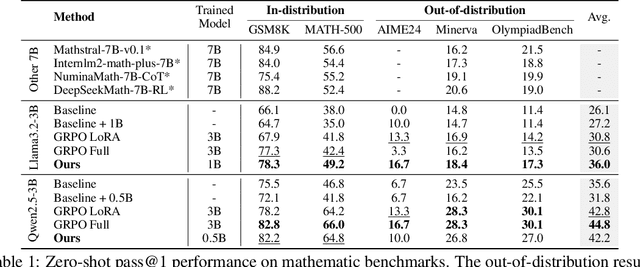
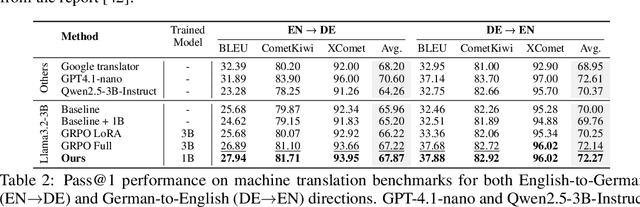
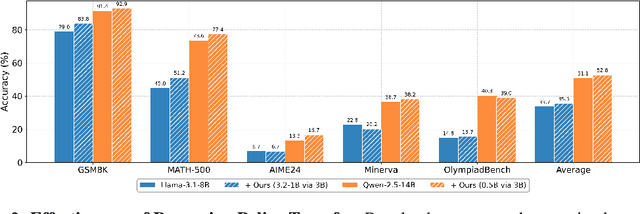
Large Language Models (LLMs) have demonstrated remarkable general capabilities, but enhancing skills such as reasoning often demands substantial computational resources and may compromise their generalization. While Parameter-Efficient Fine-Tuning (PEFT) methods offer a more resource-conscious alternative, they typically requires retraining for each LLM backbone due to architectural dependencies. To address these challenges, here we propose Universal Reasoner (UniR) - a single, lightweight, composable, and plug-and-play reasoning module that can be used with any frozen LLM to endow it with specialized reasoning capabilities. Specifically, UniR decomposes the reward into a standalone reasoning module that is trained independently using predefined rewards, effectively translating trajectory-level signals into token-level guidance. Once trained, UniR can be combined with any frozen LLM at inference time by simply adding its output logits to those of the LLM backbone. This additive structure naturally enables modular composition: multiple UniR modules trained for different tasks can be jointly applied by summing their logits, enabling complex reasoning via composition. Experimental results on mathematical reasoning and machine translation tasks show that UniR significantly outperforms \add{existing baseline fine-tuning methods using the Llama3.2 model}. Furthermore, UniR demonstrates strong weak-to-strong generalization: reasoning modules trained on smaller models effectively guide much larger LLMs. This makes UniR a cost-efficient, adaptable, and robust solution for enhancing reasoning in LLMs without compromising their core capabilities. Code is open-sourced at https://github.com/hangeol/UniR