 Add to Chrome
 Add to Firefox
 Add to Edge
Arm2Air: Cross-Embodiment Skeleton Transfer for 3D Relay Formation
Jul 30, 2026
Unmanned aerial vehicle (UAV) relay networks can restore connectivity after communication infrastructure is damaged. Urban relay placement is difficult because line-of-sight blockage, communication range, altitude, and three-dimensional obstacles must be considered jointly. Arm2Air transfers obstacle-avoidance skeletons from robot arms to UAV relay placement through cross-embodiment transfer. Source-domain robot-arm motions from a pretrained Neural MP model are converted into ordered skeletons that pretrain a transformer-based transfer platform, which is then adapted to the UAV domain using limited target data and Low-Rank Adaptation. The transferred skeleton initializes a relay chain that is refined for connectivity, bottleneck capacity, delay, and movement cost. On nine held-out high-clutter 3D urban maps, Arm2Air reduced median end-to-end planning runtime by 64.9 percent relative to the fastest conventional planner. On the high-obstruction group of a separate 30-map dense urban holdout, it increased bottleneck capacity by 32.6 percent, reduced capacity variance by 74.7 percent, reduced maximum hop distance by 13.2 percent, reduced hop-distance variance by 75.2 percent, and reduced relay displacement by 16.9 percent relative to IMPC-MD. With only three target-domain training maps, Arm2Air reduced relay-position root mean square error by 53.6 percent relative to training from scratch while updating 0.134 million parameters, compared with 1.383 million for Scratch and Full Fine-tuning. These results demonstrate computationally and data-efficient UAV relay placement and suggest a broader principle for transferring ordered structural priors across heterogeneous embodied tasks.

Redefining Maritime Anomaly Detection via Equation-Grounded Synthetic Anomalies
Jun 29, 2026Maritime anomaly detection is essential for ensuring maritime safety, security, and efficient traffic management at sea, with Automatic Identification System (AIS) data serving as a primary data source. Despite its importance, most publicly available AIS datasets lack predefined anomaly labels, forcing prior studies to rely on either distribution-based rarity or domain rule/expert-assisted labeling. These approaches, however, face fundamental limitations: statistical rarity often fails to reflect practically critical events, while expert-based labeling is costly, subjective, and difficult to scale. Moreover, both paradigms tend to overlook interaction-driven hazards such as near-miss approaches between vessels. To address these challenges, we propose an equation-grounded anomaly taxonomy that is implementable under a limited AIS observation schema and extensible to other AIS datasets. Specifically, the taxonomy defines three anomaly types: unexpected AIS activity (A1), route deviation (A2), and close approach (A3), covering both single-vessel and inter-vessel anomalies. Building on this taxonomy, we introduce a unified score-synthesize-label pipeline that produces LLM-guided plausibility scores, uses them to synthesize anomalies, and assigns timestamp-level labels. To rigorously assess detection performance, we further design benchmark evaluation settings that account for variations in temporal-window length and anomaly-type composition, and evaluate a broad range of time-series models and anomaly detection models. Together, these contributions provide a systematic basis for evaluating maritime anomaly detection methods across different anomaly types. Our code is available at https://github.com/snudial/open-maritime-anomaly-detection.
Memory-V2V: Augmenting Video-to-Video Diffusion Models with Memory
Jan 22, 2026Recent foundational video-to-video diffusion models have achieved impressive results in editing user provided videos by modifying appearance, motion, or camera movement. However, real-world video editing is often an iterative process, where users refine results across multiple rounds of interaction. In this multi-turn setting, current video editors struggle to maintain cross-consistency across sequential edits. In this work, we tackle, for the first time, the problem of cross-consistency in multi-turn video editing and introduce Memory-V2V, a simple, yet effective framework that augments existing video-to-video models with explicit memory. Given an external cache of previously edited videos, Memory-V2V employs accurate retrieval and dynamic tokenization strategies to condition the current editing step on prior results. To further mitigate redundancy and computational overhead, we propose a learnable token compressor within the DiT backbone that compresses redundant conditioning tokens while preserving essential visual cues, achieving an overall speedup of 30%. We validate Memory-V2V on challenging tasks including video novel view synthesis and text-conditioned long video editing. Extensive experiments show that Memory-V2V produces videos that are significantly more cross-consistent with minimal computational overhead, while maintaining or even improving task-specific performance over state-of-the-art baselines. Project page: https://dohunlee1.github.io/MemoryV2V
Improving Video Diffusion Transformer Training by Multi-Feature Fusion and Alignment from Self-Supervised Vision Encoders
Sep 11, 2025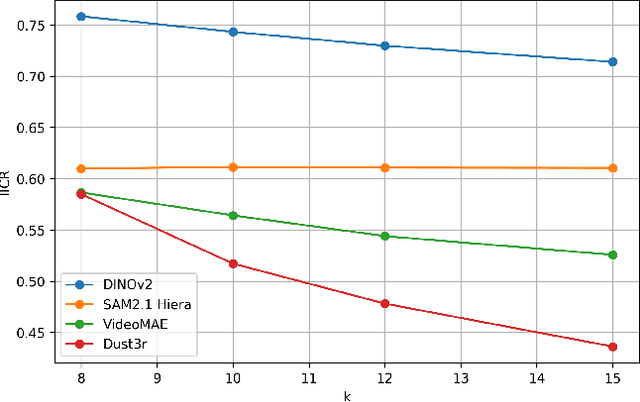
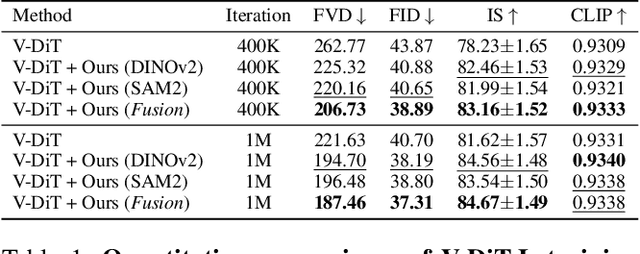
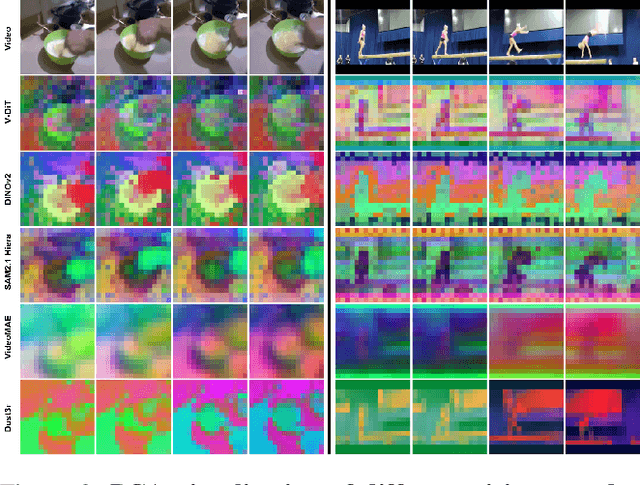
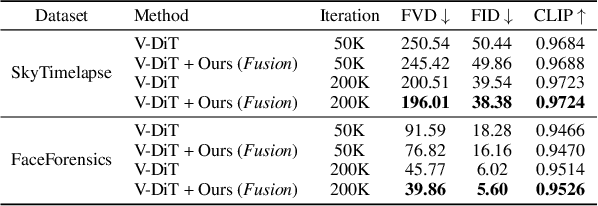
Video diffusion models have advanced rapidly in the recent years as a result of series of architectural innovations (e.g., diffusion transformers) and use of novel training objectives (e.g., flow matching). In contrast, less attention has been paid to improving the feature representation power of such models. In this work, we show that training video diffusion models can benefit from aligning the intermediate features of the video generator with feature representations of pre-trained vision encoders. We propose a new metric and conduct an in-depth analysis of various vision encoders to evaluate their discriminability and temporal consistency, thereby assessing their suitability for video feature alignment. Based on the analysis, we present Align4Gen which provides a novel multi-feature fusion and alignment method integrated into video diffusion model training. We evaluate Align4Gen both for unconditional and class-conditional video generation tasks and show that it results in improved video generation as quantified by various metrics. Full video results are available on our project page: https://align4gen.github.io/align4gen/
ContextMRI: Enhancing Compressed Sensing MRI through Metadata Conditioning
Jan 08, 2025Compressed sensing MRI seeks to accelerate MRI acquisition processes by sampling fewer k-space measurements and then reconstructing the missing data algorithmically. The success of these approaches often relies on strong priors or learned statistical models. While recent diffusion model-based priors have shown great potential, previous methods typically ignore clinically available metadata (e.g. patient demographics, imaging parameters, slice-specific information). In practice, metadata contains meaningful cues about the anatomy and acquisition protocol, suggesting it could further constrain the reconstruction problem. In this work, we propose ContextMRI, a text-conditioned diffusion model for MRI that integrates granular metadata into the reconstruction process. We train a pixel-space diffusion model directly on minimally processed, complex-valued MRI images. During inference, metadata is converted into a structured text prompt and fed to the model via CLIP text embeddings. By conditioning the prior on metadata, we unlock more accurate reconstructions and show consistent gains across multiple datasets, acceleration factors, and undersampling patterns. Our experiments demonstrate that increasing the fidelity of metadata, ranging from slice location and contrast to patient age, sex, and pathology, systematically boosts reconstruction performance. This work highlights the untapped potential of leveraging clinical context for inverse problems and opens a new direction for metadata-driven MRI reconstruction.
Optical-Flow Guided Prompt Optimization for Coherent Video Generation
Nov 23, 2024While text-to-video diffusion models have made significant strides, many still face challenges in generating videos with temporal consistency. Within diffusion frameworks, guidance techniques have proven effective in enhancing output quality during inference; however, applying these methods to video diffusion models introduces additional complexity of handling computations across entire sequences. To address this, we propose a novel framework called MotionPrompt that guides the video generation process via optical flow. Specifically, we train a discriminator to distinguish optical flow between random pairs of frames from real videos and generated ones. Given that prompts can influence the entire video, we optimize learnable token embeddings during reverse sampling steps by using gradients from a trained discriminator applied to random frame pairs. This approach allows our method to generate visually coherent video sequences that closely reflect natural motion dynamics, without compromising the fidelity of the generated content. We demonstrate the effectiveness of our approach across various models.
ACDC: Autoregressive Coherent Multimodal Generation using Diffusion Correction
Oct 07, 2024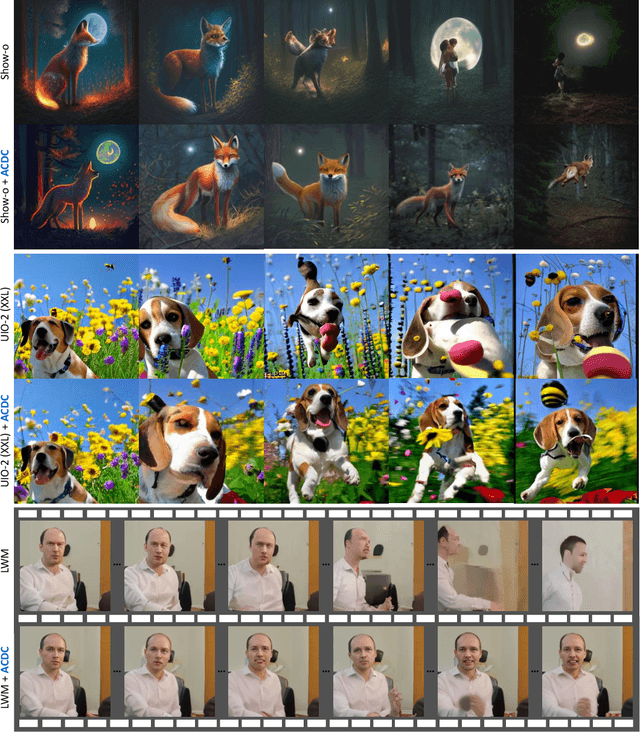
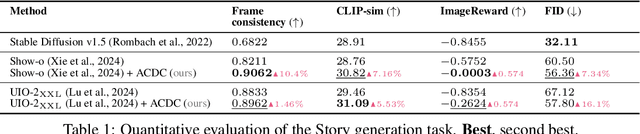
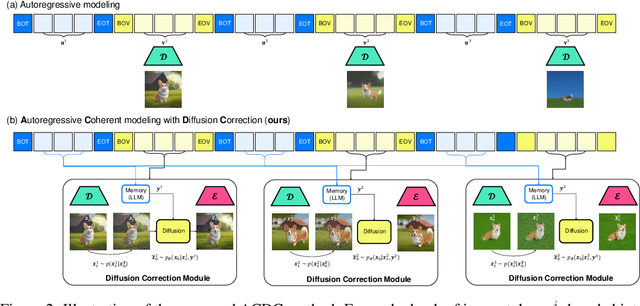
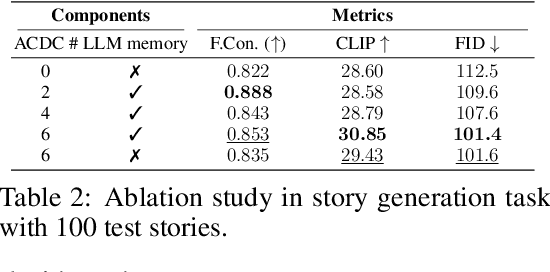
Autoregressive models (ARMs) and diffusion models (DMs) represent two leading paradigms in generative modeling, each excelling in distinct areas: ARMs in global context modeling and long-sequence generation, and DMs in generating high-quality local contexts, especially for continuous data such as images and short videos. However, ARMs often suffer from exponential error accumulation over long sequences, leading to physically implausible results, while DMs are limited by their local context generation capabilities. In this work, we introduce Autoregressive Coherent multimodal generation with Diffusion Correction (ACDC), a zero-shot approach that combines the strengths of both ARMs and DMs at the inference stage without the need for additional fine-tuning. ACDC leverages ARMs for global context generation and memory-conditioned DMs for local correction, ensuring high-quality outputs by correcting artifacts in generated multimodal tokens. In particular, we propose a memory module based on large language models (LLMs) that dynamically adjusts the conditioning texts for the DMs, preserving crucial global context information. Our experiments on multimodal tasks, including coherent multi-frame story generation and autoregressive video generation, demonstrate that ACDC effectively mitigates the accumulation of errors and significantly enhances the quality of generated outputs, achieving superior performance while remaining agnostic to specific ARM and DM architectures. Project page: https://acdc2025.github.io/
VideoGuide: Improving Video Diffusion Models without Training Through a Teacher's Guide
Oct 06, 2024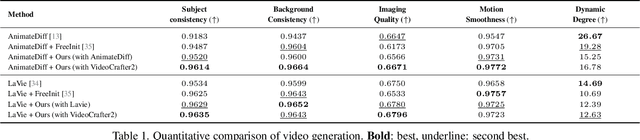
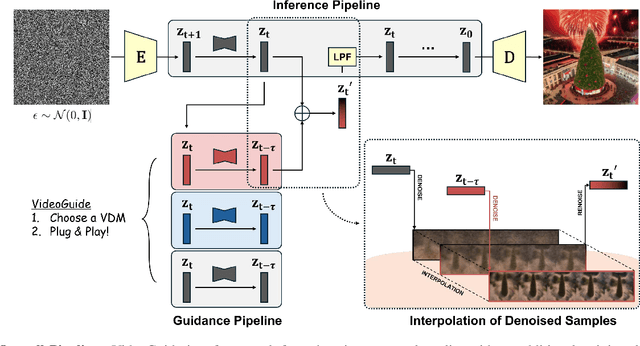
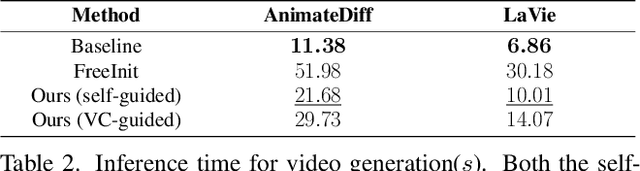
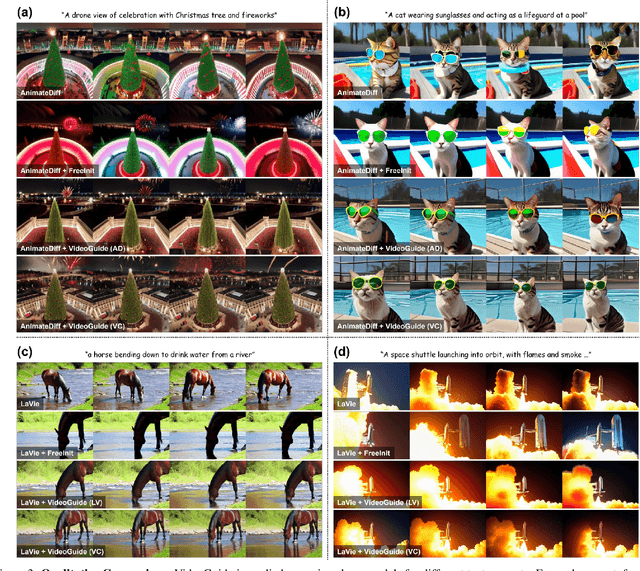
Text-to-image (T2I) diffusion models have revolutionized visual content creation, but extending these capabilities to text-to-video (T2V) generation remains a challenge, particularly in preserving temporal consistency. Existing methods that aim to improve consistency often cause trade-offs such as reduced imaging quality and impractical computational time. To address these issues we introduce VideoGuide, a novel framework that enhances the temporal consistency of pretrained T2V models without the need for additional training or fine-tuning. Instead, VideoGuide leverages any pretrained video diffusion model (VDM) or itself as a guide during the early stages of inference, improving temporal quality by interpolating the guiding model's denoised samples into the sampling model's denoising process. The proposed method brings about significant improvement in temporal consistency and image fidelity, providing a cost-effective and practical solution that synergizes the strengths of various video diffusion models. Furthermore, we demonstrate prior distillation, revealing that base models can achieve enhanced text coherence by utilizing the superior data prior of the guiding model through the proposed method. Project Page: http://videoguide2025.github.io/