 Add to Chrome
 Add to Firefox
 Add to Edge
Polar: A Benchmark for Evaluating Political Bias in LLMs
Jun 11, 2026
Political bias in large language models (LLMs) is increasingly significant, but difficult to measure reproducibly across political and linguistic contexts. We introduce Polar, a 4,026-instance multiple-choice benchmark that measures political bias through option-level likelihoods rather than prompt-based generation. Polar covers two ideological axes and eight issue categories derived from the Manifesto Project, and evaluates models in parallel across U.S. and South Korean political contexts. Across 38 LLMs, measured bias varies systematically with political context, issue category, model group, and presentation language. All models lean left-progressive on U.S. political content, but show more centered and mixed patterns on South Korean content. Translation experiments further show that presentation language alone can shift measured bias. These findings highlight the need for multilingual and cross-contextual evaluation of political bias in LLMs.

What Makes Video World Model Latents Action-Relevant: Prediction over Reconstruction
Jun 05, 2026Video world models are increasingly used to provide predictive visual representations, yet it remains unclear which pretraining signals induce action-relevant structure in their latent spaces. We study this question through a unified probe-based evaluation across diverse encoder families, including image-only self-supervision, video pretraining with and without latent prediction, reconstruction-based autoencoders, diffusion models, and shortcut-forcing dynamics models. Using a common inverse-dynamics probing objective, we find that action-relevant structure is driven primarily by temporal video pretraining rather than pixel reconstruction fidelity: models with strong pixel decoding quality can exhibit near-zero action recoverability, while video-pretrained self-supervised encoders consistently achieve the best Pareto trade-off between visual fidelity and action prediction. Comparing V-JEPA and VideoMAE further shows that most gains arise from natural-video temporal context, with feature-level latent prediction providing a smaller additional benefit. These trends transfer across robotic benchmarks, though CALVIN reveals that static-environment tasks can partially mask the importance of temporal structure by allowing strong image priors to suffice. Finally, inverse-dynamics supervision substantially improves robustness to visual corruption, suggesting that action-aware objectives regularize latent geometry beyond clean-setting performance. Our results identify temporal predictive structure -- not reconstruction fidelity -- as the primary ingredient underlying action-relevant video representations.
Reasoning by Commented Code for Table Question Answering
Jan 31, 2026Table Question Answering (TableQA) poses a significant challenge for large language models (LLMs) because conventional linearization of tables often disrupts the two-dimensional relationships intrinsic to structured data. Existing methods, which depend on end-to-end answer generation or single-line program queries, typically exhibit limited numerical accuracy and reduced interpretability. This work introduces a commented, step-by-step code-generation framework that incorporates explicit reasoning into the Python program-generation process. The approach decomposes TableQA reasoning into multi-line executable programs with concise natural language comments, thereby promoting clearer reasoning and increasing the likelihood of generating correct code. On the WikiTableQuestions benchmark, the proposed method achieves 70.9\% accuracy using Qwen2.5-Coder-7B-Instruct, surpassing the Repanda baseline (67.6\%). Integrating the proposed framework with a robust end-to-end TableQA model via a lightweight answer-selection mechanism yields further improvements. This combined approach achieves up to 84.3\% accuracy on the WikiTableQuestions benchmark.
HetCCL: Accelerating LLM Training with Heterogeneous GPUs
Jan 30, 2026The rapid growth of large language models is driving organizations to expand their GPU clusters, often with GPUs from multiple vendors. However, current deep learning frameworks lack support for collective communication across heterogeneous GPUs, leading to inefficiency and higher costs. We present HetCCL, a collective communication library that unifies vendor-specific backends and enables RDMA-based communication across GPUs without requiring driver modifications. HetCCL introduces two novel mechanisms that enable cross-vendor communication while leveraging optimized vendor libraries, NVIDIA NCCL and AMD RCCL. Evaluations on a multi-vendor GPU cluster show that HetCCL matches NCCL and RCCL performance in homogeneous setups while uniquely scaling in heterogeneous environments, enabling practical, high-performance training with both NVIDIA and AMD GPUs without changes to existing deep learning applications.
Models Know Models Best: Evaluation via Model-Preferred Formats
Jan 30, 2026Performance of Large Language Models (LLMs) on multiple-choice tasks differs markedly between symbol-based and cloze-style evaluation formats. The observed discrepancies are systematically attributable to task characteristics: natural language continuation benefits from likelihood scoring, whereas explicit comparison is better suited to symbol-based selection. These trends are consistent across various decoder-based LLMs, indicating model-agnostic effects. To address these inconsistencies, a dynamic format-alignment strategy is introduced that employs a lightweight classifier trained on latent model-preference signals. In contrast to human-designed heuristics, which often degrade performance, this approach uses model-generated signals to determine the optimal format for each problem instance. The proposed method achieves substantial and consistent improvements in zero-shot accuracy across reasoning and knowledge benchmarks, better revealing the models' latent capabilities.
Thunder-KoNUBench: A Corpus-Aligned Benchmark for Korean Negation Understanding
Jan 08, 2026Although negation is known to challenge large language models (LLMs), benchmarks for evaluating negation understanding, especially in Korean, are scarce. We conduct a corpus-based analysis of Korean negation and show that LLM performance degrades under negation. We then introduce Thunder-KoNUBench, a sentence-level benchmark that reflects the empirical distribution of Korean negation phenomena. Evaluating 47 LLMs, we analyze the effects of model size and instruction tuning, and show that fine-tuning on Thunder-KoNUBench improves negation understanding and broader contextual comprehension in Korean.
Thunder-NUBench: A Benchmark for LLMs' Sentence-Level Negation Understanding
Jun 18, 2025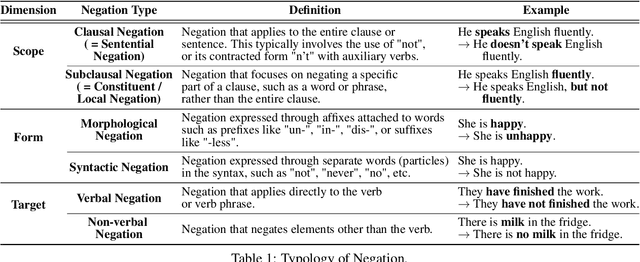
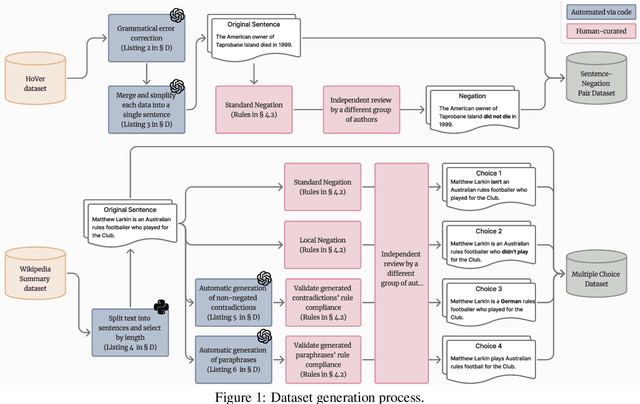
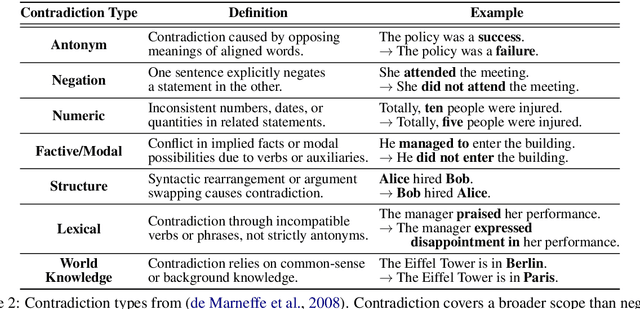
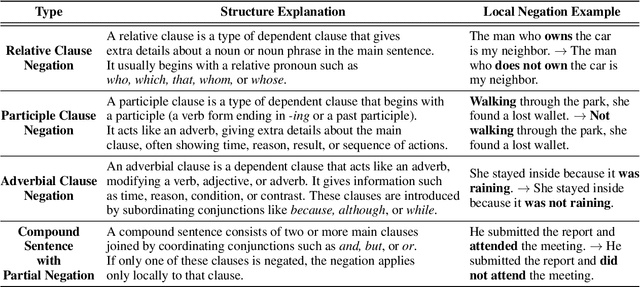
Negation is a fundamental linguistic phenomenon that poses persistent challenges for Large Language Models (LLMs), particularly in tasks requiring deep semantic understanding. Existing benchmarks often treat negation as a side case within broader tasks like natural language inference, resulting in a lack of benchmarks that exclusively target negation understanding. In this work, we introduce Thunder-NUBench, a novel benchmark explicitly designed to assess sentence-level negation understanding in LLMs. Thunder-NUBench goes beyond surface-level cue detection by contrasting standard negation with structurally diverse alternatives such as local negation, contradiction, and paraphrase. The benchmark consists of manually curated sentence-negation pairs and a multiple-choice dataset that enables in-depth evaluation of models' negation understanding.
Thunder-DeID: Accurate and Efficient De-identification Framework for Korean Court Judgments
Jun 18, 2025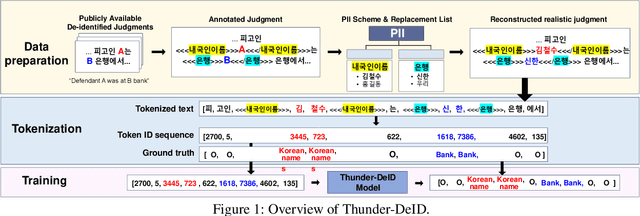
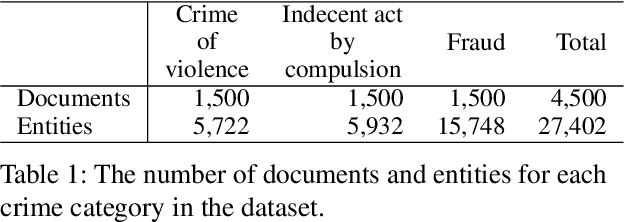
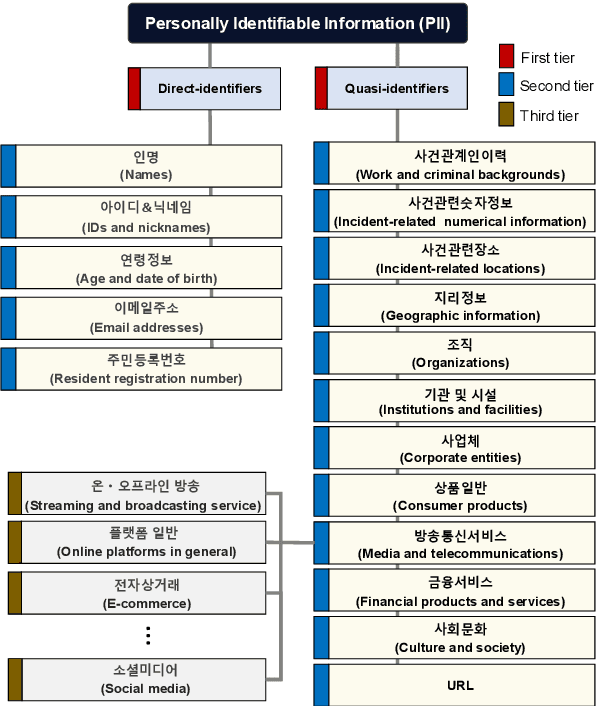
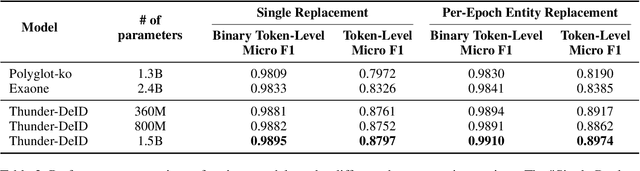
To ensure a balance between open access to justice and personal data protection, the South Korean judiciary mandates the de-identification of court judgments before they can be publicly disclosed. However, the current de-identification process is inadequate for handling court judgments at scale while adhering to strict legal requirements. Additionally, the legal definitions and categorizations of personal identifiers are vague and not well-suited for technical solutions. To tackle these challenges, we propose a de-identification framework called Thunder-DeID, which aligns with relevant laws and practices. Specifically, we (i) construct and release the first Korean legal dataset containing annotated judgments along with corresponding lists of entity mentions, (ii) introduce a systematic categorization of Personally Identifiable Information (PII), and (iii) develop an end-to-end deep neural network (DNN)-based de-identification pipeline. Our experimental results demonstrate that our model achieves state-of-the-art performance in the de-identification of court judgments.
Thunder-Tok: Minimizing Tokens per Word in Tokenizing Korean Texts for Generative Language Models
Jun 18, 2025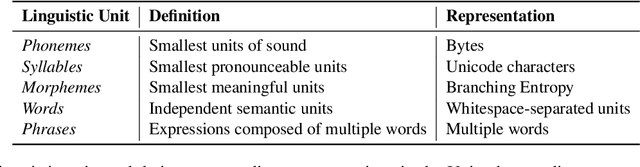
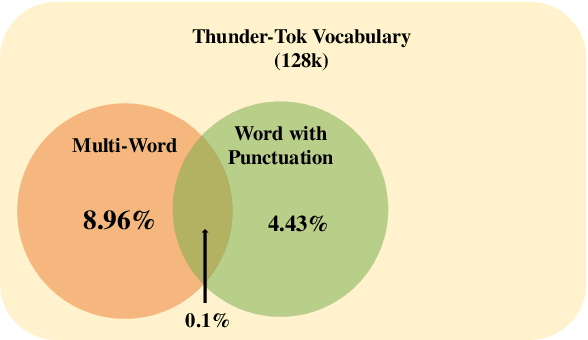
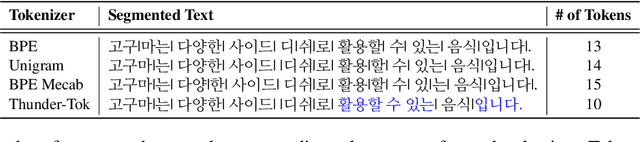
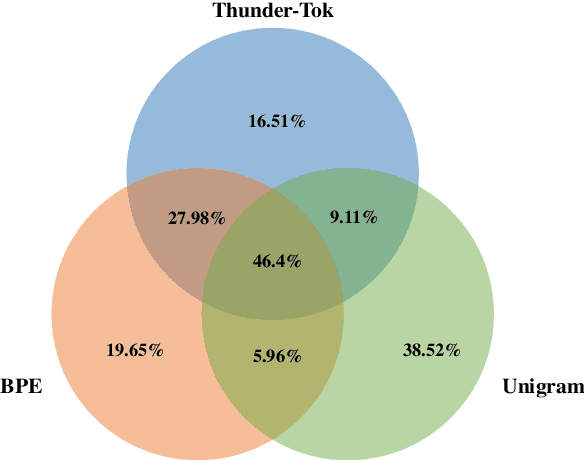
This paper introduces Thunder-Tok, a new Korean tokenizer designed to reduce token fertility without compromising model performance. Our approach uses a rule-based pre-tokenization method that aligns with the linguistic structure of the Korean language. We also create a seed vocabulary containing tokens that resemble linguistic units and employ a branching entropy-based selection algorithm. These techniques increase the average token length, thus lowering fertility while preserving linguistic information. Experimental results indicate that Thunder-Tok reduces fertility by approximately 10% (i.e., reduces the number of tokens by 10%, improving the inference speed by 10%) compared to BPE without compromising performance across various downstream tasks. These findings demonstrate that our linguistically informed approach is effective and practical for designing efficient tokenizers for language models.
ANPMI: Assessing the True Comprehension Capabilities of LLMs for Multiple Choice Questions
Feb 26, 2025Multiple-choice benchmarks, consisting of various prompts and choices, are among the most widely used methods to assess a language model's natural language understanding capability. Given a specific prompt, we typically compute $P(Choice|Prompt)$ to evaluate how likely a language model is to generate the correct choice compared to incorrect ones. However, we observe that performance measured using this approach reflects not only the model's comprehension of the prompt but also its inherent biases for certain choices regardless of the prompt. This issue makes it challenging to accurately measure a model's natural language understanding, as models may select the answer without fully understanding the prompt. To address this limitation, we propose a novel metric called ANPMI, which normalizes Pointwise Mutual Information (PMI) by $-\log P(Choice)$. ANPMI provides a more accurate assessment of the model's natural language understanding by ensuring that it is challenging to answer a question without properly understanding the prompt.