 Add to Chrome
 Add to Firefox
 Add to Edge
Polar: A Benchmark for Evaluating Political Bias in LLMs
Jun 11, 2026
Political bias in large language models (LLMs) is increasingly significant, but difficult to measure reproducibly across political and linguistic contexts. We introduce Polar, a 4,026-instance multiple-choice benchmark that measures political bias through option-level likelihoods rather than prompt-based generation. Polar covers two ideological axes and eight issue categories derived from the Manifesto Project, and evaluates models in parallel across U.S. and South Korean political contexts. Across 38 LLMs, measured bias varies systematically with political context, issue category, model group, and presentation language. All models lean left-progressive on U.S. political content, but show more centered and mixed patterns on South Korean content. Translation experiments further show that presentation language alone can shift measured bias. These findings highlight the need for multilingual and cross-contextual evaluation of political bias in LLMs.

Personal Visual Context Learning in Large Multimodal Models
May 11, 2026As wearable devices like smart glasses integrate Large Multimodal Models (LMMs) into the continuous first-person visual streams of individual users, the evolution of these models into true personal assistants hinges on visual personalization: the ability to reason over visual information unique to the wearer. We formalize this capability as Personal Visual Context Learning (Personal VCL), the prompt-time capability of using user-specific visual context to resolve personalized queries. To systematically evaluate this, we present Personal-VCL-Bench, a comprehensive benchmark capturing the personal visual world across persons, objects, and behaviors. Our analysis of frontier LMMs identifies a profound context utilization gap, revealing that the mechanisms for leveraging visual evidence, as well as aggregating multiple visual observations, remain critically understudied. Motivated by these findings, we propose the Agentic Context Bank, a strong inference-time baseline that structures a user's visual context into a self-refining memory bank and employs query-adaptive evidence selection. Our baseline approach consistently improves over standard context prompting regimes across tasks and evaluated backbones, demonstrating a practical path towards future personalized LMMs.
Optimal Power Allocation and Sub-Optimal Channel Assignment for Downlink NOMA Systems Using Deep Reinforcement Learning
Jan 18, 2026In recent years, Non-Orthogonal Multiple Access (NOMA) system has emerged as a promising candidate for multiple access frameworks due to the evolution of deep machine learning, trying to incorporate deep machine learning into the NOMA system. The main motivation for such active studies is the growing need to optimize the utilization of network resources as the expansion of the internet of things (IoT) caused a scarcity of network resources. The NOMA addresses this need by power multiplexing, allowing multiple users to access the network simultaneously. Nevertheless, the NOMA system has few limitations. Several works have proposed to mitigate this, including the optimization of power allocation known as joint resource allocation(JRA) method, and integration of the JRA method and deep reinforcement learning (JRA-DRL). Despite this, the channel assignment problem remains unclear and requires further investigation. In this paper, we propose a deep reinforcement learning framework incorporating replay memory with an on-policy algorithm, allocating network resources in a NOMA system to generalize the learning. Also, we provide extensive simulations to evaluate the effects of varying the learning rate, batch size, type of model, and the number of features in the state.
Thunder-KoNUBench: A Corpus-Aligned Benchmark for Korean Negation Understanding
Jan 08, 2026Although negation is known to challenge large language models (LLMs), benchmarks for evaluating negation understanding, especially in Korean, are scarce. We conduct a corpus-based analysis of Korean negation and show that LLM performance degrades under negation. We then introduce Thunder-KoNUBench, a sentence-level benchmark that reflects the empirical distribution of Korean negation phenomena. Evaluating 47 LLMs, we analyze the effects of model size and instruction tuning, and show that fine-tuning on Thunder-KoNUBench improves negation understanding and broader contextual comprehension in Korean.
Thunder-NUBench: A Benchmark for LLMs' Sentence-Level Negation Understanding
Jun 18, 2025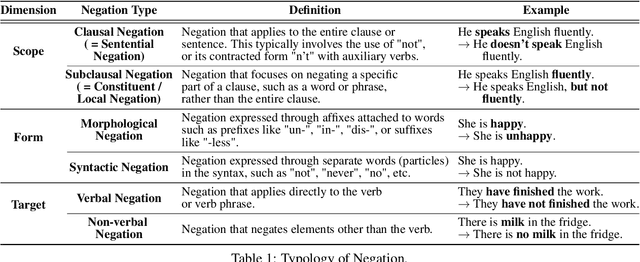
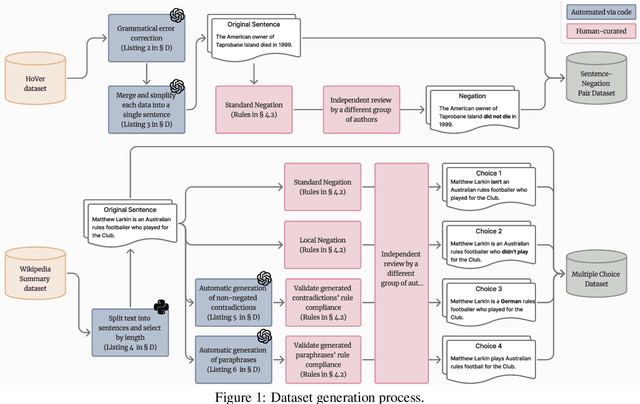
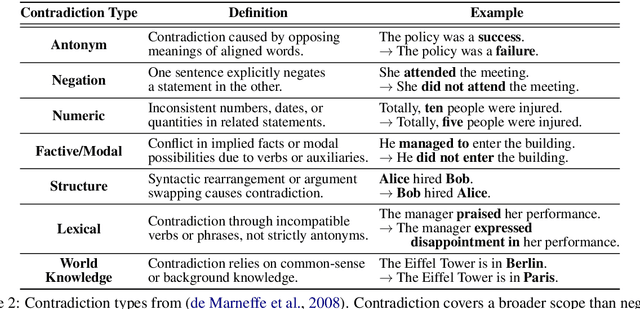
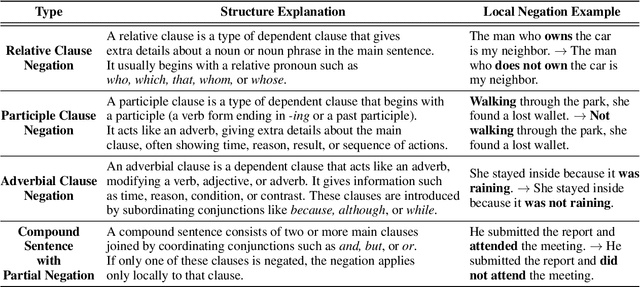
Negation is a fundamental linguistic phenomenon that poses persistent challenges for Large Language Models (LLMs), particularly in tasks requiring deep semantic understanding. Existing benchmarks often treat negation as a side case within broader tasks like natural language inference, resulting in a lack of benchmarks that exclusively target negation understanding. In this work, we introduce Thunder-NUBench, a novel benchmark explicitly designed to assess sentence-level negation understanding in LLMs. Thunder-NUBench goes beyond surface-level cue detection by contrasting standard negation with structurally diverse alternatives such as local negation, contradiction, and paraphrase. The benchmark consists of manually curated sentence-negation pairs and a multiple-choice dataset that enables in-depth evaluation of models' negation understanding.