 Add to Chrome
 Add to Firefox
 Add to Edge
Models Know Models Best: Evaluation via Model-Preferred Formats
Jan 30, 2026
Performance of Large Language Models (LLMs) on multiple-choice tasks differs markedly between symbol-based and cloze-style evaluation formats. The observed discrepancies are systematically attributable to task characteristics: natural language continuation benefits from likelihood scoring, whereas explicit comparison is better suited to symbol-based selection. These trends are consistent across various decoder-based LLMs, indicating model-agnostic effects. To address these inconsistencies, a dynamic format-alignment strategy is introduced that employs a lightweight classifier trained on latent model-preference signals. In contrast to human-designed heuristics, which often degrade performance, this approach uses model-generated signals to determine the optimal format for each problem instance. The proposed method achieves substantial and consistent improvements in zero-shot accuracy across reasoning and knowledge benchmarks, better revealing the models' latent capabilities.

Thunder-KoNUBench: A Corpus-Aligned Benchmark for Korean Negation Understanding
Jan 08, 2026Although negation is known to challenge large language models (LLMs), benchmarks for evaluating negation understanding, especially in Korean, are scarce. We conduct a corpus-based analysis of Korean negation and show that LLM performance degrades under negation. We then introduce Thunder-KoNUBench, a sentence-level benchmark that reflects the empirical distribution of Korean negation phenomena. Evaluating 47 LLMs, we analyze the effects of model size and instruction tuning, and show that fine-tuning on Thunder-KoNUBench improves negation understanding and broader contextual comprehension in Korean.
Thunder-NUBench: A Benchmark for LLMs' Sentence-Level Negation Understanding
Jun 18, 2025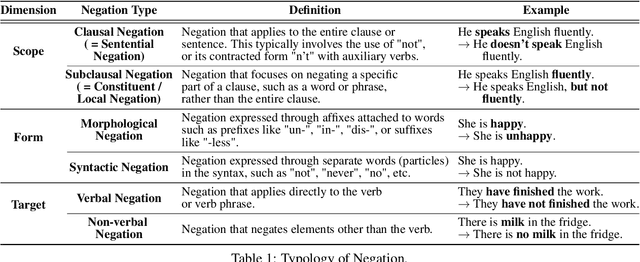
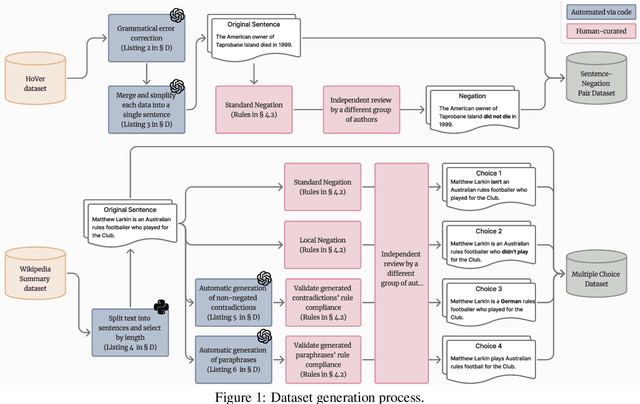
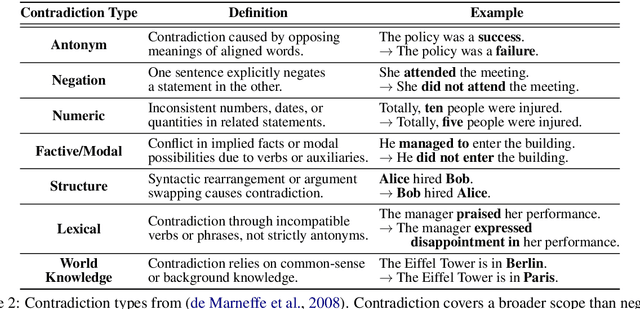
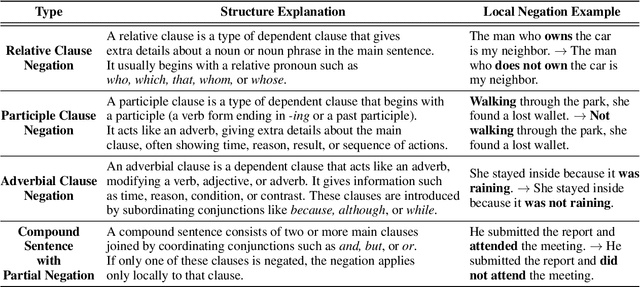
Negation is a fundamental linguistic phenomenon that poses persistent challenges for Large Language Models (LLMs), particularly in tasks requiring deep semantic understanding. Existing benchmarks often treat negation as a side case within broader tasks like natural language inference, resulting in a lack of benchmarks that exclusively target negation understanding. In this work, we introduce Thunder-NUBench, a novel benchmark explicitly designed to assess sentence-level negation understanding in LLMs. Thunder-NUBench goes beyond surface-level cue detection by contrasting standard negation with structurally diverse alternatives such as local negation, contradiction, and paraphrase. The benchmark consists of manually curated sentence-negation pairs and a multiple-choice dataset that enables in-depth evaluation of models' negation understanding.