 Add to Chrome
 Add to Firefox
 Add to Edge
Position: It's Time to Optimize LLMs for Self-Consistency
Jul 31, 2026
Despite ever-increasing sophistication in language model (LM) pre- and post-training pipelines, many important failures persist: models overcondition on user framing ("sycophancy"), exhibit incomplete logical generalization, and produce confident but incorrect responses. We argue that these failures arise from a modeling assumption permeating all aspects of the pipeline: that behavior can be specified and evaluated independently on single-output pairs. Many model failures are difficult, if not impossible, to detect without reasoning about relationships between a model's responses across inputs. In this position paper, we propose self-consistency as a framework for understanding these failures. We first observe that a wide variety of techniques designed to improve specific aspects of LM behavior-targeting properties as diverse as adversarial robustness and factual coherence-can be understood as special cases of a common "consistency optimization" procedure and addressed with a standard set of optimization tools. We next outline a set of new model properties that could be achieved by optimizing for consistency, and conclude with a discussion of what it would mean to develop generally consistent LMs, including the capabilities they would enable and the objections they raise.

Self-CTRL: Self-Consistency Training with Reinforcement Learning
Jun 16, 2026Language models (LMs) that faithfully describe their own behavior can more easily be audited, understood, and trusted by users. This paper describes Self-Consistency Training with Reinforcement Learning (Self-CTRL), a method that optimizes for consistency between a LM's self-explanations and behavior on related inputs by updating explanations to better predict behavior or updating behavior to better match explanations. We apply our method in two domains. First, we study a formal probabilistic reasoning task in which LMs must learn to imitate a family of biased samplers and evaluated on their ability to report the associated biases. We find that consistency training improves the correlation between self-reported and behaviorally-measured latent biases from $R^2=0.24$ to $R^2=0.64$ on a set of held-out distributions, matching the generalization of direct ground-truth supervision. Second, we study a constitutional AI domain in which LMs must describe when they will refuse or comply with user requests. Here, Self-CTRL produces rules that faithfully describe the model's behavior on held-out requests, improving the refusal predictions of a third-party auditor model from $36\%$ to $92\%$. In the other direction, behavior updates improve alignment, reducing HarmBench failure rate from $15.0\%$ to $0.5\%$ without substantially increasing refusal on harmless prompts. By aligning explanations and behavior, our work provides a general recipe for training AI models to be safer, more transparent, and more controllable.
Competition Dynamics Shape Algorithmic Phases of In-Context Learning
Dec 01, 2024


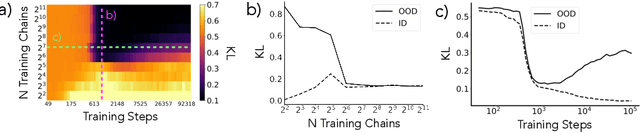
In-Context Learning (ICL) has significantly expanded the general-purpose nature of large language models, allowing them to adapt to novel tasks using merely the inputted context. This has motivated a series of papers that analyze tractable synthetic domains and postulate precise mechanisms that may underlie ICL. However, the use of relatively distinct setups that often lack a sequence modeling nature to them makes it unclear how general the reported insights from such studies are. Motivated by this, we propose a synthetic sequence modeling task that involves learning to simulate a finite mixture of Markov chains. As we show, models trained on this task reproduce most well-known results on ICL, hence offering a unified setting for studying the concept. Building on this setup, we demonstrate we can explain a model's behavior by decomposing it into four broad algorithms that combine a fuzzy retrieval vs. inference approach with either unigram or bigram statistics of the context. These algorithms engage in a competition dynamics to dominate model behavior, with the precise experimental conditions dictating which algorithm ends up superseding others: e.g., we find merely varying context size or amount of training yields (at times sharp) transitions between which algorithm dictates the model behavior, revealing a mechanism that explains the transient nature of ICL. In this sense, we argue ICL is best thought of as a mixture of different algorithms, each with its own peculiarities, instead of a monolithic capability. This also implies that making general claims about ICL that hold universally across all settings may be infeasible.
Towards Reliable Evaluation of Behavior Steering Interventions in LLMs
Oct 22, 2024Representation engineering methods have recently shown promise for enabling efficient steering of model behavior. However, evaluation pipelines for these methods have primarily relied on subjective demonstrations, instead of quantitative, objective metrics. We aim to take a step towards addressing this issue by advocating for four properties missing from current evaluations: (i) contexts sufficiently similar to downstream tasks should be used for assessing intervention quality; (ii) model likelihoods should be accounted for; (iii) evaluations should allow for standardized comparisons across different target behaviors; and (iv) baseline comparisons should be offered. We introduce an evaluation pipeline grounded in these criteria, offering both a quantitative and visual analysis of how effectively a given method works. We use this pipeline to evaluate two representation engineering methods on how effectively they can steer behaviors such as truthfulness and corrigibility, finding that some interventions are less effective than previously reported.
A Mechanistic Understanding of Alignment Algorithms: A Case Study on DPO and Toxicity
Jan 03, 2024
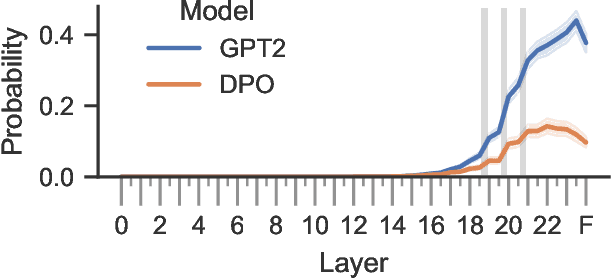
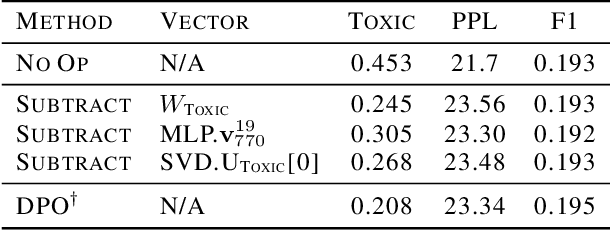

While alignment algorithms are now commonly used to tune pre-trained language models towards a user's preferences, we lack explanations for the underlying mechanisms in which models become ``aligned'', thus making it difficult to explain phenomena like jailbreaks. In this work we study a popular algorithm, direct preference optimization (DPO), and the mechanisms by which it reduces toxicity. Namely, we first study how toxicity is represented and elicited in a pre-trained language model, GPT2-medium. We then apply DPO with a carefully crafted pairwise dataset to reduce toxicity. We examine how the resulting model averts toxic outputs, and find that capabilities learned from pre-training are not removed, but rather bypassed. We use this insight to demonstrate a simple method to un-align the model, reverting it back to its toxic behavior.