 Add to Chrome
 Add to Firefox
 Add to Edge
Decision-Making with Deliberation: Meta-reviewing as a Document-grounded Dialogue
Aug 07, 2025
Meta-reviewing is a pivotal stage in the peer-review process, serving as the final step in determining whether a paper is recommended for acceptance. Prior research on meta-reviewing has treated this as a summarization problem over review reports. However, complementary to this perspective, meta-reviewing is a decision-making process that requires weighing reviewer arguments and placing them within a broader context. Prior research has demonstrated that decision-makers can be effectively assisted in such scenarios via dialogue agents. In line with this framing, we explore the practical challenges for realizing dialog agents that can effectively assist meta-reviewers. Concretely, we first address the issue of data scarcity for training dialogue agents by generating synthetic data using Large Language Models (LLMs) based on a self-refinement strategy to improve the relevance of these dialogues to expert domains. Our experiments demonstrate that this method produces higher-quality synthetic data and can serve as a valuable resource towards training meta-reviewing assistants. Subsequently, we utilize this data to train dialogue agents tailored for meta-reviewing and find that these agents outperform \emph{off-the-shelf} LLM-based assistants for this task. Finally, we apply our agents in real-world meta-reviewing scenarios and confirm their effectiveness in enhancing the efficiency of meta-reviewing.\footnote{Code and Data: https://github.com/UKPLab/arxiv2025-meta-review-as-dialog

SPARE: Single-Pass Annotation with Reference-Guided Evaluation for Automatic Process Supervision and Reward Modelling
Jun 18, 2025Process or step-wise supervision has played a crucial role in advancing complex multi-step reasoning capabilities of Large Language Models (LLMs). However, efficient, high-quality automated process annotation remains a significant challenge. To address this, we introduce Single-Pass Annotation with Reference-Guided Evaluation (SPARE), a novel structured framework that enables single-pass, per-step annotation by aligning each solution step to one or multiple steps in a reference solution, accompanied by explicit reasoning for evaluation. We show that reference-guided step-level evaluation effectively facilitates process supervision on four datasets spanning three domains: mathematical reasoning, multi-hop compositional question answering, and spatial reasoning. We demonstrate that SPARE, when compared to baselines, improves reasoning performance when used for: (1) fine-tuning models in an offline RL setup for inference-time greedy-decoding, and (2) training reward models for ranking/aggregating multiple LLM-generated outputs. Additionally, SPARE achieves competitive performance on challenging mathematical datasets while offering 2.6 times greater efficiency, requiring only 38% of the runtime, compared to tree search-based automatic annotation. The codebase, along with a trained SPARE-PRM model, is publicly released to facilitate further research and reproducibility.
Factual Self-Awareness in Language Models: Representation, Robustness, and Scaling
May 27, 2025Factual incorrectness in generated content is one of the primary concerns in ubiquitous deployment of large language models (LLMs). Prior findings suggest LLMs can (sometimes) detect factual incorrectness in their generated content (i.e., fact-checking post-generation). In this work, we provide evidence supporting the presence of LLMs' internal compass that dictate the correctness of factual recall at the time of generation. We demonstrate that for a given subject entity and a relation, LLMs internally encode linear features in the Transformer's residual stream that dictate whether it will be able to recall the correct attribute (that forms a valid entity-relation-attribute triplet). This self-awareness signal is robust to minor formatting variations. We investigate the effects of context perturbation via different example selection strategies. Scaling experiments across model sizes and training dynamics highlight that self-awareness emerges rapidly during training and peaks in intermediate layers. These findings uncover intrinsic self-monitoring capabilities within LLMs, contributing to their interpretability and reliability.
Community Moderation and the New Epistemology of Fact Checking on Social Media
May 26, 2025Social media platforms have traditionally relied on internal moderation teams and partnerships with independent fact-checking organizations to identify and flag misleading content. Recently, however, platforms including X (formerly Twitter) and Meta have shifted towards community-driven content moderation by launching their own versions of crowd-sourced fact-checking -- Community Notes. If effectively scaled and governed, such crowd-checking initiatives have the potential to combat misinformation with increased scale and speed as successfully as community-driven efforts once did with spam. Nevertheless, general content moderation, especially for misinformation, is inherently more complex. Public perceptions of truth are often shaped by personal biases, political leanings, and cultural contexts, complicating consensus on what constitutes misleading content. This suggests that community efforts, while valuable, cannot replace the indispensable role of professional fact-checkers. Here we systemically examine the current approaches to misinformation detection across major platforms, explore the emerging role of community-driven moderation, and critically evaluate both the promises and challenges of crowd-checking at scale.
From Surveys to Narratives: Rethinking Cultural Value Adaptation in LLMs
May 22, 2025Adapting cultural values in Large Language Models (LLMs) presents significant challenges, particularly due to biases and limited training data. Prior work primarily aligns LLMs with different cultural values using World Values Survey (WVS) data. However, it remains unclear whether this approach effectively captures cultural nuances or produces distinct cultural representations for various downstream tasks. In this paper, we systematically investigate WVS-based training for cultural value adaptation and find that relying solely on survey data can homogenize cultural norms and interfere with factual knowledge. To investigate these issues, we augment WVS with encyclopedic and scenario-based cultural narratives from Wikipedia and NormAd. While these narratives may have variable effects on downstream tasks, they consistently improve cultural distinctiveness than survey data alone. Our work highlights the inherent complexity of aligning cultural values with the goal of guiding task-specific behavior.
From Problem-Solving to Teaching Problem-Solving: Aligning LLMs with Pedagogy using Reinforcement Learning
May 21, 2025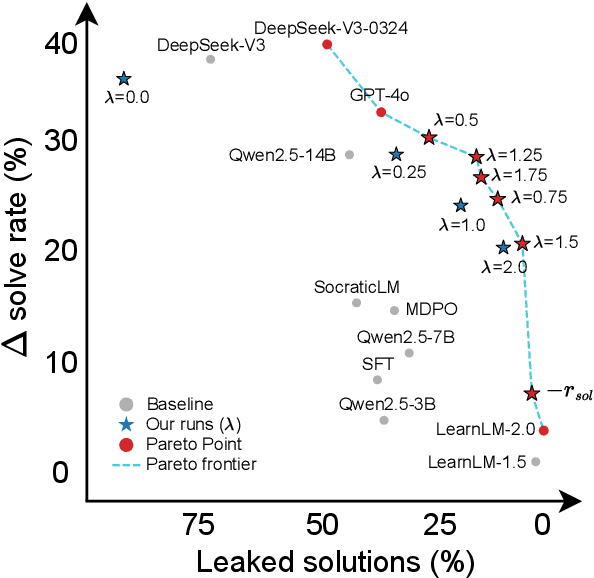
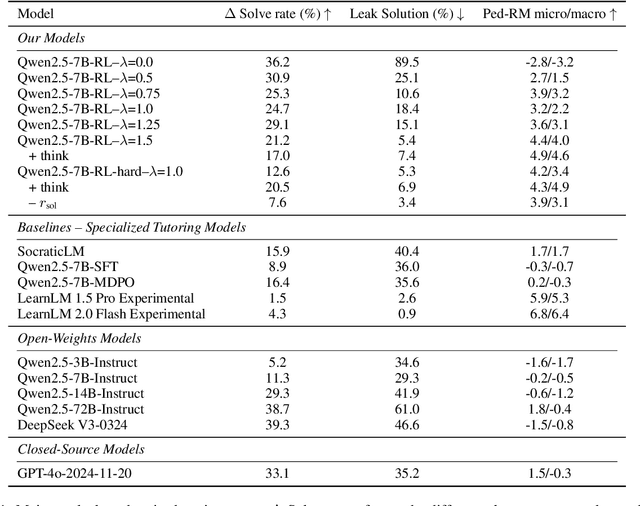
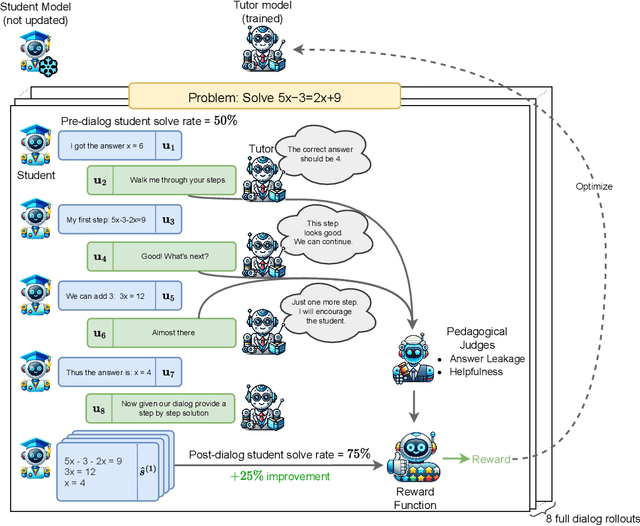
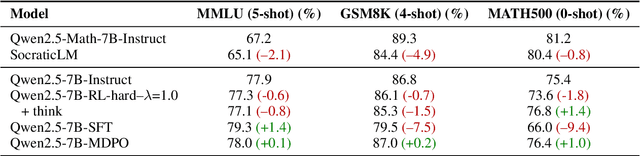
Large language models (LLMs) can transform education, but their optimization for direct question-answering often undermines effective pedagogy which requires strategically withholding answers. To mitigate this, we propose an online reinforcement learning (RL)-based alignment framework that can quickly adapt LLMs into effective tutors using simulated student-tutor interactions by emphasizing pedagogical quality and guided problem-solving over simply giving away answers. We use our method to train a 7B parameter tutor model without human annotations which reaches similar performance to larger proprietary models like LearnLM. We introduce a controllable reward weighting to balance pedagogical support and student solving accuracy, allowing us to trace the Pareto frontier between these two objectives. Our models better preserve reasoning capabilities than single-turn SFT baselines and can optionally enhance interpretability through thinking tags that expose the model's instructional planning.
In-depth Research Impact Summarization through Fine-Grained Temporal Citation Analysis
May 20, 2025Understanding the impact of scientific publications is crucial for identifying breakthroughs and guiding future research. Traditional metrics based on citation counts often miss the nuanced ways a paper contributes to its field. In this work, we propose a new task: generating nuanced, expressive, and time-aware impact summaries that capture both praise (confirmation citations) and critique (correction citations) through the evolution of fine-grained citation intents. We introduce an evaluation framework tailored to this task, showing moderate to strong human correlation on subjective metrics such as insightfulness. Expert feedback from professors reveals a strong interest in these summaries and suggests future improvements.
Illusion or Algorithm? Investigating Memorization, Emergence, and Symbolic Processing in In-Context Learning
May 16, 2025Large-scale Transformer language models (LMs) trained solely on next-token prediction with web-scale data can solve a wide range of tasks after seeing just a few examples. The mechanism behind this capability, known as in-context learning (ICL), remains both controversial and poorly understood. Some studies argue that it is merely the result of memorizing vast amounts of data, while others contend that it reflects a fundamental, symbolic algorithmic development in LMs. In this work, we introduce a suite of investigative tasks and a novel method to systematically investigate ICL by leveraging the full Pythia scaling suite, including interim checkpoints that capture progressively larger amount of training data. By carefully exploring ICL performance on downstream tasks and simultaneously conducting a mechanistic analysis of the residual stream's subspace, we demonstrate that ICL extends beyond mere "memorization" of the training corpus, yet does not amount to the implementation of an independent symbolic algorithm. Our results also clarify several aspects of ICL, including the influence of training dynamics, model capabilities, and elements of mechanistic interpretability. Overall, our work advances the understanding of ICL and its implications, offering model developers insights into potential improvements and providing AI security practitioners with a basis for more informed guidelines.
NeoQA: Evidence-based Question Answering with Generated News Events
May 09, 2025Evaluating Retrieval-Augmented Generation (RAG) in large language models (LLMs) is challenging because benchmarks can quickly become stale. Questions initially requiring retrieval may become answerable from pretraining knowledge as newer models incorporate more recent information during pretraining, making it difficult to distinguish evidence-based reasoning from recall. We introduce NeoQA (News Events for Out-of-training Question Answering), a benchmark designed to address this issue. To construct NeoQA, we generated timelines and knowledge bases of fictional news events and entities along with news articles and Q\&A pairs to prevent LLMs from leveraging pretraining knowledge, ensuring that no prior evidence exists in their training data. We propose our dataset as a new platform for evaluating evidence-based question answering, as it requires LLMs to generate responses exclusively from retrieved evidence and only when sufficient evidence is available. NeoQA enables controlled evaluation across various evidence scenarios, including cases with missing or misleading details. Our findings indicate that LLMs struggle to distinguish subtle mismatches between questions and evidence, and suffer from short-cut reasoning when key information required to answer a question is missing from the evidence, underscoring key limitations in evidence-based reasoning.
LazyReview A Dataset for Uncovering Lazy Thinking in NLP Peer Reviews
Apr 15, 2025Peer review is a cornerstone of quality control in scientific publishing. With the increasing workload, the unintended use of `quick' heuristics, referred to as lazy thinking, has emerged as a recurring issue compromising review quality. Automated methods to detect such heuristics can help improve the peer-reviewing process. However, there is limited NLP research on this issue, and no real-world dataset exists to support the development of detection tools. This work introduces LazyReview, a dataset of peer-review sentences annotated with fine-grained lazy thinking categories. Our analysis reveals that Large Language Models (LLMs) struggle to detect these instances in a zero-shot setting. However, instruction-based fine-tuning on our dataset significantly boosts performance by 10-20 performance points, highlighting the importance of high-quality training data. Furthermore, a controlled experiment demonstrates that reviews revised with lazy thinking feedback are more comprehensive and actionable than those written without such feedback. We will release our dataset and the enhanced guidelines that can be used to train junior reviewers in the community. (Code available here: https://github.com/UKPLab/arxiv2025-lazy-review)