 Add to Chrome
 Add to Firefox
 Add to Edge
Retrieving and Refining Winning Noise Tickets for Diffusion-Based Motion Generation
Jul 07, 2026
Diffusion-based text-to-motion models synthesize realistic human motions but often exhibit semantic drift from the input text. Motion is inherently temporal, especially in compositional and long-duration sequences that require semantic consistency across multiple action segments and smooth kinematic transitions throughout the trajectory. We posit that the initial noise is central to this consistency: within the Gaussian noise space, certain instances, i.e. winning noise tickets, carry latent structure that biases denoising toward particular motion semantics, even under null prompts. We propose WInning Noise Retrieval and Optimization (WINRO), a training-free, model-agnostic framework that improves text-motion alignment by selecting and refining such tickets before diffusion sampling. WINRO maps random noises to motion features generated under null prompts, retrieves the best-aligned noise for a given text, and refines it via a KL-regularized objective that reduces the residual semantic gap while preserving the Gaussian prior. An optional LoRA-based adapter amortizes this refinement into a single forward pass. WINRO consistently improves text-motion fidelity across different base models, MDM and MotionLCM, on HumanML3D without retraining, improves temporal robustness on the MTT benchmark, and generalizes to applications such as motion stylization and spatial constraint satisfaction.

What-Where Transformer: A Slot-Centric Visual Backbone for Concurrent Representation and Localization
May 12, 2026Many image understanding tasks involve identifying what is present and where it appears. However, tasks that address where, such as object discovery, detection, and segmentation, are often considerably more complex than image classification, which primarily focuses on what. One possible reason is that classification-oriented backbones tend to emphasize semantic information about what, while implicitly entangling or suppressing information about where. In this work, we focus on an inductive bias termed what-where separation, which encourages models to represent object appearance and spatial location in a decomposed manner. To incorporate this bias throughout an attentive backbone in the style of Vision Transformer (ViT), we propose the What-Where Transformer (WWT). Our method introduces two key novel designs: (1) it treats tokens as representations of what and attention maps as representations of where, and processes them in concurrent feed-forward modules via a multi-stream, slot-based architecture; (2) it reuses both the final-layer tokens and attention maps for downstream tasks, and directly exposes them to gradients derived from task losses, thereby facilitating more effective and explicit learning of localization. We demonstrate that even under standard single-label classification-based supervision on ImageNet, WWT exhibits emergent multiple object discovery directly from raw attention maps, rather than via additional postprocessing such as token clustering. Furthermore, WWT achieves superior performance compared to ViT-based methods on zero-shot object discovery and weakly supervised semantic segmentation, and it is transferable to various localization setups with minimal modifications. Code will be published after acceptance.
Teacher-Guided Routing for Sparse Vision Mixture-of-Experts
Apr 23, 2026Recent progress in deep learning has been driven by increasingly large-scale models, but the resulting computational cost has become a critical bottleneck. Sparse Mixture of Experts (MoE) offers an effective solution by activating only a small subset of experts for each input, achieving high scalability without sacrificing inference speed. Although effective, sparse MoE training exhibits characteristic optimization difficulties. Because the router receives informative gradients only through the experts selected in the forward pass, it suffers from gradient blocking and obtains little information from unselected routes. This limited, highly localized feedback makes it difficult for the router to learn appropriate expert-selection scores and often leads to unstable routing dynamics, such as fluctuating expert assignments during training. To address this issue, we propose TGR-MoE: Teacher-Guided Routing for Sparse Vision Mixture-of-Experts, a simple yet effective method that stabilizes router learning using supervision derived from a pretrained dense teacher model. TGR-MoE constructs a teacher router from the teacher's intermediate representations and uses its routing outputs as pseudo-supervision for the student router, suppressing frequent routing fluctuations during training and enabling knowledge-guided expert selection from the early stages of training. Extensive experiments on ImageNet-1K and CIFAR-100 demonstrate that TGR consistently improves both accuracy and routing consistency, while maintaining stable training even under highly sparse configurations.
Takeuchi's Information Criteria as Generalization Measures for DNNs Close to NTK Regime
Feb 26, 2026Generalization measures have been studied extensively in the machine learning community to better characterize generalization gaps. However, establishing a reliable generalization measure for statistically singular models such as deep neural networks (DNNs) is difficult due to their complex nature. This study focuses on Takeuchi's information criterion (TIC) to investigate the conditions under which this classical measure can effectively explain the generalization gaps of DNNs. Importantly, the developed theory indicates the applicability of TIC near the neural tangent kernel (NTK) regime. In a series of experiments, we trained more than 5,000 DNN models with 12 architectures, including large models (e.g., VGG-16), on four datasets, and estimated the corresponding TIC values to examine the relationship between the generalization gap and the TIC estimates. We applied several TIC approximation methods with feasible computational costs and assessed the accuracy trade-off. Our experimental results indicate that the estimated TIC values correlate well with the generalization gap under conditions close to the NTK regime. However, we show both theoretically and empirically that outside the NTK regime such correlation disappears. Finally, we demonstrate that TIC provides better trial pruning ability than existing methods for hyperparameter optimization.
Rectified Lagrangian for Out-of-Distribution Detection in Modern Hopfield Networks
Feb 19, 2025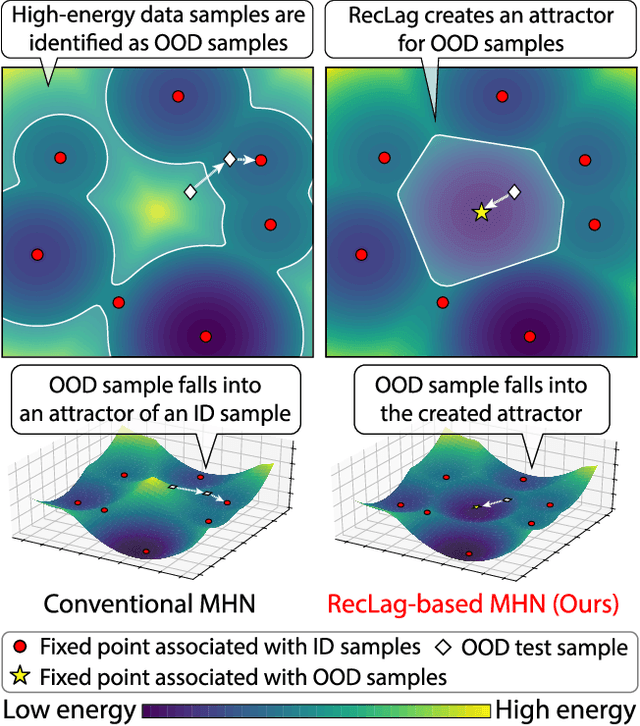
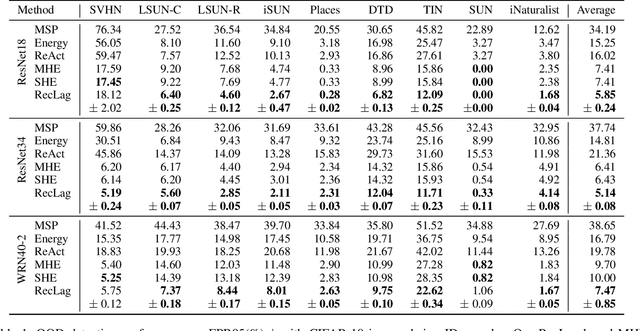
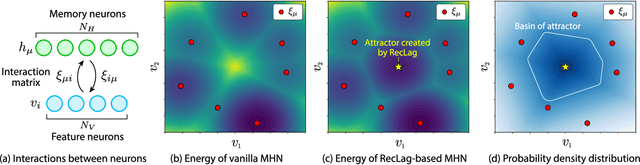
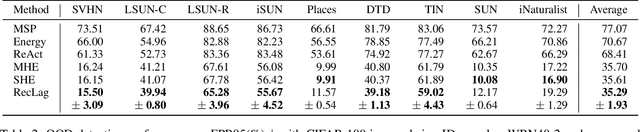
Modern Hopfield networks (MHNs) have recently gained significant attention in the field of artificial intelligence because they can store and retrieve a large set of patterns with an exponentially large memory capacity. A MHN is generally a dynamical system defined with Lagrangians of memory and feature neurons, where memories associated with in-distribution (ID) samples are represented by attractors in the feature space. One major problem in existing MHNs lies in managing out-of-distribution (OOD) samples because it was originally assumed that all samples are ID samples. To address this, we propose the rectified Lagrangian (RegLag), a new Lagrangian for memory neurons that explicitly incorporates an attractor for OOD samples in the dynamical system of MHNs. RecLag creates a trivial point attractor for any interaction matrix, enabling OOD detection by identifying samples that fall into this attractor as OOD. The interaction matrix is optimized so that the probability densities can be estimated to identify ID/OOD. We demonstrate the effectiveness of RecLag-based MHNs compared to energy-based OOD detection methods, including those using state-of-the-art Hopfield energies, across nine image datasets.
GUMBEL-NERF: Representing Unseen Objects as Part-Compositional Neural Radiance Fields
Oct 27, 2024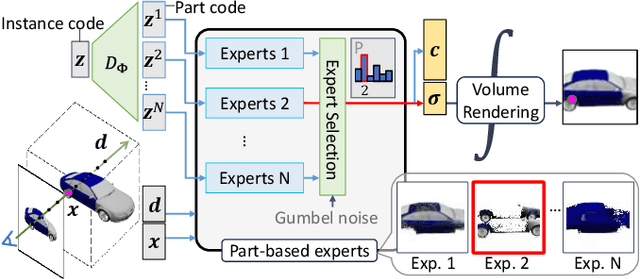
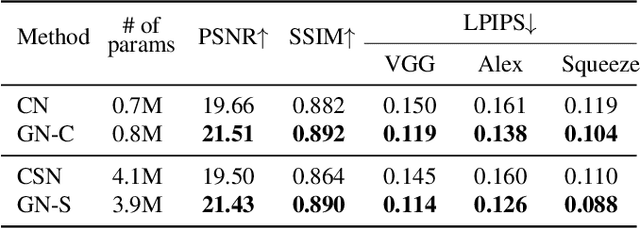
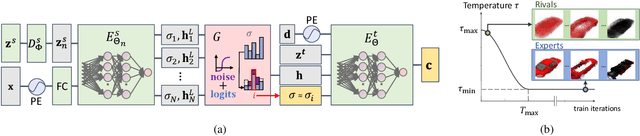
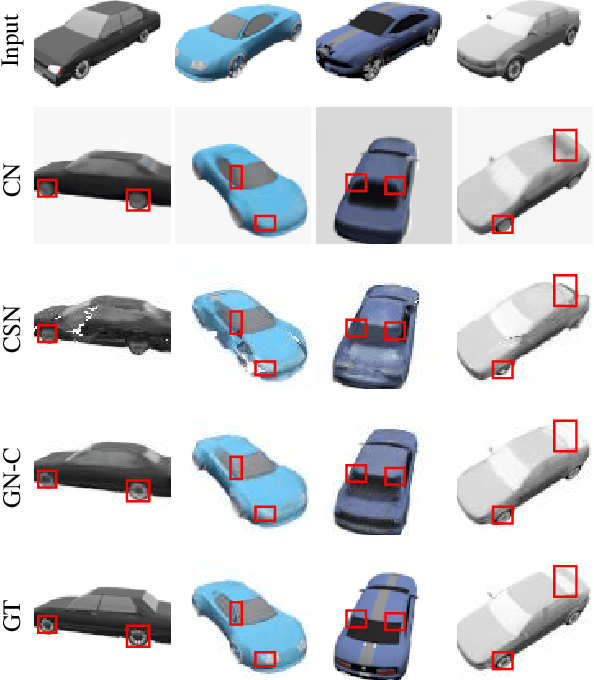
We propose Gumbel-NeRF, a mixture-of-expert (MoE) neural radiance fields (NeRF) model with a hindsight expert selection mechanism for synthesizing novel views of unseen objects. Previous studies have shown that the MoE structure provides high-quality representations of a given large-scale scene consisting of many objects. However, we observe that such a MoE NeRF model often produces low-quality representations in the vicinity of experts' boundaries when applied to the task of novel view synthesis of an unseen object from one/few-shot input. We find that this deterioration is primarily caused by the foresight expert selection mechanism, which may leave an unnatural discontinuity in the object shape near the experts' boundaries. Gumbel-NeRF adopts a hindsight expert selection mechanism, which guarantees continuity in the density field even near the experts' boundaries. Experiments using the SRN cars dataset demonstrate the superiority of Gumbel-NeRF over the baselines in terms of various image quality metrics.
Fixed-Weight Difference Target Propagation
Dec 19, 2022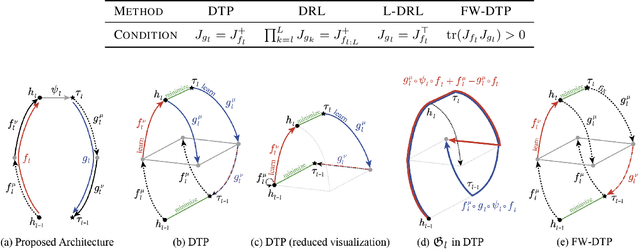
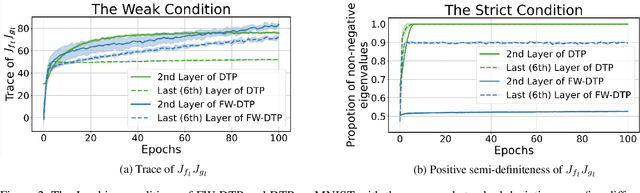
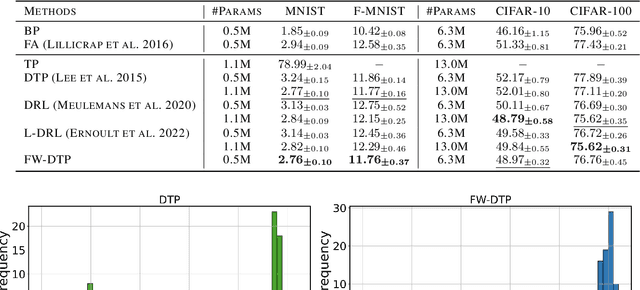
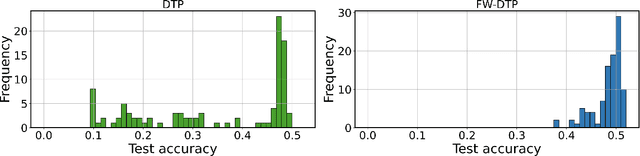
Target Propagation (TP) is a biologically more plausible algorithm than the error backpropagation (BP) to train deep networks, and improving practicality of TP is an open issue. TP methods require the feedforward and feedback networks to form layer-wise autoencoders for propagating the target values generated at the output layer. However, this causes certain drawbacks; e.g., careful hyperparameter tuning is required to synchronize the feedforward and feedback training, and frequent updates of the feedback path are usually required than that of the feedforward path. Learning of the feedforward and feedback networks is sufficient to make TP methods capable of training, but is having these layer-wise autoencoders a necessary condition for TP to work? We answer this question by presenting Fixed-Weight Difference Target Propagation (FW-DTP) that keeps the feedback weights constant during training. We confirmed that this simple method, which naturally resolves the abovementioned problems of TP, can still deliver informative target values to hidden layers for a given task; indeed, FW-DTP consistently achieves higher test performance than a baseline, the Difference Target Propagation (DTP), on four classification datasets. We also present a novel propagation architecture that explains the exact form of the feedback function of DTP to analyze FW-DTP.
Empirical Study on Optimizer Selection for Out-of-Distribution Generalization
Nov 18, 2022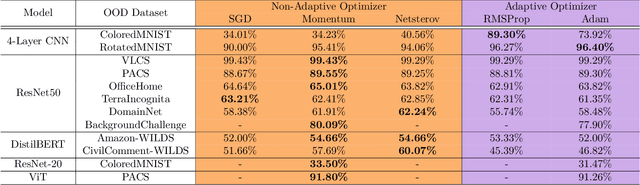


Modern deep learning systems are fragile and do not generalize well under distribution shifts. While much promising work has been accomplished to address these concerns, a systematic study of the role of optimizers and their out-of-distribution generalization performance has not been undertaken. In this study, we examine the performance of popular first-order optimizers for different classes of distributional shift under empirical risk minimization and invariant risk minimization. We address the problem settings for image and text classification using DomainBed, WILDS, and Backgrounds Challenge as out-of-distribution datasets for the exhaustive study. We search over a wide range of hyperparameters and examine the classification accuracy (in-distribution and out-of-distribution) for over 20,000 models. We arrive at the following findings: i) contrary to conventional wisdom, adaptive optimizers (e.g., Adam) perform worse than non-adaptive optimizers (e.g., SGD, momentum-based SGD), ii) in-distribution performance and out-of-distribution performance exhibit three types of behavior depending on the dataset - linear returns, increasing returns, and diminishing returns. We believe these findings can help practitioners choose the right optimizer and know what behavior to expect.
Informative Sample-Aware Proxy for Deep Metric Learning
Nov 18, 2022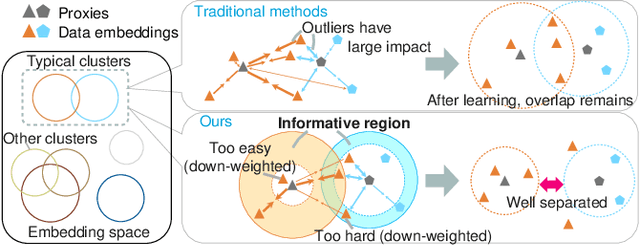
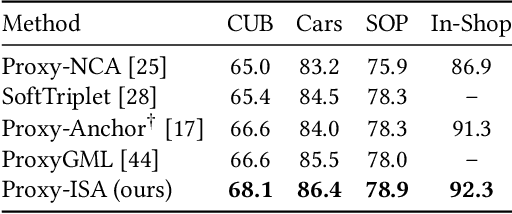
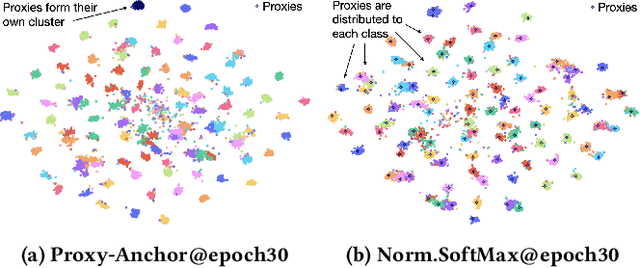
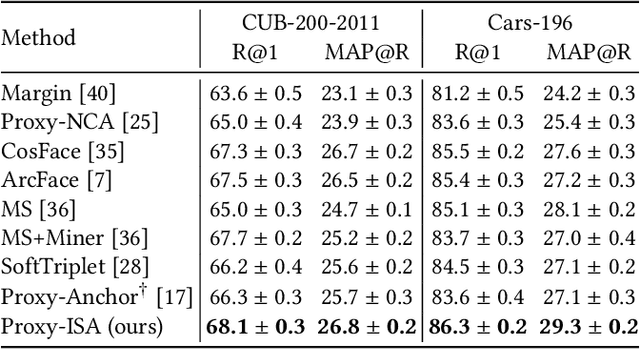
Among various supervised deep metric learning methods proxy-based approaches have achieved high retrieval accuracies. Proxies, which are class-representative points in an embedding space, receive updates based on proxy-sample similarities in a similar manner to sample representations. In existing methods, a relatively small number of samples can produce large gradient magnitudes (ie, hard samples), and a relatively large number of samples can produce small gradient magnitudes (ie, easy samples); these can play a major part in updates. Assuming that acquiring too much sensitivity to such extreme sets of samples would deteriorate the generalizability of a method, we propose a novel proxy-based method called Informative Sample-Aware Proxy (Proxy-ISA), which directly modifies a gradient weighting factor for each sample using a scheduled threshold function, so that the model is more sensitive to the informative samples. Extensive experiments on the CUB-200-2011, Cars-196, Stanford Online Products and In-shop Clothes Retrieval datasets demonstrate the superiority of Proxy-ISA compared with the state-of-the-art methods.
PoF: Post-Training of Feature Extractor for Improving Generalization
Jul 05, 2022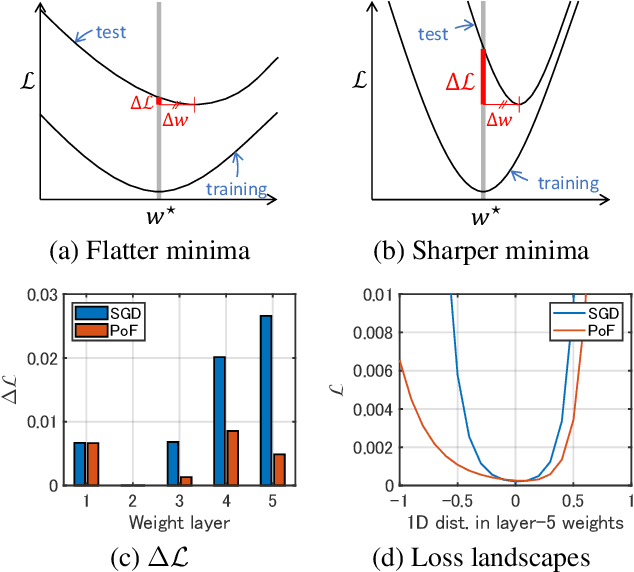
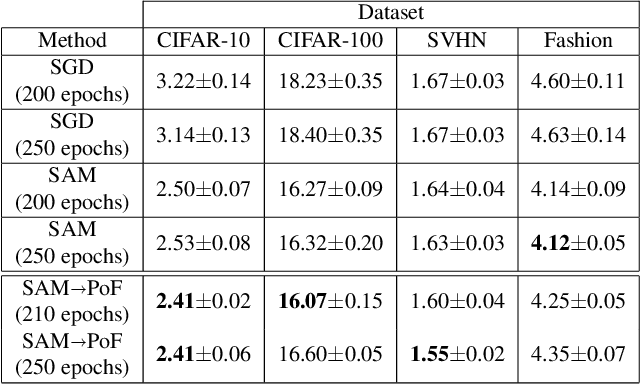
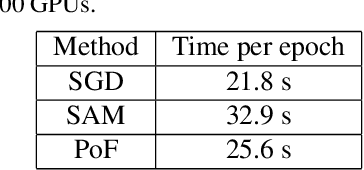
It has been intensively investigated that the local shape, especially flatness, of the loss landscape near a minimum plays an important role for generalization of deep models. We developed a training algorithm called PoF: Post-Training of Feature Extractor that updates the feature extractor part of an already-trained deep model to search a flatter minimum. The characteristics are two-fold: 1) Feature extractor is trained under parameter perturbations in the higher-layer parameter space, based on observations that suggest flattening higher-layer parameter space, and 2) the perturbation range is determined in a data-driven manner aiming to reduce a part of test loss caused by the positive loss curvature. We provide a theoretical analysis that shows the proposed algorithm implicitly reduces the target Hessian components as well as the loss. Experimental results show that PoF improved model performance against baseline methods on both CIFAR-10 and CIFAR-100 datasets for only 10-epoch post-training, and on SVHN dataset for 50-epoch post-training. Source code is available at: \url{https://github.com/DensoITLab/PoF-v1