 Add to Chrome
 Add to Firefox
 Add to Edge
When Should LLMs Be Less Specific? Selective Abstraction for Reliable Long-Form Text Generation
Feb 13, 2026
LLMs are widely used, yet they remain prone to factual errors that erode user trust and limit adoption in high-risk settings. One approach to mitigate this risk is to equip models with uncertainty estimation mechanisms that abstain when confidence is low. However, this binary "all-or-nothing" approach is excessively restrictive in long-form settings, often discarding valuable information. We introduce Selective Abstraction (SA), a framework that enables LLMs to trade specificity for reliability by selectively reducing the detail of uncertain content. We first formalize SA through the lenses of selective risk and coverage. We then propose Atom-wise Selective Abstraction, a claim-level instantiation that decomposes responses into atomic claims (short, self-contained statements each expressing a single fact) and replaces uncertain atoms with higher confidence, less specific abstractions. To evaluate this framework, we develop a novel end-to-end pipeline for open-ended generation that instantiates risk as factual correctness and measures coverage using an information-theoretic measure of retained information. Across six open-source models on the FactScore and LongFact-Objects benchmarks, atom-wise SA consistently outperforms existing baselines, improving the area under the risk-coverage curve (AURC) by up to 27.73% over claim removal, demonstrating that reducing specificity can boost accuracy and reliability while preserving most of their original meaning.

ChaI-TeA: A Benchmark for Evaluating Autocompletion of Interactions with LLM-based Chatbots
Dec 24, 2024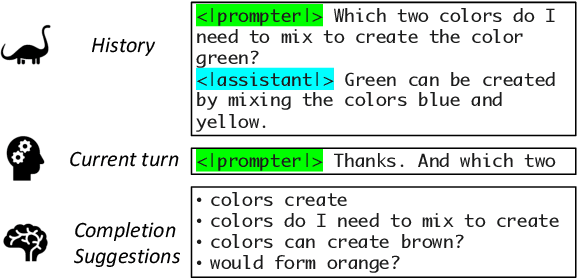
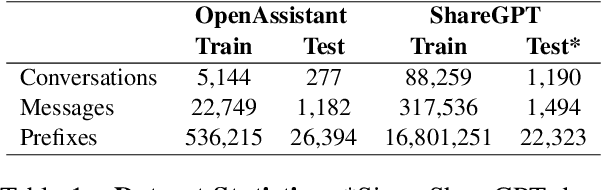
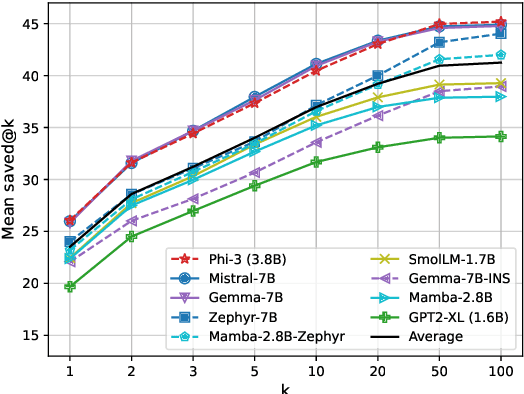
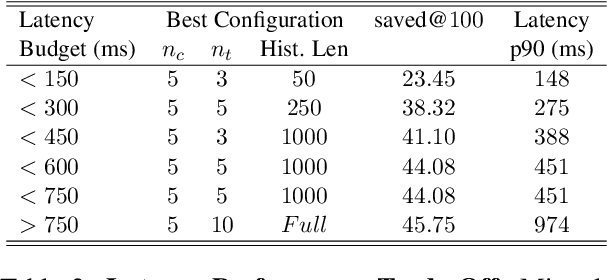
The rise of LLMs has deflected a growing portion of human-computer interactions towards LLM-based chatbots. The remarkable abilities of these models allow users to interact using long, diverse natural language text covering a wide range of topics and styles. Phrasing these messages is a time and effort consuming task, calling for an autocomplete solution to assist users. We introduce the task of chatbot interaction autocomplete. We present ChaI-TeA: CHat InTEraction Autocomplete; An autcomplete evaluation framework for LLM-based chatbot interactions. The framework includes a formal definition of the task, coupled with suitable datasets and metrics. We use the framework to evaluate After formally defining the task along with suitable datasets and metrics, we test 9 models on the defined auto completion task, finding that while current off-the-shelf models perform fairly, there is still much room for improvement, mainly in ranking of the generated suggestions. We provide insights for practitioners working on this task and open new research directions for researchers in the field. We release our framework to serve as a foundation for future research.
Hierarchical Selective Classification
May 19, 2024Deploying deep neural networks for risk-sensitive tasks necessitates an uncertainty estimation mechanism. This paper introduces hierarchical selective classification, extending selective classification to a hierarchical setting. Our approach leverages the inherent structure of class relationships, enabling models to reduce the specificity of their predictions when faced with uncertainty. In this paper, we first formalize hierarchical risk and coverage, and introduce hierarchical risk-coverage curves. Next, we develop algorithms for hierarchical selective classification (which we refer to as "inference rules"), and propose an efficient algorithm that guarantees a target accuracy constraint with high probability. Lastly, we conduct extensive empirical studies on over a thousand ImageNet classifiers, revealing that training regimes such as CLIP, pretraining on ImageNet21k and knowledge distillation boost hierarchical selective performance.