 Add to Chrome
 Add to Firefox
 Add to Edge
Extending Puzzle for Mixture-of-Experts Reasoning Models with Application to GPT-OSS Acceleration
Feb 12, 2026
Reasoning-focused LLMs improve answer quality by generating longer reasoning traces, but the additional tokens dramatically increase serving cost, motivating inference optimization. We extend and apply Puzzle, a post-training neural architecture search (NAS) framework, to gpt-oss-120B to produce gpt-oss-puzzle-88B, a deployment-optimized derivative. Our approach combines heterogeneous MoE expert pruning, selective replacement of full-context attention with window attention, FP8 KV-cache quantization with calibrated scales, and post-training reinforcement learning to recover accuracy, while maintaining low generation length. In terms of per-token speeds, on an 8XH100 node we achieve 1.63X and 1.22X throughput speedups in long-context and short-context settings, respectively. gpt-oss-puzzle-88B also delivers throughput speedups of 2.82X on a single NVIDIA H100 GPU. However, because token counts can change with reasoning effort and model variants, per-token throughput (tok/s) and latency (ms/token) do not necessarily lead to end-to-end speedups: a 2X throughput gain is erased if traces grow 2X. Conversely, throughput gains can be spent on more reasoning tokens to improve accuracy; we therefore advocate request-level efficiency metrics that normalize throughput by tokens generated and trace an accuracy--speed frontier across reasoning efforts. We show that gpt-oss-puzzle-88B improves over gpt-oss-120B along the entire frontier, delivering up to 1.29X higher request-level efficiency. Across various benchmarks, gpt-oss-puzzle-88B matches or slightly exceeds the parent on suite-average accuracy across reasoning efforts, with retention ranging from 100.8% (high) to 108.2% (low), showing that post-training architecture search can substantially reduce inference costs without sacrificing quality.

FFN Fusion: Rethinking Sequential Computation in Large Language Models
Mar 24, 2025We introduce FFN Fusion, an architectural optimization technique that reduces sequential computation in large language models by identifying and exploiting natural opportunities for parallelization. Our key insight is that sequences of Feed-Forward Network (FFN) layers, particularly those remaining after the removal of specific attention layers, can often be parallelized with minimal accuracy impact. We develop a principled methodology for identifying and fusing such sequences, transforming them into parallel operations that significantly reduce inference latency while preserving model behavior. Applying these techniques to Llama-3.1-405B-Instruct, we create Llama-Nemotron-Ultra-253B-Base (Ultra-253B-Base), an efficient and soon-to-be publicly available model that achieves a 1.71X speedup in inference latency and 35X lower per-token cost while maintaining strong performance across benchmarks. Through extensive experiments on models from 49B to 253B parameters, we demonstrate that FFN Fusion becomes increasingly effective at larger scales and can complement existing optimization techniques like quantization and pruning. Most intriguingly, we find that even full transformer blocks containing both attention and FFN layers can sometimes be parallelized, suggesting new directions for neural architecture design.
Puzzle: Distillation-Based NAS for Inference-Optimized LLMs
Dec 03, 2024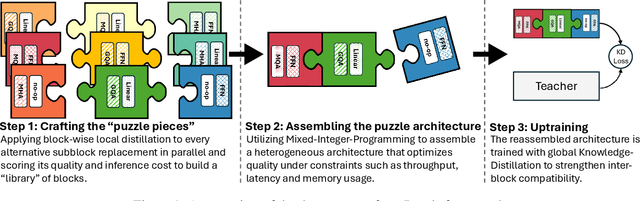
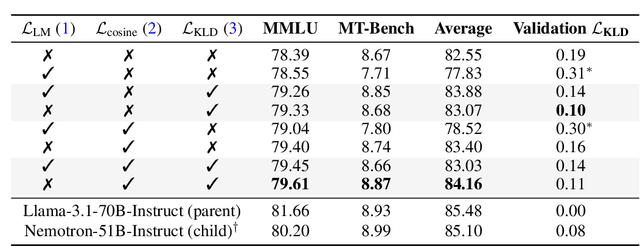


Large language models (LLMs) have demonstrated remarkable capabilities, but their adoption is limited by high computational costs during inference. While increasing parameter counts enhances accuracy, it also widens the gap between state-of-the-art capabilities and practical deployability. We present Puzzle, a framework to accelerate LLM inference on specific hardware while preserving their capabilities. Through an innovative application of neural architecture search (NAS) at an unprecedented scale, Puzzle systematically optimizes models with tens of billions of parameters under hardware constraints. Our approach utilizes blockwise local knowledge distillation (BLD) for parallel architecture exploration and employs mixed-integer programming for precise constraint optimization. We demonstrate the real-world impact of our framework through Llama-3.1-Nemotron-51B-Instruct (Nemotron-51B), a publicly available model derived from Llama-3.1-70B-Instruct. Nemotron-51B achieves a 2.17x inference throughput speedup, fitting on a single NVIDIA H100 GPU while preserving 98.4% of the original model's capabilities. Nemotron-51B currently stands as the most accurate language model capable of inference on a single GPU with large batch sizes. Remarkably, this transformation required just 45B training tokens, compared to over 15T tokens used for the 70B model it was derived from. This establishes a new paradigm where powerful models can be optimized for efficient deployment with only negligible compromise of their capabilities, demonstrating that inference performance, not parameter count alone, should guide model selection. With the release of Nemotron-51B and the presentation of the Puzzle framework, we provide practitioners immediate access to state-of-the-art language modeling capabilities at significantly reduced computational costs.
Deep Anomaly Detection Using Geometric Transformations
May 28, 2018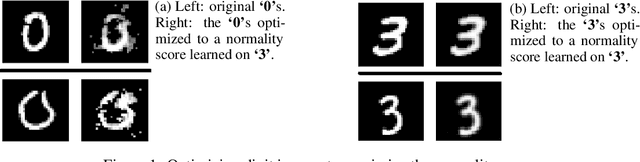
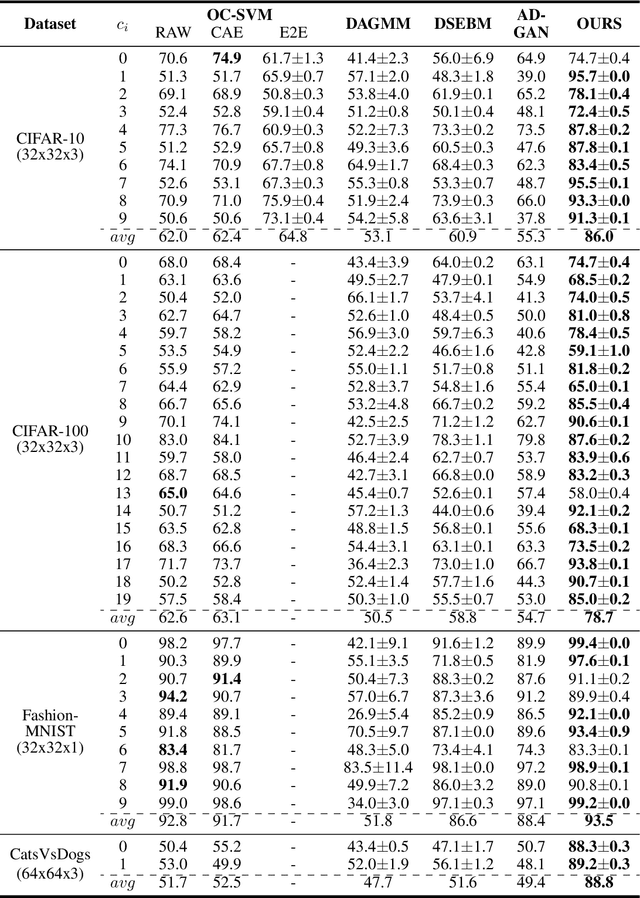
We consider the problem of anomaly detection in images, and present a new detection technique. Given a sample of images, all known to belong to a "normal" class (e.g., dogs), we show how to train a deep neural model that can detect out-of-distribution images (i.e., non-dog objects). The main idea behind our scheme is to train a multi-class model to discriminate between dozens of geometric transformations applied on all the given images. The auxiliary expertise learned by the model generates feature detectors that effectively identify, at test time, anomalous images based on the softmax activation statistics of the model when applied on transformed images. We present extensive experiments using the proposed detector, which indicate that our algorithm improves state-of-the-art methods by a wide margin.