 Add to Chrome
 Add to Firefox
 Add to Edge
KForge: LLM-Driven Cross-Platform Kernel Generation for AI Accelerators
Jun 01, 2026
Production inference increasingly targets a heterogeneous mix of accelerators. Agentic pipelines interleave reasoning, tool calls, and multi-agent coordination, each with distinct compute and memory profiles. For optimal efficiency, each stage should run on the accelerator best suited to it. This creates a systems challenge: each pipeline now requires high-performance kernels across a growing set of hardware backends and programming models. Writing these kernels by hand is time-consuming, demands deep low-level expertise, and does not scale as kernel complexity grows. Recently, Large Language Models (LLMs) have been leveraged for automatic kernel generation, but challenges in low-level code generation and cross-backend generalization persist. We present KForge, a cross-platform framework built around an iterative refinement loop driven by two collaborating LLM-based agents: a generation agent that produces and progressively refines kernels using compilation and correctness feedback, and a performance-analysis agent that interprets profiling data, from programmatic APIs to GUI-based tools, and emits recommendations that steer the next round of synthesis. The loop alternates between functional passes, which drive a candidate to correctness, and optimization passes, which close the performance gap to hand-tuned baselines. We evaluate KForge on two backends with very different baseline reference availability. On NVIDIA B200, KForge achieves a 2.12$\%$ improvement in end-to-end throughput compared to TensorRT-LLM on the gpt-oss-20b inference speed benchmark. On Intel Arc B580, KForge generates Triton kernels achieving a 5.13$\times$ geometric mean speedup over the faster of PyTorch eager and torch.compile on 37 GEMM + tail-ops workloads from KernelBench Level 2, primarily via operator fusion and mixed-precision execution.

Efficient Reasoning on the Edge
Mar 17, 2026Large language models (LLMs) with chain-of-thought reasoning achieve state-of-the-art performance across complex problem-solving tasks, but their verbose reasoning traces and large context requirements make them impractical for edge deployment. These challenges include high token generation costs, large KV-cache footprints, and inefficiencies when distilling reasoning capabilities into smaller models for mobile devices. Existing approaches often rely on distilling reasoning traces from larger models into smaller models, which are verbose and stylistically redundant, undesirable for on-device inference. In this work, we propose a lightweight approach to enable reasoning in small LLMs using LoRA adapters combined with supervised fine-tuning. We further introduce budget forcing via reinforcement learning on these adapters, significantly reducing response length with minimal accuracy loss. To address memory-bound decoding, we exploit parallel test-time scaling, improving accuracy at minor latency increase. Finally, we present a dynamic adapter-switching mechanism that activates reasoning only when needed and a KV-cache sharing strategy during prompt encoding, reducing time-to-first-token for on-device inference. Experiments on Qwen2.5-7B demonstrate that our method achieves efficient, accurate reasoning under strict resource constraints, making LLM reasoning practical for mobile scenarios. Videos demonstrating our solution running on mobile devices are available on our project page.
SubZero: Composing Subject, Style, and Action via Zero-Shot Personalization
Feb 27, 2025Diffusion models are increasingly popular for generative tasks, including personalized composition of subjects and styles. While diffusion models can generate user-specified subjects performing text-guided actions in custom styles, they require fine-tuning and are not feasible for personalization on mobile devices. Hence, tuning-free personalization methods such as IP-Adapters have progressively gained traction. However, for the composition of subjects and styles, these works are less flexible due to their reliance on ControlNet, or show content and style leakage artifacts. To tackle these, we present SubZero, a novel framework to generate any subject in any style, performing any action without the need for fine-tuning. We propose a novel set of constraints to enhance subject and style similarity, while reducing leakage. Additionally, we propose an orthogonalized temporal aggregation scheme in the cross-attention blocks of denoising model, effectively conditioning on a text prompt along with single subject and style images. We also propose a novel method to train customized content and style projectors to reduce content and style leakage. Through extensive experiments, we show that our proposed approach, while suitable for running on-edge, shows significant improvements over state-of-the-art works performing subject, style and action composition.
QuArch: A Question-Answering Dataset for AI Agents in Computer Architecture
Jan 06, 2025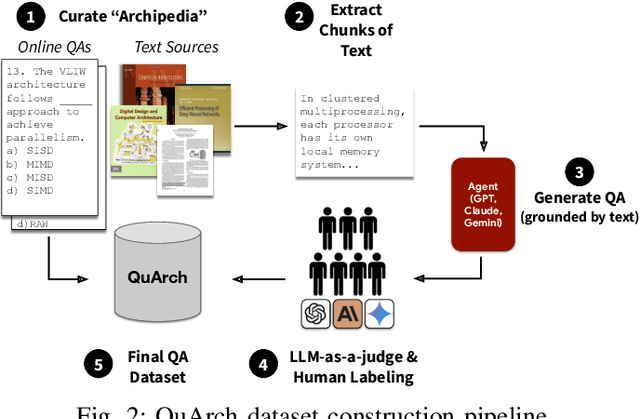
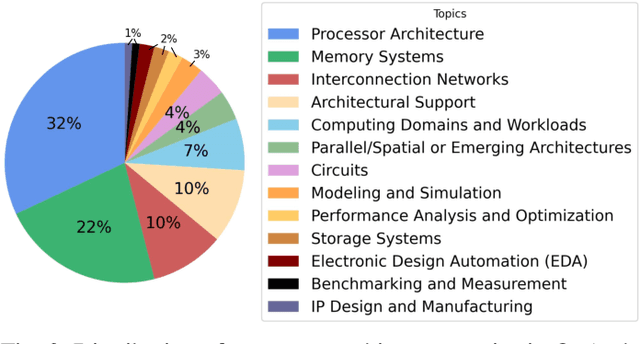
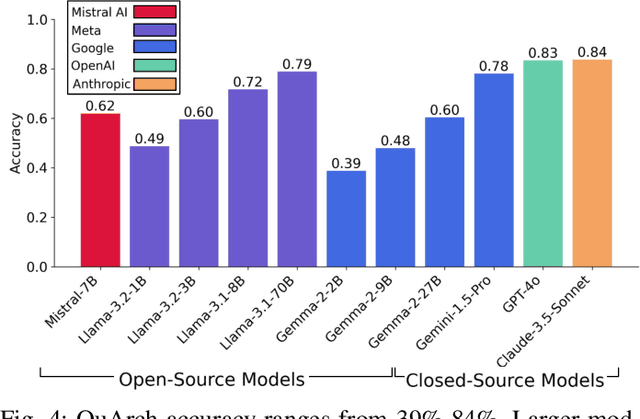
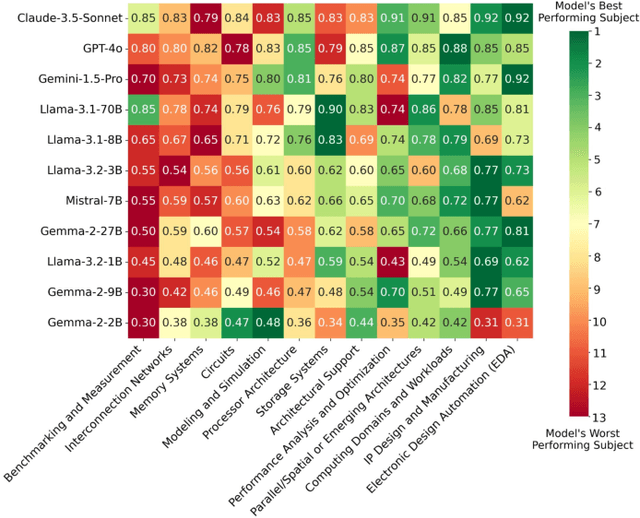
We introduce QuArch, a dataset of 1500 human-validated question-answer pairs designed to evaluate and enhance language models' understanding of computer architecture. The dataset covers areas including processor design, memory systems, and performance optimization. Our analysis highlights a significant performance gap: the best closed-source model achieves 84% accuracy, while the top small open-source model reaches 72%. We observe notable struggles in memory systems, interconnection networks, and benchmarking. Fine-tuning with QuArch improves small model accuracy by up to 8%, establishing a foundation for advancing AI-driven computer architecture research. The dataset and leaderboard are at https://harvard-edge.github.io/QuArch/.