 Add to Chrome
 Add to Firefox
 Add to Edge
BEACON: Benefit-Aware Early-Exit for Automatic Modulation Classification via Recoverability Prediction
Apr 09, 2026
Convolutional neural networks (CNNs) have emerged as a powerful tool for automatic modulation classification (AMC) by directly extracting discriminative features from raw in-phase and quadrature (I/Q) signals. However, deploying CNN-based AMC models on IoT devices remains challenging because of limited computational resources, energy constraints, and real-time processing requirements. Early-exit (EE) strategies alleviate this burden by allowing qualified samples to terminate inference at an EE branch. However, our empirical analysis reveals a critical limitation of existing confidence-based EE strategies: they predominantly select samples whose early and final predictions are correct and consistent, while failing to capture whether deeper inference can provide a tangible accuracy gain. To address this limitation, we propose BEACON, a Benefit-Aware Early-Exit framework for AMC via recoverability prediction. BEACON introduces a benefit-aware EE criterion that explicitly predicts recoverable errors, defined as instances where the final-exit branch corrects an initial early-branch misclassification. Using only short-branch observables, we design a lightweight benefit-aware predictor (LBAP) to implement this criterion, estimating the likelihood of such recoverable cases and triggering deeper inference only when an accuracy gain is expected. Extensive experiments on ResNet-18-based AMC models demonstrate that the proposed approach consistently outperforms state-of-the-art baselines, achieving a superior accuracy-computation tradeoff across diverse EE threshold settings and signal-to-noise ratio regimes. These findings validate the effectiveness of the benefit-aware criterion and its practicality for energy-efficient on-device AMC under stringent resource constraints.

Personalized QoE Enhancement for Adaptive Video Streaming: A Digital Twin-Assisted Scheme
May 09, 2022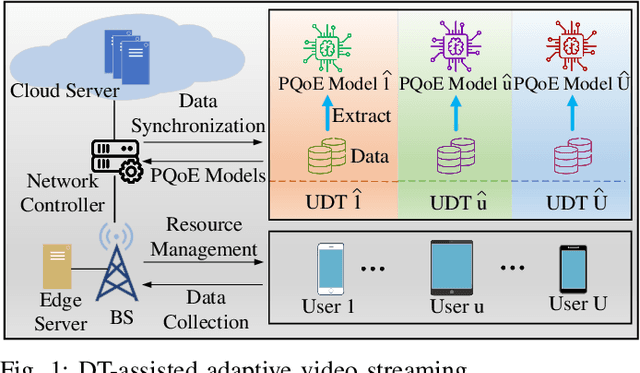
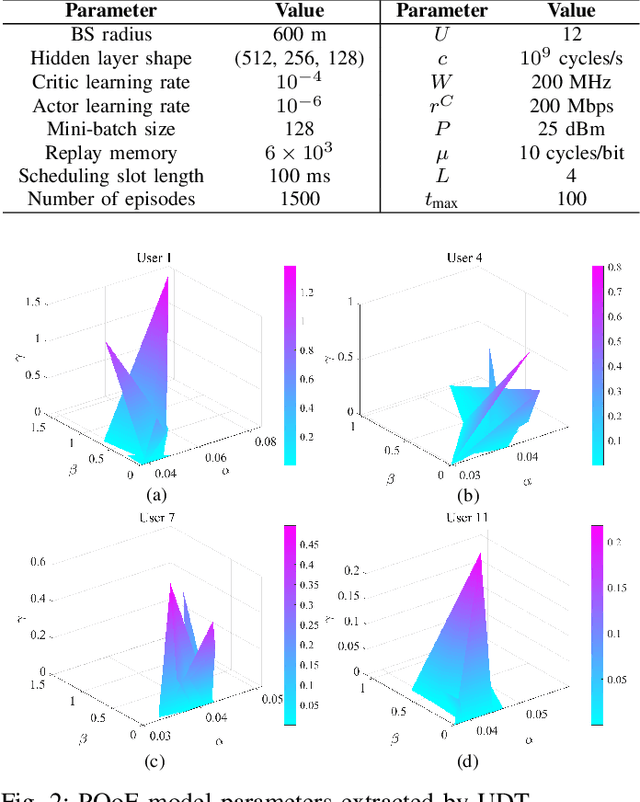
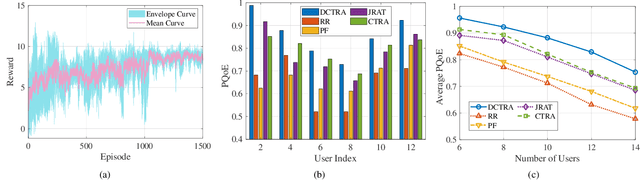
In this paper, we present a digital twin (DT)-assisted adaptive video streaming scheme to enhance personalized quality-of-experience (PQoE). Since PQoE models are user-specific and time-varying, existing schemes based on universal and time-invariant PQoE models may suffer from performance degradation. To address this issue, we first propose a DT-assisted PQoE model construction method to obtain accurate user-specific PQoE models. Specifically, user DTs (UDTs) are respectively constructed for individual users, which can acquire and utilize users' data to accurately tune PQoE model parameters in real time. Next, given the obtained PQoE models, we formulate a resource management problem to maximize the overall long-term PQoE by taking the dynamics of user' locations, video content requests, and buffer statuses into account. To solve this problem, a deep reinforcement learning algorithm is developed to jointly determine segment version selection, and communication and computing resource allocation. Simulation results on the real-world dataset demonstrate that the proposed scheme can effectively enhance PQoE compared with benchmark schemes.
AI-Native Network Slicing for 6G Networks
May 18, 2021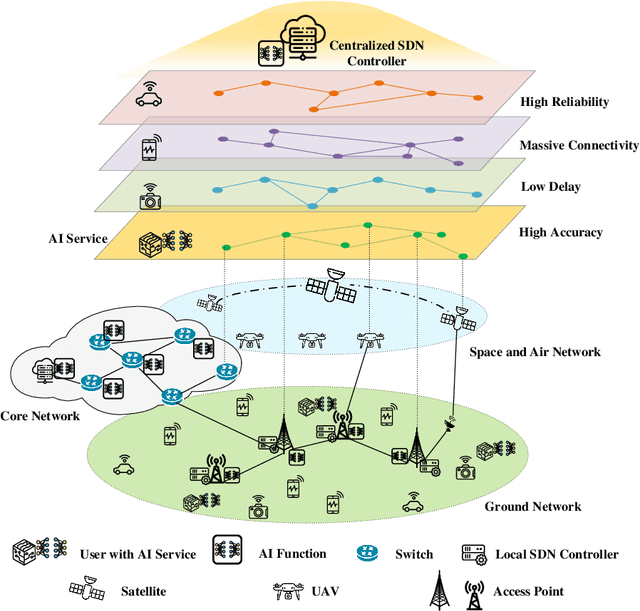
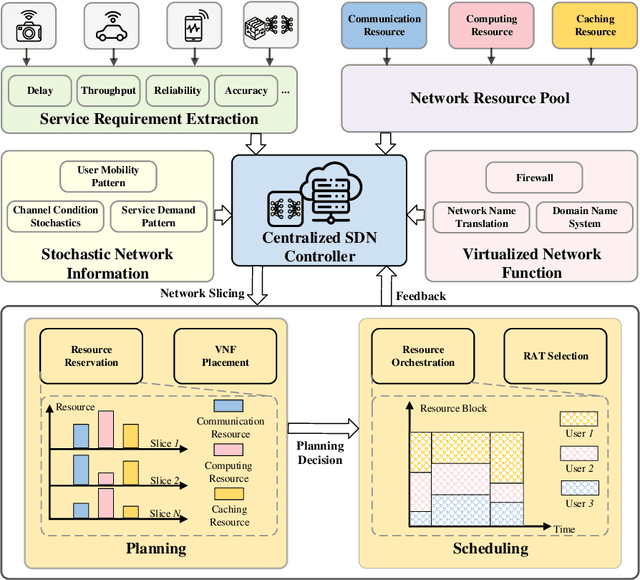
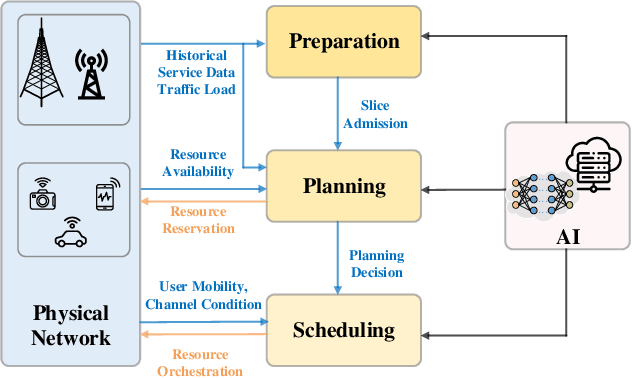
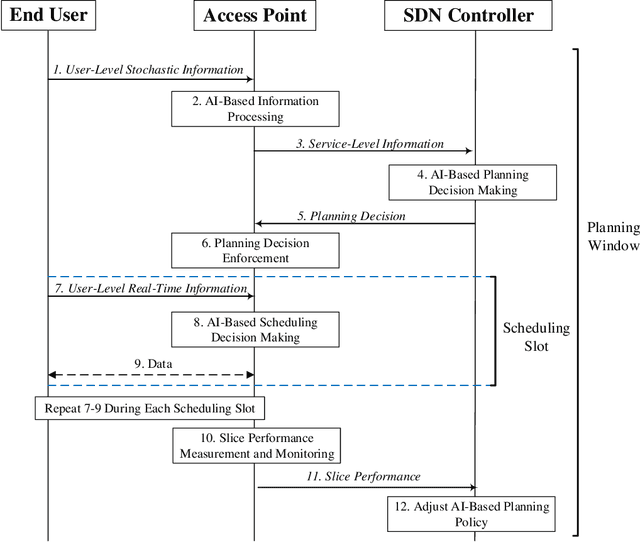
With the global roll-out of the fifth generation (5G) networks, it is necessary to look beyond 5G and envision the sixth generation (6G) networks. The 6G networks are expected to have space-air-ground integrated networking, advanced network virtualization, and ubiquitous intelligence. This article proposes an artificial intelligence (AI)-native network slicing architecture for 6G networks to facilitate intelligent network management and support emerging AI services. AI is built in the proposed network slicing architecture to enable the synergy of AI and network slicing. AI solutions are investigated for the entire lifecycle of network slicing to facilitate intelligent network management, i.e., AI for slicing. Furthermore, network slicing approaches are discussed to support emerging AI services by constructing slice instances and performing efficient resource management, i.e., slicing for AI. Finally, a case study is presented, followed by a discussion of open research issues that are essential for AI-native network slicing in 6G.