 Add to Chrome
 Add to Firefox
 Add to Edge
Deep Reinforcement Learning for 6G AI-RAN: A Comprehensive Survey
Aug 14, 2026
The evolution toward sixth-generation (6G) networks is transforming the radio access network (RAN) into a programmable and intelligent control platform that must continuously adapt to heterogeneous services, dynamic environments, and competing performance objectives. Open Radio Access Network (O-RAN) provides the open interfaces, disaggregated architecture, and multi-timescale control loops needed to support this transformation, while deep reinforcement learning (DRL) offers a natural framework for optimizing sequential decisions under uncertainty. However, existing surveys either address artificial intelligence (AI) and machine learning (ML) in O-RAN broadly or focus on isolated DRL use cases, leaving a gap in the systematic connection between DRL methodology, O-RAN architecture, and operational deployment. To the best of our knowledge, this article presents the first dedicated and comprehensive survey of DRL for Open AI-RAN. We review the foundations of model-free, model-based, offline, safe, multi-agent, federated, and transfer learning, and provide an O-RAN-aware framework for formulating RAN control problems through states, observations, actions, rewards, constraints, and temporal structure. We classify DRL applications across radio resource management, mobility management, interference control, traffic steering, energy efficiency, network slicing, integrated sensing and communication, security, and massive MIMO. We further examine multi-agent and federated coordination, foundation models and agentic AI, trustworthy DRL, sim-to-real transfer, continual adaptation, resource-efficient inference, and reinforcement learning operations. Finally, we review experimental platforms, benchmarks, standards, and industry activities, and identify research directions toward sample-efficient, safe, scalable, interoperable, and deployable DRL control for 6G Open AI-RAN.

Rascene: High-Fidelity 3D Scene Imaging with mmWave Communication Signals
Apr 03, 2026Robust 3D environmental perception is critical for applications such as autonomous driving and robot navigation. However, optical sensors such as cameras and LiDAR often fail under adverse conditions, including smoke, fog, and non-ideal lighting. Although specialized radar systems can operate in these environments, their reliance on bespoke hardware and licensed spectrum limits scalability and cost-effectiveness. This paper introduces Rascene, an integrated sensing and communication (ISAC) framework that leverages ubiquitous mmWave OFDM communication signals for 3D scene imaging. To overcome the sparse and multipath-ambiguous nature of individual radio frames, Rascene performs multi-frame, spatially adaptive fusion with confidence-weighted forward projection, enabling the recovery of geometric consensus across arbitrary poses. Experimental results demonstrate that our method reconstructs 3D scenes with high precision, offering a new pathway toward low-cost, scalable, and robust 3D perception.
Spectrum Shortage for Radio Sensing? Leveraging Ambient 5G Signals for Human Activity Detection
Mar 03, 2026Radio sensing in the sub-10 GHz spectrum offers unique advantages over traditional vision-based systems, including the ability to see through occlusions and preserve user privacy. However, the limited availability of spectrum in this range presents significant challenges for deploying largescale radio sensing applications. In this paper, we introduce Ambient Radio Sensing (ARS), a novel Integrated Sensing and Communications (ISAC) approach that addresses spectrum scarcity by repurposing over-the-air radio signals from existing wireless systems (e.g., 5G and Wi-Fi) for sensing applications, without interfering with their primary communication functions. ARS operates as a standalone device that passively receives communication signals, amplifies them to illuminate surrounding objects, and captures the reflected signals using a self-mixing RF architecture to extract baseband features. This hardware innovation enables robust Doppler and angular feature extraction from ambient OFDM signals. To support downstream applications, we propose a cross-modal learning framework focusing on human activity recognition, featuring a streamlined training process that leverages an off-the-shelf vision model to supervise radio model training. We have developed a prototype of ARS and validated its effectiveness through extensive experiments using ambient 5G signals, demonstrating accurate human skeleton estimation and body mask segmentation applications.
EExApp: GNN-Based Reinforcement Learning for Radio Unit Energy Optimization in 5G O-RAN
Feb 09, 2026With over 3.5 million 5G base stations deployed globally, their collective energy consumption (projected to exceed 131 TWh annually) raises significant concerns over both operational costs and environmental impacts. In this paper, we present EExAPP, a deep reinforcement learning (DRL)-based xApp for 5G Open Radio Access Network (O-RAN) that jointly optimizes radio unit (RU) sleep scheduling and distributed unit (DU) resource slicing. EExAPP uses a dual-actor-dual-critic Proximal Policy Optimization (PPO) architecture, with dedicated actor-critic pairs targeting energy efficiency and quality-of-service (QoS) compliance. A transformer-based encoder enables scalable handling of variable user equipment (UE) populations by encoding all-UE observations into fixed-dimensional representations. To coordinate the two optimization objectives, a bipartite Graph Attention Network (GAT) is used to modulate actor updates based on both critic outputs, enabling adaptive tradeoffs between power savings and QoS. We have implemented EExAPP and deployed it on a real-world 5G O-RAN testbed with live traffic, commercial RU and smartphones. Extensive over-the-air experiments and ablation studies confirm that EExAPP significantly outperforms existing methods in reducing the energy consumption of RU while maintaining QoS.
Near-Real-Time Resource Slicing for QoS Optimization in 5G O-RAN using Deep Reinforcement Learning
Sep 17, 2025Open-Radio Access Network (O-RAN) has become an important paradigm for 5G and beyond radio access networks. This paper presents an xApp called xSlice for the Near-Real-Time (Near-RT) RAN Intelligent Controller (RIC) of 5G O-RANs. xSlice is an online learning algorithm that adaptively adjusts MAC-layer resource allocation in response to dynamic network states, including time-varying wireless channel conditions, user mobility, traffic fluctuations, and changes in user demand. To address these network dynamics, we first formulate the Quality-of-Service (QoS) optimization problem as a regret minimization problem by quantifying the QoS demands of all traffic sessions through weighting their throughput, latency, and reliability. We then develop a deep reinforcement learning (DRL) framework that utilizes an actor-critic model to combine the advantages of both value-based and policy-based updating methods. A graph convolutional network (GCN) is incorporated as a component of the DRL framework for graph embedding of RAN data, enabling xSlice to handle a dynamic number of traffic sessions. We have implemented xSlice on an O-RAN testbed with 10 smartphones and conducted extensive experiments to evaluate its performance in realistic scenarios. Experimental results show that xSlice can reduce performance regret by 67% compared to the state-of-the-art solutions. Source code is available on GitHub [1].
Structured Reinforcement Learning for Delay-Optimal Data Transmission in Dense mmWave Networks
Apr 25, 2024We study the data packet transmission problem (mmDPT) in dense cell-free millimeter wave (mmWave) networks, i.e., users sending data packet requests to access points (APs) via uplinks and APs transmitting requested data packets to users via downlinks. Our objective is to minimize the average delay in the system due to APs' limited service capacity and unreliable wireless channels between APs and users. This problem can be formulated as a restless multi-armed bandits problem with fairness constraint (RMAB-F). Since finding the optimal policy for RMAB-F is intractable, existing learning algorithms are computationally expensive and not suitable for practical dynamic dense mmWave networks. In this paper, we propose a structured reinforcement learning (RL) solution for mmDPT by exploiting the inherent structure encoded in RMAB-F. To achieve this, we first design a low-complexity and provably asymptotically optimal index policy for RMAB-F. Then, we leverage this structure information to develop a structured RL algorithm called mmDPT-TS, which provably achieves an \tilde{O}(\sqrt{T}) Bayesian regret. More importantly, mmDPT-TS is computation-efficient and thus amenable to practical implementation, as it fully exploits the structure of index policy for making decisions. Extensive emulation based on data collected in realistic mmWave networks demonstrate significant gains of mmDPT-TS over existing approaches.
ChatTracer: Large Language Model Powered Real-time Bluetooth Device Tracking System
Mar 28, 2024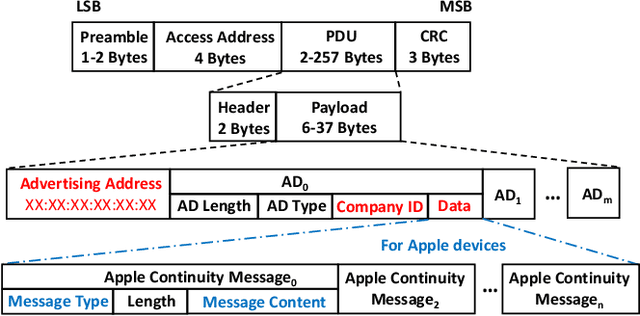
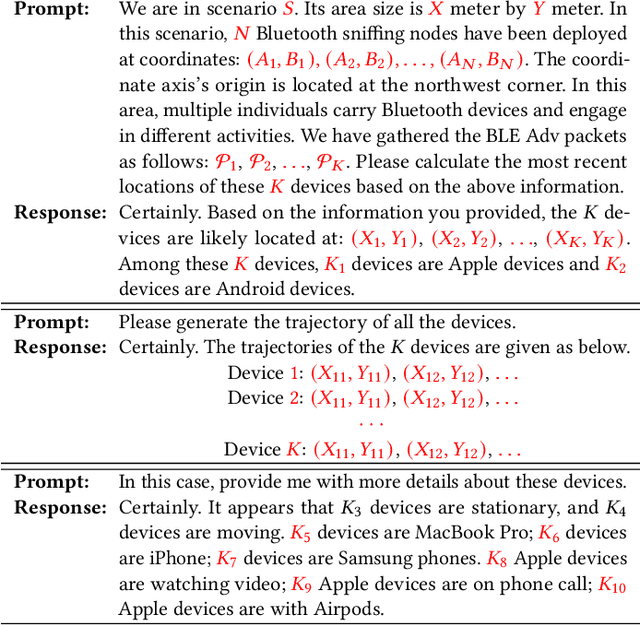
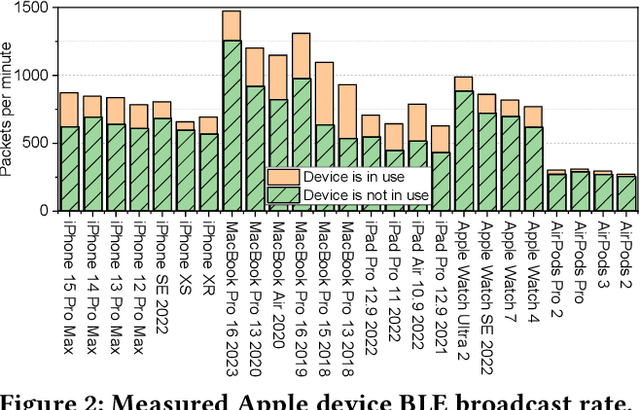
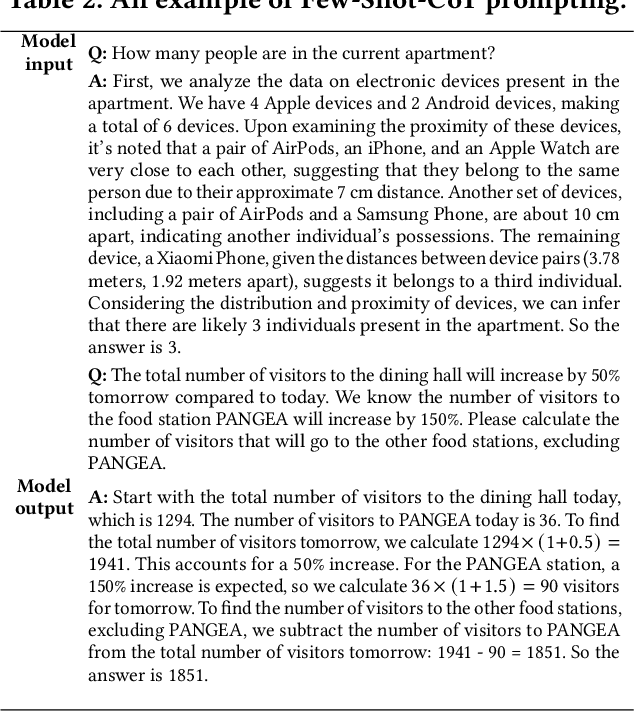
Large language models (LLMs), exemplified by OpenAI ChatGPT and Google Bard, have transformed the way we interact with cyber technologies. In this paper, we study the possibility of connecting LLM with wireless sensor networks (WSN). A successful design will not only extend LLM's knowledge landscape to the physical world but also revolutionize human interaction with WSN. To the end, we present ChatTracer, an LLM-powered real-time Bluetooth device tracking system. ChatTracer comprises three key components: an array of Bluetooth sniffing nodes, a database, and a fine-tuned LLM. ChatTracer was designed based on our experimental observation that commercial Apple/Android devices always broadcast hundreds of BLE packets per minute even in their idle status. Its novelties lie in two aspects: i) a reliable and efficient BLE packet grouping algorithm; and ii) an LLM fine-tuning strategy that combines both supervised fine-tuning (SFT) and reinforcement learning with human feedback (RLHF). We have built a prototype of ChatTracer with four sniffing nodes. Experimental results show that ChatTracer not only outperforms existing localization approaches, but also provides an intelligent interface for user interaction.