 Add to Chrome
 Add to Firefox
 Add to Edge
Rascene: High-Fidelity 3D Scene Imaging with mmWave Communication Signals
Apr 03, 2026
Robust 3D environmental perception is critical for applications such as autonomous driving and robot navigation. However, optical sensors such as cameras and LiDAR often fail under adverse conditions, including smoke, fog, and non-ideal lighting. Although specialized radar systems can operate in these environments, their reliance on bespoke hardware and licensed spectrum limits scalability and cost-effectiveness. This paper introduces Rascene, an integrated sensing and communication (ISAC) framework that leverages ubiquitous mmWave OFDM communication signals for 3D scene imaging. To overcome the sparse and multipath-ambiguous nature of individual radio frames, Rascene performs multi-frame, spatially adaptive fusion with confidence-weighted forward projection, enabling the recovery of geometric consensus across arbitrary poses. Experimental results demonstrate that our method reconstructs 3D scenes with high precision, offering a new pathway toward low-cost, scalable, and robust 3D perception.

Spectrum Shortage for Radio Sensing? Leveraging Ambient 5G Signals for Human Activity Detection
Mar 03, 2026Radio sensing in the sub-10 GHz spectrum offers unique advantages over traditional vision-based systems, including the ability to see through occlusions and preserve user privacy. However, the limited availability of spectrum in this range presents significant challenges for deploying largescale radio sensing applications. In this paper, we introduce Ambient Radio Sensing (ARS), a novel Integrated Sensing and Communications (ISAC) approach that addresses spectrum scarcity by repurposing over-the-air radio signals from existing wireless systems (e.g., 5G and Wi-Fi) for sensing applications, without interfering with their primary communication functions. ARS operates as a standalone device that passively receives communication signals, amplifies them to illuminate surrounding objects, and captures the reflected signals using a self-mixing RF architecture to extract baseband features. This hardware innovation enables robust Doppler and angular feature extraction from ambient OFDM signals. To support downstream applications, we propose a cross-modal learning framework focusing on human activity recognition, featuring a streamlined training process that leverages an off-the-shelf vision model to supervise radio model training. We have developed a prototype of ARS and validated its effectiveness through extensive experiments using ambient 5G signals, demonstrating accurate human skeleton estimation and body mask segmentation applications.
ChatTracer: Large Language Model Powered Real-time Bluetooth Device Tracking System
Mar 28, 2024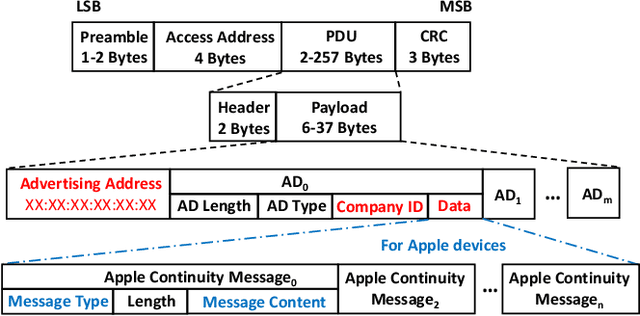

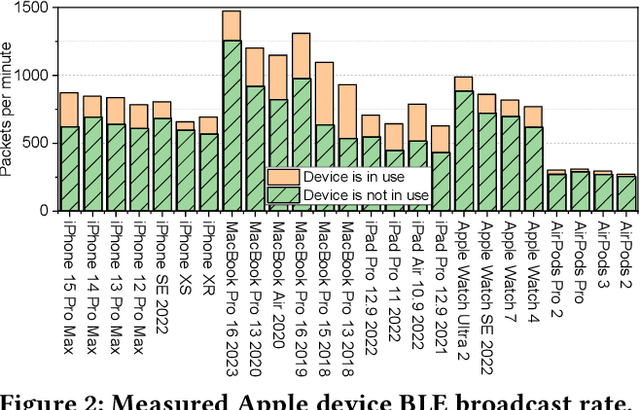

Large language models (LLMs), exemplified by OpenAI ChatGPT and Google Bard, have transformed the way we interact with cyber technologies. In this paper, we study the possibility of connecting LLM with wireless sensor networks (WSN). A successful design will not only extend LLM's knowledge landscape to the physical world but also revolutionize human interaction with WSN. To the end, we present ChatTracer, an LLM-powered real-time Bluetooth device tracking system. ChatTracer comprises three key components: an array of Bluetooth sniffing nodes, a database, and a fine-tuned LLM. ChatTracer was designed based on our experimental observation that commercial Apple/Android devices always broadcast hundreds of BLE packets per minute even in their idle status. Its novelties lie in two aspects: i) a reliable and efficient BLE packet grouping algorithm; and ii) an LLM fine-tuning strategy that combines both supervised fine-tuning (SFT) and reinforcement learning with human feedback (RLHF). We have built a prototype of ChatTracer with four sniffing nodes. Experimental results show that ChatTracer not only outperforms existing localization approaches, but also provides an intelligent interface for user interaction.
Self-Supervised Multi-Modal Sequential Recommendation
Apr 26, 2023
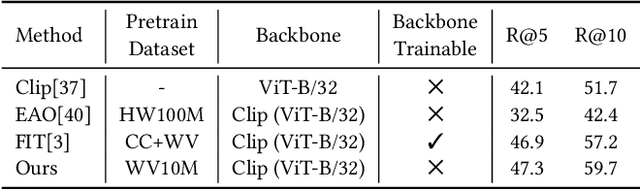

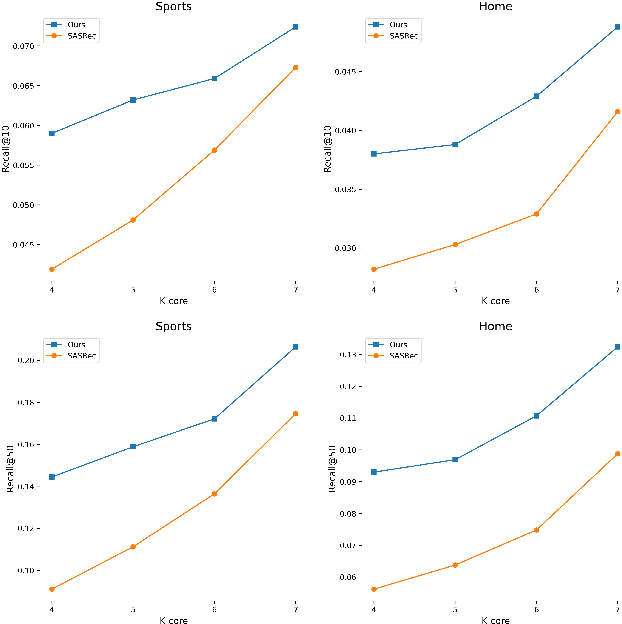
With the increasing development of e-commerce and online services, personalized recommendation systems have become crucial for enhancing user satisfaction and driving business revenue. Traditional sequential recommendation methods that rely on explicit item IDs encounter challenges in handling item cold start and domain transfer problems. Recent approaches have attempted to use modal features associated with items as a replacement for item IDs, enabling the transfer of learned knowledge across different datasets. However, these methods typically calculate the correlation between the model's output and item embeddings, which may suffer from inconsistencies between high-level feature vectors and low-level feature embeddings, thereby hindering further model learning. To address this issue, we propose a dual-tower retrieval architecture for sequence recommendation. In this architecture, the predicted embedding from the user encoder is used to retrieve the generated embedding from the item encoder, thereby alleviating the issue of inconsistent feature levels. Moreover, in order to further improve the retrieval performance of the model, we also propose a self-supervised multi-modal pretraining method inspired by the consistency property of contrastive learning. This pretraining method enables the model to align various feature combinations of items, thereby effectively generalizing to diverse datasets with different item features. We evaluate the proposed method on five publicly available datasets and conduct extensive experiments. The results demonstrate significant performance improvement of our method.