 Add to Chrome
 Add to Firefox
 Add to Edge
PRBench: End-to-end Paper Reproduction in Physics Research
Mar 29, 2026
AI agents powered by large language models exhibit strong reasoning and problem-solving capabilities, enabling them to assist scientific research tasks such as formula derivation and code generation. However, whether these agents can reliably perform end-to-end reproduction from real scientific papers remains an open question. We introduce PRBench, a benchmark of 30 expert-curated tasks spanning 11 subfields of physics. Each task requires an agent to comprehend the methodology of a published paper, implement the corresponding algorithms from scratch, and produce quantitative results matching the original publication. Agents are provided only with the task instruction and paper content, and operate in a sandboxed execution environment. All tasks are contributed by domain experts from over 20 research groups at the School of Physics, Peking University, each grounded in a real published paper and validated through end-to-end reproduction with verified ground-truth results and detailed scoring rubrics. Using an agentified assessment pipeline, we evaluate a set of coding agents on PRBench and analyze their capabilities across key dimensions of scientific reasoning and execution. The best-performing agent, OpenAI Codex powered by GPT-5.3-Codex, achieves a mean overall score of 34%. All agents exhibit a zero end-to-end callback success rate, with particularly poor performance in data accuracy and code correctness. We further identify systematic failure modes, including errors in formula implementation, inability to debug numerical simulations, and fabrication of output data. Overall, PRBench provides a rigorous benchmark for evaluating progress toward autonomous scientific research.

A Theory of LLM Information Susceptibility
Mar 24, 2026Large language models (LLMs) are increasingly deployed as optimization modules in agentic systems, yet the fundamental limits of such LLM-mediated improvement remain poorly understood. Here we propose a theory of LLM information susceptibility, centred on the hypothesis that when computational resources are sufficiently large, the intervention of a fixed LLM does not increase the performance susceptibility of a strategy set with respect to budget. We develop a multi-variable utility-function framework that generalizes this hypothesis to architectures with multiple co-varying budget channels, and discuss the conditions under which co-scaling can exceed the susceptibility bound. We validate the theory empirically across structurally diverse domains and model scales spanning an order of magnitude, and show that nested, co-scaling architectures open response channels unavailable to fixed configurations. These results clarify when LLM intervention helps and when it does not, demonstrating that tools from statistical physics can provide predictive constraints for the design of AI systems. If the susceptibility hypothesis holds generally, the theory suggests that nested architectures may be a necessary structural condition for open-ended agentic self-improvement.
An End-to-end Architecture for Collider Physics and Beyond
Mar 15, 2026We present, to our knowledge, the first language-driven agent system capable of executing end-to-end collider phenomenology tasks, instantiated within a decoupled, domain-agnostic architecture for autonomous High-Energy Physics phenomenology. Guided only by natural-language prompts supplemented with standard physics notation, ColliderAgent carries out workflows from a theoretical Lagrangian to final phenomenological outputs without relying on package-specific code. In this framework, a hierarchical multi-agent reasoning layer is coupled to Magnus, a unified execution backend for phenomenological calculations and simulation toolchains. We validate the system on representative literature reproductions spanning leptoquark and axion-like-particle scenarios, higher-dimensional effective operators, parton-level and detector-level analyses, and large-scale parameter scans leading to exclusion limits. These results point to a route toward more automated, scalable, and reproducible research in collider physics, cosmology, and physics more broadly.
Detailed balance in large language model-driven agents
Dec 10, 2025Large language model (LLM)-driven agents are emerging as a powerful new paradigm for solving complex problems. Despite the empirical success of these practices, a theoretical framework to understand and unify their macroscopic dynamics remains lacking. This Letter proposes a method based on the least action principle to estimate the underlying generative directionality of LLMs embedded within agents. By experimentally measuring the transition probabilities between LLM-generated states, we statistically discover a detailed balance in LLM-generated transitions, indicating that LLM generation may not be achieved by generally learning rule sets and strategies, but rather by implicitly learning a class of underlying potential functions that may transcend different LLM architectures and prompt templates. To our knowledge, this is the first discovery of a macroscopic physical law in LLM generative dynamics that does not depend on specific model details. This work is an attempt to establish a macroscopic dynamics theory of complex AI systems, aiming to elevate the study of AI agents from a collection of engineering practices to a science built on effective measurements that are predictable and quantifiable.
PHYBench: Holistic Evaluation of Physical Perception and Reasoning in Large Language Models
Apr 22, 2025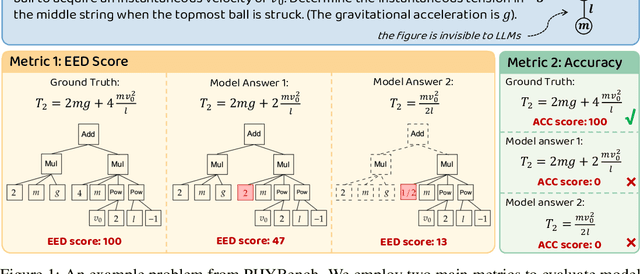

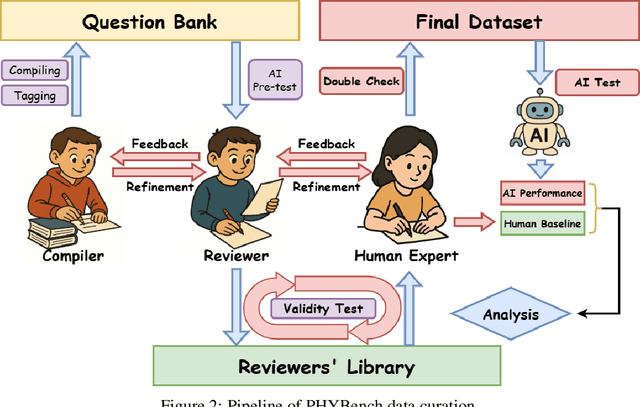
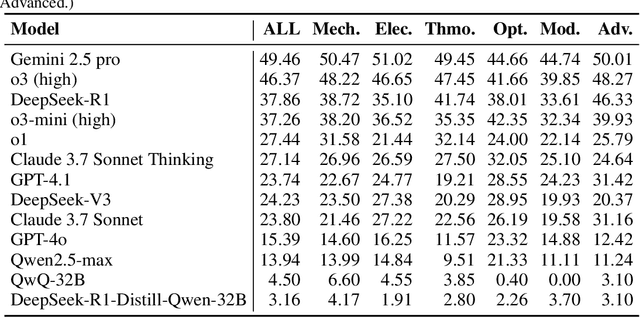
We introduce PHYBench, a novel, high-quality benchmark designed for evaluating reasoning capabilities of large language models (LLMs) in physical contexts. PHYBench consists of 500 meticulously curated physics problems based on real-world physical scenarios, designed to assess the ability of models to understand and reason about realistic physical processes. Covering mechanics, electromagnetism, thermodynamics, optics, modern physics, and advanced physics, the benchmark spans difficulty levels from high school exercises to undergraduate problems and Physics Olympiad challenges. Additionally, we propose the Expression Edit Distance (EED) Score, a novel evaluation metric based on the edit distance between mathematical expressions, which effectively captures differences in model reasoning processes and results beyond traditional binary scoring methods. We evaluate various LLMs on PHYBench and compare their performance with human experts. Our results reveal that even state-of-the-art reasoning models significantly lag behind human experts, highlighting their limitations and the need for improvement in complex physical reasoning scenarios. Our benchmark results and dataset are publicly available at https://phybench-official.github.io/phybench-demo/.
Bridging the Dimensional Chasm: Uncover Layer-wise Dimensional Reduction in Transformers through Token Correlation
Mar 28, 2025The geometric evolution of token representations in large language models (LLMs) presents a fundamental paradox: while human language inherently organizes semantic information in low-dimensional spaces ($\sim 10^1$ dimensions), modern LLMs employ high-dimensional embeddings ($\sim 10^3$ dimensions) processed through Transformer architectures. To resolve this paradox, this work bridges this conceptual gap by developing a geometric framework that tracks token dynamics across Transformers layers. Through layer-wise analysis of intrinsic dimensions across multiple architectures, we reveal an expansion-contraction pattern where tokens diffuse to a "working space" and then progressively project onto lower-dimensional submanifolds. Our finding implies a negative correlation between the working space dimension and parameter-sensitive performance of the LLMs, and indicates that effective models tend to compress tokens into approximately 10-dimensional submanifolds, closely resembling human semantic spaces. This work not only advances LLM interpretability by reframing Transformers layers as projectors that mediate between high-dimensional computation and low-dimensional semantics, but also provides practical tools for model diagnostics that do not rely on task-specific evaluations.