 Add to Chrome
 Add to Firefox
 Add to Edge
VDE: Training-Free Accelerating Rectified Flow Model via Velocity Decomposition and Estimation
May 22, 2026
Though rectified flow models have achieved remarkable performance in image, video, and 3D generation, their practical deployments are challenged by slow inference speeds. Prior acceleration methods reuse cached features from previous steps, which neglects the growing mismatch between static caches and the evolving input, leading to reduced output fidelity. This work proposes Velocity Decomposition and Estimation (VDE), a training-free acceleration method that shifts the paradigm from caching-and-reusing to decomposing-and-estimating. Specifically, VDE decomposes the model's velocity into components parallel and orthogonal to the input, exploiting their temporal predictability and directional stability for precise, input-adaptive estimation. To prevent error accumulation, it periodically anchors the model's state via full forward passes. Extensive experiments on image and video generation tasks demonstrate that VDE achieves substantial acceleration with minimal loss in visual quality. Notably, VDE accelerates Flux by 3.22 times and achieves an LPIPS of 0.069 on Qwen-Image, outperforming the best baseline with a 52.2% reduction.

Learning Hierarchical and Geometry-Aware Graph Representations for Text-to-CAD
Apr 11, 2026Text-to-CAD code generation is a long-horizon task that translates textual instructions into long sequences of interdependent operations. Existing methods typically decode text directly into executable code (e.g., bpy) without explicitly modeling assembly hierarchy or geometric constraints, which enlarges the search space, accumulates local errors, and often causes cascading failures in complex assemblies. To address this issue, we propose a hierarchical and geometry-aware graph as an intermediate representation. The graph models multi-level parts and components as nodes and encodes explicit geometric constraints as edges. Instead of mapping text directly to code, our framework first predicts structure and constraints, then conditions action sequencing and code generation, thereby improving geometric fidelity and constraint satisfaction. We further introduce a structure-aware progressive curriculum learning strategy that constructs graded tasks through controlled structural edits, explores the model's capability boundary, and synthesizes boundary examples for iterative training. In addition, we build a 12K dataset with instructions, decomposition graphs, action sequences, and bpy code, together with graph- and constraint-oriented evaluation metrics. Extensive experiments show that our method consistently outperforms existing approaches in both geometric fidelity and accurate satisfaction of geometric constraints.
Motion 3-to-4: 3D Motion Reconstruction for 4D Synthesis
Jan 20, 2026We present Motion 3-to-4, a feed-forward framework for synthesising high-quality 4D dynamic objects from a single monocular video and an optional 3D reference mesh. While recent advances have significantly improved 2D, video, and 3D content generation, 4D synthesis remains difficult due to limited training data and the inherent ambiguity of recovering geometry and motion from a monocular viewpoint. Motion 3-to-4 addresses these challenges by decomposing 4D synthesis into static 3D shape generation and motion reconstruction. Using a canonical reference mesh, our model learns a compact motion latent representation and predicts per-frame vertex trajectories to recover complete, temporally coherent geometry. A scalable frame-wise transformer further enables robustness to varying sequence lengths. Evaluations on both standard benchmarks and a new dataset with accurate ground-truth geometry show that Motion 3-to-4 delivers superior fidelity and spatial consistency compared to prior work. Project page is available at https://motion3-to-4.github.io/.
PGAHum: Prior-Guided Geometry and Appearance Learning for High-Fidelity Animatable Human Reconstruction
Apr 22, 2024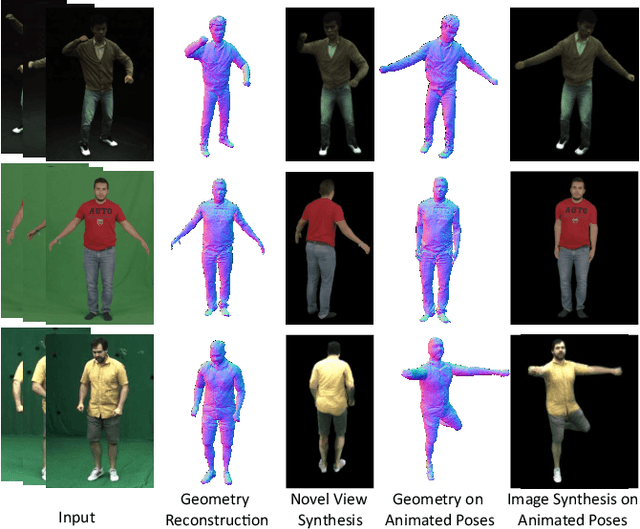
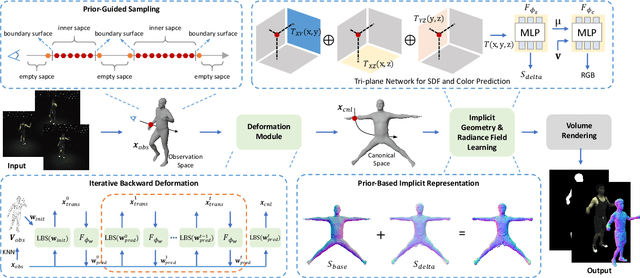

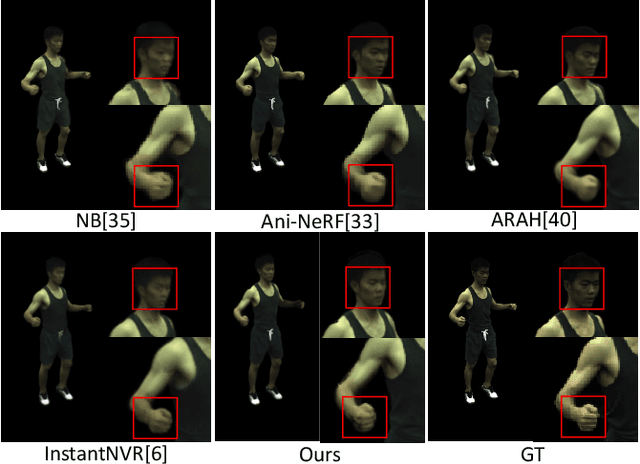
Recent techniques on implicit geometry representation learning and neural rendering have shown promising results for 3D clothed human reconstruction from sparse video inputs. However, it is still challenging to reconstruct detailed surface geometry and even more difficult to synthesize photorealistic novel views with animated human poses. In this work, we introduce PGAHum, a prior-guided geometry and appearance learning framework for high-fidelity animatable human reconstruction. We thoroughly exploit 3D human priors in three key modules of PGAHum to achieve high-quality geometry reconstruction with intricate details and photorealistic view synthesis on unseen poses. First, a prior-based implicit geometry representation of 3D human, which contains a delta SDF predicted by a tri-plane network and a base SDF derived from the prior SMPL model, is proposed to model the surface details and the body shape in a disentangled manner. Second, we introduce a novel prior-guided sampling strategy that fully leverages the prior information of the human pose and body to sample the query points within or near the body surface. By avoiding unnecessary learning in the empty 3D space, the neural rendering can recover more appearance details. Last, we propose a novel iterative backward deformation strategy to progressively find the correspondence for the query point in observation space. A skinning weights prediction model is learned based on the prior provided by the SMPL model to achieve the iterative backward LBS deformation. Extensive quantitative and qualitative comparisons on various datasets are conducted and the results demonstrate the superiority of our framework. Ablation studies also verify the effectiveness of each scheme for geometry and appearance learning.