 Add to Chrome
 Add to Firefox
 Add to Edge
Learning Hierarchical and Geometry-Aware Graph Representations for Text-to-CAD
Apr 11, 2026
Text-to-CAD code generation is a long-horizon task that translates textual instructions into long sequences of interdependent operations. Existing methods typically decode text directly into executable code (e.g., bpy) without explicitly modeling assembly hierarchy or geometric constraints, which enlarges the search space, accumulates local errors, and often causes cascading failures in complex assemblies. To address this issue, we propose a hierarchical and geometry-aware graph as an intermediate representation. The graph models multi-level parts and components as nodes and encodes explicit geometric constraints as edges. Instead of mapping text directly to code, our framework first predicts structure and constraints, then conditions action sequencing and code generation, thereby improving geometric fidelity and constraint satisfaction. We further introduce a structure-aware progressive curriculum learning strategy that constructs graded tasks through controlled structural edits, explores the model's capability boundary, and synthesizes boundary examples for iterative training. In addition, we build a 12K dataset with instructions, decomposition graphs, action sequences, and bpy code, together with graph- and constraint-oriented evaluation metrics. Extensive experiments show that our method consistently outperforms existing approaches in both geometric fidelity and accurate satisfaction of geometric constraints.

Order-Level Attention Similarity Across Language Models: A Latent Commonality
Nov 07, 2025
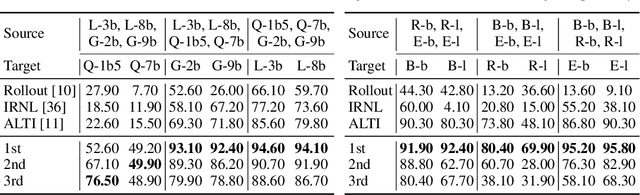


In this paper, we explore an important yet previously neglected question: Do context aggregation patterns across Language Models (LMs) share commonalities? While some works have investigated context aggregation or attention weights in LMs, they typically focus on individual models or attention heads, lacking a systematic analysis across multiple LMs to explore their commonalities. In contrast, we focus on the commonalities among LMs, which can deepen our understanding of LMs and even facilitate cross-model knowledge transfer. In this work, we introduce the Order-Level Attention (OLA) derived from the order-wise decomposition of Attention Rollout and reveal that the OLA at the same order across LMs exhibits significant similarities. Furthermore, we discover an implicit mapping between OLA and syntactic knowledge. Based on these two findings, we propose the Transferable OLA Adapter (TOA), a training-free cross-LM adapter transfer method. Specifically, we treat the OLA as a unified syntactic feature representation and train an adapter that takes OLA as input. Due to the similarities in OLA across LMs, the adapter generalizes to unseen LMs without requiring any parameter updates. Extensive experiments demonstrate that TOA's cross-LM generalization effectively enhances the performance of unseen LMs. Code is available at https://github.com/jinglin-liang/OLAS.