 Add to Chrome
 Add to Firefox
 Add to Edge
CamoNAS: Neural Architecture Search for Enhanced Camouflaged Object Detection
Jul 02, 2026
Camouflaged Object Detection (COD) aims to locate and segment objects that blend into their surroundings, presenting challenges due to weak edge cues and ill-defined boundaries. Traditional COD models rely on hand-designed architectures and multi-scale feature fusion, which are often guided by intuition rather than systematic search. This paper introduces CamoNAS, a frequency-aware multi-resolution Neural Architecture Search (NAS) framework for COD. CamoNAS automatically searches both cell-level operations and network-level downsampling paths, forming a hierarchical search space tailored to detect camouflaged objects. Additionally, it adopts an RGB frequency dual-stream architecture, where a learnable wavelet transform complements the RGB spatial stream. CamoNAS achieves state-of-the-art performance on four COD benchmarks (CAMO, COD10K, NC4K, CHAMELEON), highlighting the effectiveness of NAS for COD. Our code is available at https://github.com/rendaweiSIMIT/CamoNAS.
* Published in The Visual Computer. Author manuscript version

Restrictive Hierarchical Semantic Segmentation for Stratified Tooth Layer Detection
Dec 22, 2025Accurate understanding of anatomical structures is essential for reliably staging certain dental diseases. A way of introducing this within semantic segmentation models is by utilising hierarchy-aware methodologies. However, existing hierarchy-aware segmentation methods largely encode anatomical structure through the loss functions, providing weak and indirect supervision. We introduce a general framework that embeds an explicit anatomical hierarchy into semantic segmentation by coupling a recurrent, level-wise prediction scheme with restrictive output heads and top-down feature conditioning. At each depth of the class tree, the backbone is re-run on the original image concatenated with logits from the previous level. Child class features are conditioned using Feature-wise Linear Modulation of their parent class probabilities, to modulate child feature spaces for fine grained detection. A probabilistic composition rule enforces consistency between parent and descendant classes. Hierarchical loss combines per-level class weighted Dice and cross entropy loss and a consistency term loss, ensuring parent predictions are the sum of their children. We validate our approach on our proposed dataset, TL-pano, containing 194 panoramic radiographs with dense instance and semantic segmentation annotations, of tooth layers and alveolar bone. Utilising UNet and HRNet as donor models across a 5-fold cross validation scheme, the hierarchical variants consistently increase IoU, Dice, and recall, particularly for fine-grained anatomies, and produce more anatomically coherent masks. However, hierarchical variants also demonstrated increased recall over precision, implying increased false positives. The results demonstrate that explicit hierarchical structuring improves both performance and clinical plausibility, especially in low data dental imaging regimes.
Detail-Enhancing Framework for Reference-Based Image Super-Resolution
May 01, 2024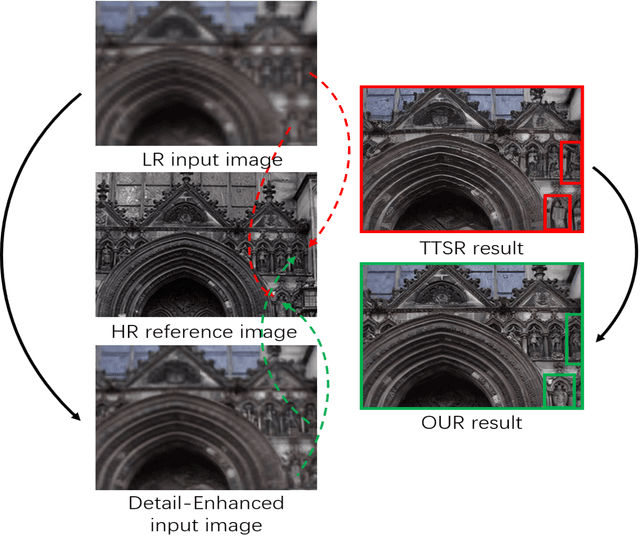
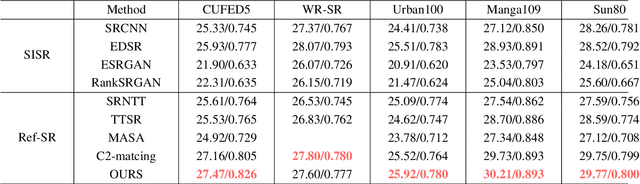
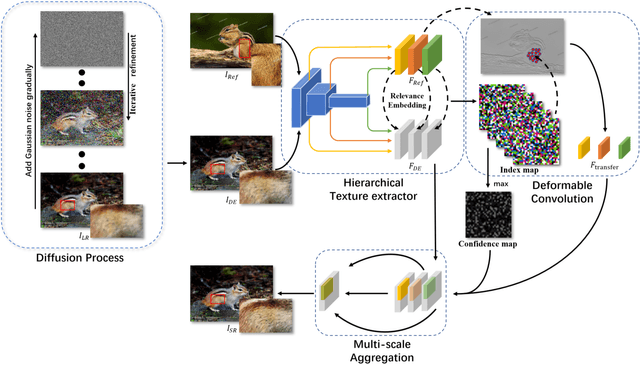
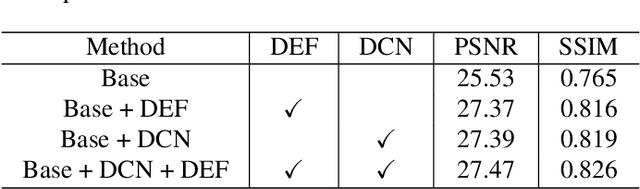
Recent years have witnessed the prosperity of reference-based image super-resolution (Ref-SR). By importing the high-resolution (HR) reference images into the single image super-resolution (SISR) approach, the ill-posed nature of this long-standing field has been alleviated with the assistance of texture transferred from reference images. Although the significant improvement in quantitative and qualitative results has verified the superiority of Ref-SR methods, the presence of misalignment before texture transfer indicates room for further performance improvement. Existing methods tend to neglect the significance of details in the context of comparison, therefore not fully leveraging the information contained within low-resolution (LR) images. In this paper, we propose a Detail-Enhancing Framework (DEF) for reference-based super-resolution, which introduces the diffusion model to generate and enhance the underlying detail in LR images. If corresponding parts are present in the reference image, our method can facilitate rigorous alignment. In cases where the reference image lacks corresponding parts, it ensures a fundamental improvement while avoiding the influence of the reference image. Extensive experiments demonstrate that our proposed method achieves superior visual results while maintaining comparable numerical outcomes.
Joint Communication and Computation Design in Transmissive RMS Transceiver Enabled Multi-Tier Computing Networks
Oct 27, 2022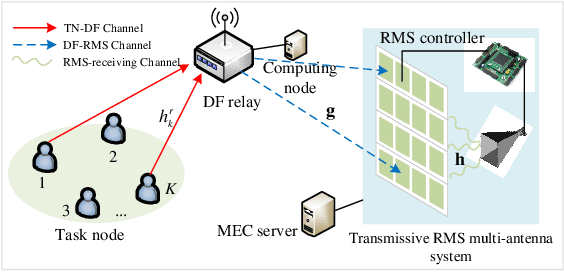
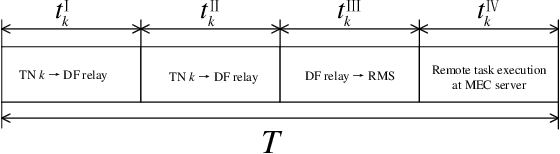
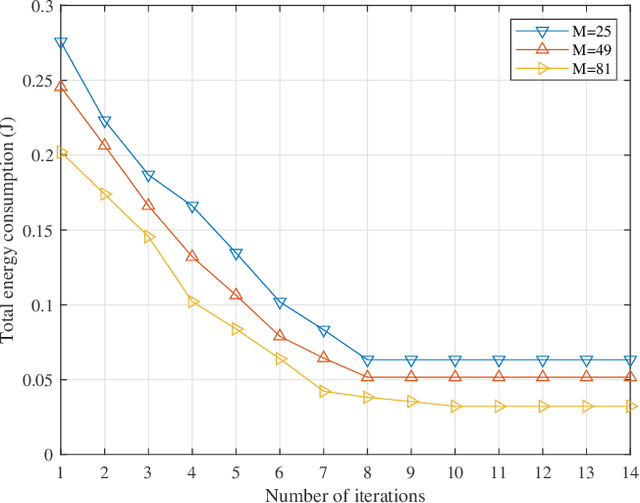
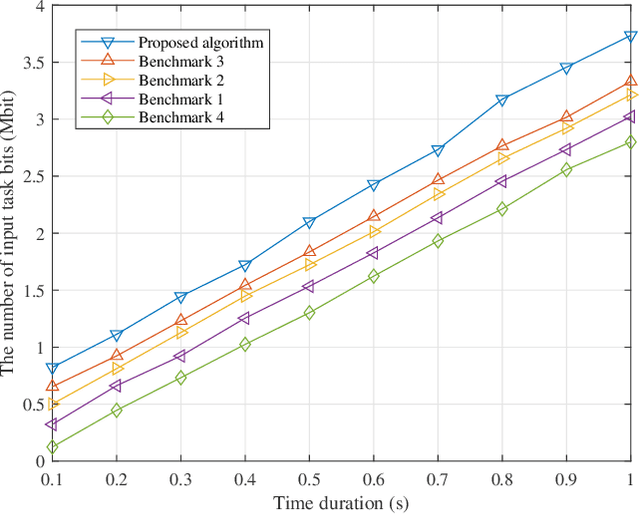
In this paper, a novel transmissive reconfigurable meta-surface (RMS) transceiver enabled multi-tier computing network architecture is proposed for improving computing capability, decreasing computing delay and reducing base station (BS) deployment cost, in which transmissive RMS equipped with a feed antenna can be regarded as a new type of multi-antenna system. We formulate a total energy consumption minimization problem by a joint optimization of subcarrier allocation, task input bits, time slot allocation, transmit power allocation and RMS transmissive coefficient while taking into account the constraints of communication resources and computing resources. This formulated problem is a non-convex optimization problem due to the high coupling of optimization variables, which is NP-hard to obtain its optimal solution. To address the above challenging problems, block coordinate descent (BCD) technique is employed to decouple the optimization variables to solve the problem. Specifically, the joint optimization problem of subcarrier allocation, task input bits, time slot allocation, transmit power allocation and RMS transmissive coefficient is divided into three subproblems to solve by applying BCD. Then, the decoupled three subproblems are optimized alternately by using successive convex approximation (SCA) and difference-convex (DC) programming until the convergence is achieved. Numerical results verify that our proposed algorithm is superior in reducing total energy consumption compared to other benchmarks.
Intelligent Reflecting Surface Empowered UAV SWIPT Networks
Jul 23, 2021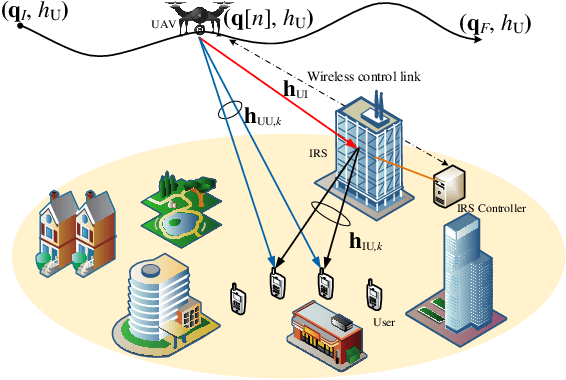
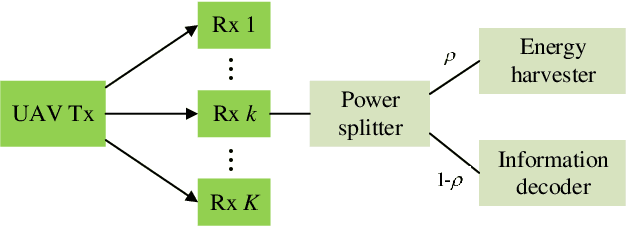
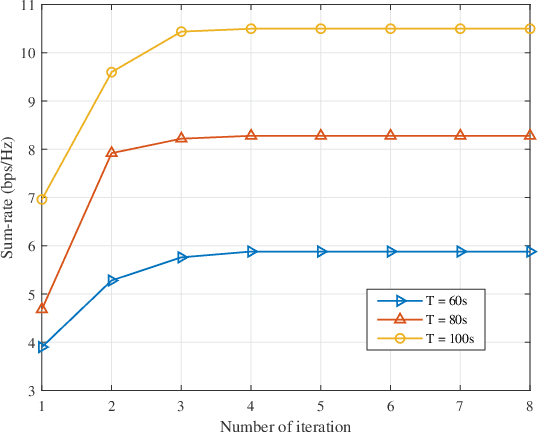
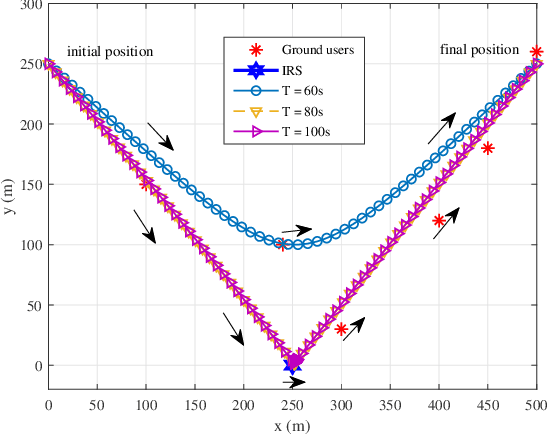
Aiming at the limited battery capacity of a large number of widely deployed low-power smart devices in the Internet-of-things (IoT), this paper proposes a novel intelligent reflecting surface (IRS) empowered unmanned aerial vehicle (UAV) simultaneous wireless information and power transfer (SWIPT) network framework, in which IRS is used to reconstruct the wireless channel to enhance the energy transmission efficiency and coverage of the UAV SWIPT networks. In this paper, we formulate an achievable sum-rate maximization problem by jointly optimizing UAV trajectory, UAV transmission power allocation, power splitting (PS) ratio and IRS reflection coefficient under a non-linear energy harvesting model. Due to the coupling of optimization variables, this problem is a complex non-convex optimization problem, and it is challenging to solve it directly. We first transform the problem, and then apply the alternating optimization (AO) algorithm framework to divide the transformed problem into four blocks to solve it. Specifically, by applying successive convex approximation (SCA) and difference-convex (DC) programming, UAV trajectory, UAV transmission power allocation, PS ratio and IRS reflection coefficient are alternately optimized when the other three are given until convergence is achieved. Numerical simulation results verify the effectiveness of our proposed algorithm compared to other algorithms.