 Add to Chrome
 Add to Firefox
 Add to Edge
High-dimensional Multi-objective Bayesian Optimization with Learned Variable Interactions
Aug 12, 2026
Multi-objective Bayesian optimization (MOBO) is effective in identifying the Pareto fronts for expensive black-box problems. However, most current MOBO approaches are limited to low-dimensional decision space due to its exponential sampling complexity. This paper presents decision variable interaction analysis-based MOBO, ViaMOBO, a generic framework for expensive multi-objective problems with high-dimensional decision space. The key idea of ViaMOBO is that it utilizes a variable interaction analysis model to determine whether the decision space can be completely or partially divided, and then performs local Bayesian optimization in the divided decision subspaces. Through the variable analysis model, it can be derived whether the objectives in black-box problems are separable, partially separable, or non-separable based on the potential independent or interdependent relationships among decision variables without any strong assumptions. We compare ViaMOBO with the state-of-the-art MOBO methods on both synthetic and real-world benchmarks. The experimental results demonstrate that ViaMOBO outperforms other related MOBO baselines in approximating the Pareto front of high-dimensional expensive multi-objective problems.

Adaptive Constraint Partition based Optimization Framework for Large-scale Integer Linear Programming(Student Abstract)
Nov 18, 2022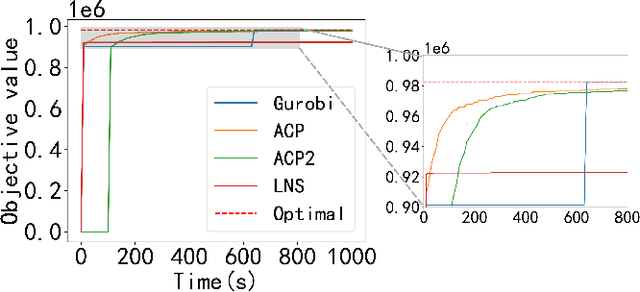
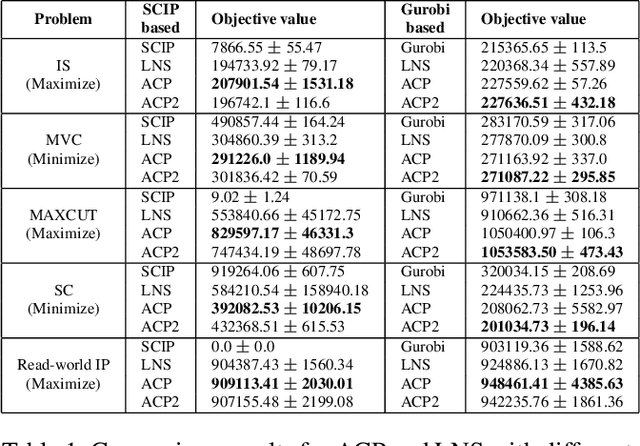
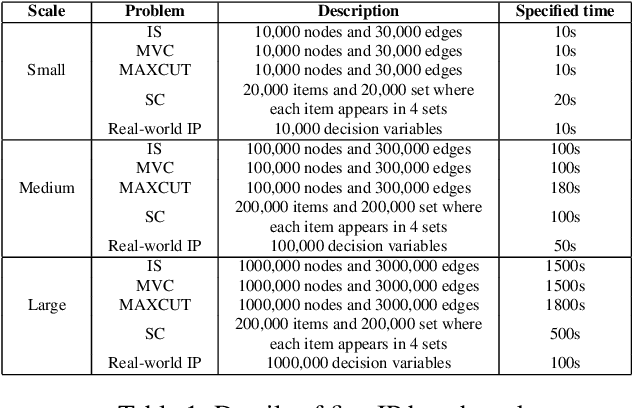
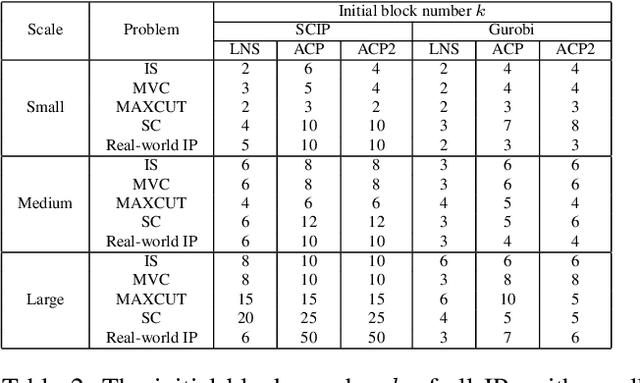
Integer programming problems (IPs) are challenging to be solved efficiently due to the NP-hardness, especially for large-scale IPs. To solve this type of IPs, Large neighborhood search (LNS) uses an initial feasible solution and iteratively improves it by searching a large neighborhood around the current solution. However, LNS easily steps into local optima and ignores the correlation between variables to be optimized, leading to compromised performance. This paper presents a general adaptive constraint partition-based optimization framework (ACP) for large-scale IPs that can efficiently use any existing optimization solver as a subroutine. Specifically, ACP first randomly partitions the constraints into blocks, where the number of blocks is adaptively adjusted to avoid local optima. Then, ACP uses a subroutine solver to optimize the decision variables in a randomly selected block of constraints to enhance the variable correlation. ACP is compared with LNS framework with different subroutine solvers on four IPs and a real-world IP. The experimental results demonstrate that in specified wall-clock time ACP shows better performance than SCIP and Gurobi.