 Add to Chrome
 Add to Firefox
 Add to Edge
ComMem: Complementary Memory Systems for Test-Time Adaptation of Vision-Language Models
Jun 27, 2026
Test-time adaptation (TTA) of vision-language models (VLMs) is essential for their robust deployment in dynamic, real-world environments. However, existing TTA methods often adapt locally without accumulating knowledge over time, or operating within a single modality without exploiting VLMs' inherently multi-modal nature. Inspired by the \textbf{Com}plementary \textbf{Mem}ory systems of the biological brain, we propose \textbf{ComMem}, an innovative approach that mimics the distinct but cooperative roles of the hippocampus and neocortex to enable effective TTA for VLMs. ComMem consists of two key components: a fast-adapting detailed memory, akin to the hippocampus, that forms a dynamic visual cache from high-confidence test samples; and a slow-integrating abstract memory, akin to the neocortex, that continually refines global textual prototypes. For each test instance, ComMem jointly optimizes both memory systems to ensure cross-modal consistency. Extensive experiments on 15 benchmark datasets show that ComMem significantly outperforms state-of-the-art methods under both natural distribution shifts and cross-dataset generalization, offering a promising direction for enhancing VLMs' practical adaptability.

MePo: Meta Post-Refinement for Rehearsal-Free General Continual Learnin
Feb 08, 2026To cope with uncertain changes of the external world, intelligent systems must continually learn from complex, evolving environments and respond in real time. This ability, collectively known as general continual learning (GCL), encapsulates practical challenges such as online datastreams and blurry task boundaries. Although leveraging pretrained models (PTMs) has greatly advanced conventional continual learning (CL), these methods remain limited in reconciling the diverse and temporally mixed information along a single pass, resulting in sub-optimal GCL performance. Inspired by meta-plasticity and reconstructive memory in neuroscience, we introduce here an innovative approach named Meta Post-Refinement (MePo) for PTMs-based GCL. This approach constructs pseudo task sequences from pretraining data and develops a bi-level meta-learning paradigm to refine the pretrained backbone, which serves as a prolonged pretraining phase but greatly facilitates rapid adaptation of representation learning to downstream GCL tasks. MePo further initializes a meta covariance matrix as the reference geometry of pretrained representation space, enabling GCL to exploit second-order statistics for robust output alignment. MePo serves as a plug-in strategy that achieves significant performance gains across a variety of GCL benchmarks and pretrained checkpoints in a rehearsal-free manner (e.g., 15.10\%, 13.36\%, and 12.56\% on CIFAR-100, ImageNet-R, and CUB-200 under Sup-21/1K). Our source code is available at \href{https://github.com/SunGL001/MePo}{MePo}
FlyPrompt: Brain-Inspired Random-Expanded Routing with Temporal-Ensemble Experts for General Continual Learning
Feb 03, 2026General continual learning (GCL) challenges intelligent systems to learn from single-pass, non-stationary data streams without clear task boundaries. While recent advances in continual parameter-efficient tuning (PET) of pretrained models show promise, they typically rely on multiple training epochs and explicit task cues, limiting their effectiveness in GCL scenarios. Moreover, existing methods often lack targeted design and fail to address two fundamental challenges in continual PET: how to allocate expert parameters to evolving data distributions, and how to improve their representational capacity under limited supervision. Inspired by the fruit fly's hierarchical memory system characterized by sparse expansion and modular ensembles, we propose FlyPrompt, a brain-inspired framework that decomposes GCL into two subproblems: expert routing and expert competence improvement. FlyPrompt introduces a randomly expanded analytic router for instance-level expert activation and a temporal ensemble of output heads to dynamically adapt decision boundaries over time. Extensive theoretical and empirical evaluations demonstrate FlyPrompt's superior performance, achieving up to 11.23%, 12.43%, and 7.62% gains over state-of-the-art baselines on CIFAR-100, ImageNet-R, and CUB-200, respectively. Our source code is available at https://github.com/AnAppleCore/FlyGCL.
Right Time to Learn:Promoting Generalization via Bio-inspired Spacing Effect in Knowledge Distillation
Feb 10, 2025
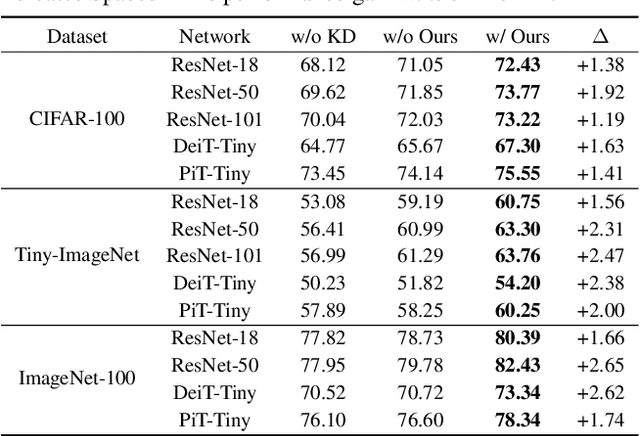
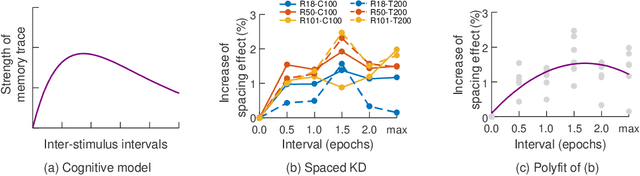
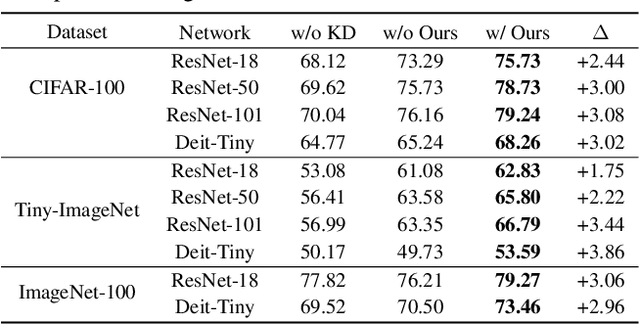
Knowledge distillation (KD) is a powerful strategy for training deep neural networks (DNNs). Although it was originally proposed to train a more compact ``student'' model from a large ``teacher'' model, many recent efforts have focused on adapting it to promote generalization of the model itself, such as online KD and self KD. % as an effective way Here, we propose an accessible and compatible strategy named Spaced KD to improve the effectiveness of both online KD and self KD, in which the student model distills knowledge from a teacher model trained with a space interval ahead. This strategy is inspired by a prominent theory named \emph{spacing effect} in biological learning and memory, positing that appropriate intervals between learning trials can significantly enhance learning performance. With both theoretical and empirical analyses, we demonstrate that the benefits of the proposed Spaced KD stem from convergence to a flatter loss landscape during stochastic gradient descent (SGD). We perform extensive experiments to validate the effectiveness of Spaced KD in improving the learning performance of DNNs (e.g., the performance gain is up to 2.31\% and 3.34\% on Tiny-ImageNet over online KD and self KD, respectively).