 Add to Chrome
 Add to Firefox
 Add to Edge
DASH: Deterministic Attention Scheduling for High-throughput Reproducible LLM Training
Jan 29, 2026
Determinism is indispensable for reproducibility in large language model (LLM) training, yet it often exacts a steep performance cost. In widely used attention implementations such as FlashAttention-3, the deterministic backward pass can incur up to a 37.9% throughput reduction relative to its non-deterministic counterpart, primarily because gradient accumulation operations must be serialized to guarantee numerical consistency. This performance loss stems from suboptimal scheduling of compute and gradient-reduction phases, leading to significant hardware underutilization. To address this challenge, we formulate the backward pass of deterministic attention as a scheduling problem on a Directed Acyclic Graph (DAG) and derive schedules that minimize the critical path length. Building on this formulation, we present DASH (Deterministic Attention Scheduling for High-Throughput), which encapsulates two complementary scheduling strategies: (i) Descending Q-Tile Iteration, a reversed query-block traversal that shrinks pipeline stalls in causal attention, and (ii) Shift Scheduling, a theoretically optimal schedule within our DAG model that reduces pipeline stalls for both full and causal masks. Our empirical evaluations on NVIDIA H800 GPUs demonstrate that DASH narrows the performance gap of deterministic attention. The proposed strategies improve the throughput of the attention backward pass by up to 1.28$\times$ compared to the baseline, significantly advancing the efficiency of reproducible LLM training. Our code is open-sourced at https://github.com/SJTU-Liquid/deterministic-FA3.

MegaScale: Scaling Large Language Model Training to More Than 10,000 GPUs
Feb 23, 2024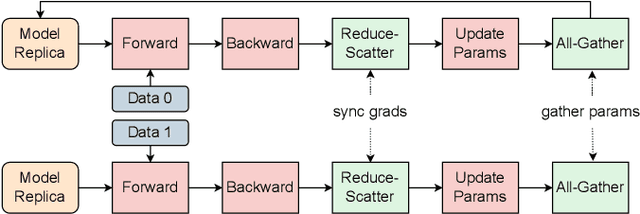
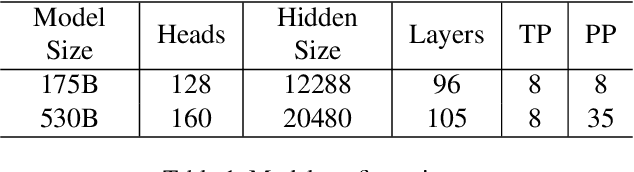
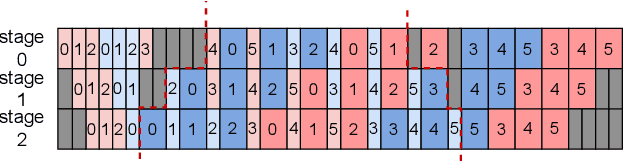
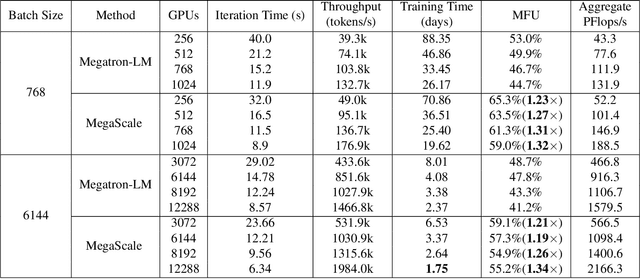
We present the design, implementation and engineering experience in building and deploying MegaScale, a production system for training large language models (LLMs) at the scale of more than 10,000 GPUs. Training LLMs at this scale brings unprecedented challenges to training efficiency and stability. We take a full-stack approach that co-designs the algorithmic and system components across model block and optimizer design, computation and communication overlapping, operator optimization, data pipeline, and network performance tuning. Maintaining high efficiency throughout the training process (i.e., stability) is an important consideration in production given the long extent of LLM training jobs. Many hard stability issues only emerge at large scale, and in-depth observability is the key to address them. We develop a set of diagnosis tools to monitor system components and events deep in the stack, identify root causes, and derive effective techniques to achieve fault tolerance and mitigate stragglers. MegaScale achieves 55.2% Model FLOPs Utilization (MFU) when training a 175B LLM model on 12,288 GPUs, improving the MFU by 1.34x compared to Megatron-LM. We share our operational experience in identifying and fixing failures and stragglers. We hope by articulating the problems and sharing our experience from a systems perspective, this work can inspire future LLM systems research.