 Add to Chrome
 Add to Firefox
 Add to Edge
LEGS: Fine-Tuning Teleop-Free VLAs for Humanoid Loco-manipulation in an Embodied Gaussian Splatting World
May 31, 2026
Training vision-language-action (VLA) policies for humanoid loco-manipulation is constrained by the high cost and complexity of collecting human teleoperation demonstrations. VLA policies fine-tuned in simulators have, until now, failed to transfer effectively in humanoid loco-manipulation tasks. We present LEGS (Loco-manipulation via Embodied Gaussian Splatting), a hybrid simulator that composites a mesh foreground (robot, objects, props) over a photorealistic 3D Gaussian Splatting (3DGS) background reconstructed from a handheld scene capture. LEGS uses a procedural motion-primitive generator to synthesize labeled demonstrations at scale without human teleoperation, and a deterministic two-stage color calibration to align the rendered 3DGS image to the robot's deployment camera. On a Unitree G1 humanoid robot, across three pick-and-place tasks of increasing whole-body difficulty and three VLA backbones (psi_0, pi_0.5, GR00T N1.6), a policy trained purely on LEGS data matches or exceeds one trained on human teleoperation demos on every experiment. It also outperforms a mesh-only simulation baseline that ablates the effect of the 3DGS background, showing that photorealistic rendering is a key enabler for synthetic data transfer. Humanoid motion is recorded independently of scene appearance in LEGS, allowing the same auto-generated demonstrations to be re-rendered under new backgrounds and object meshes--covering a new scene at more than 15x lower cost than teleoperation--to augment training data for robustness to scene variations. Under combined object-and-scene appearance shift, the policy trained on re-rendered LEGS-AUG data maintains task success while the baseline trained on teleoperation data fails entirely. Our project page is located at https://legsvla.github.io/.

2D Ego-Motion with Yaw Estimation using Only mmWave Radars via Two-Way weighted ICP
Mar 31, 2024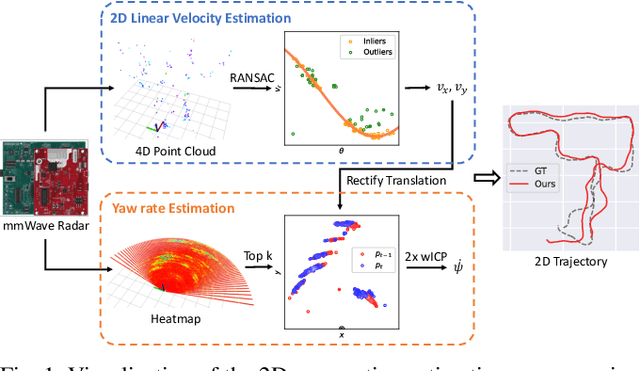
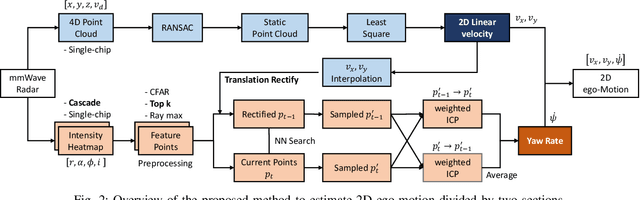
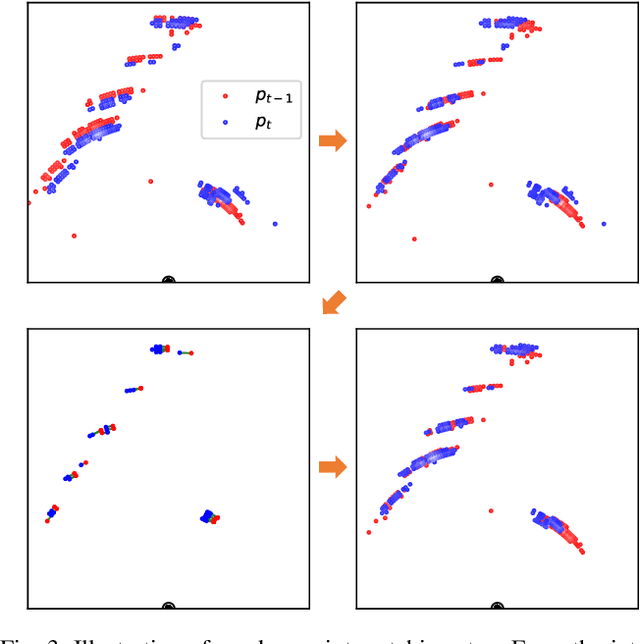
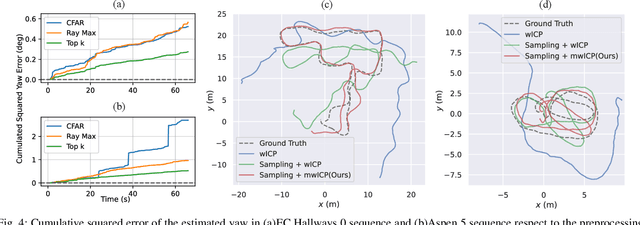
The interest in single-chip mmWave Radar is driven by their compact form factor, cost-effectiveness, and robustness under harsh environmental conditions. Despite its promising attributes, the principal limitation of mmWave radar lies in its capacity for autonomous yaw rate estimation. Conventional solutions have often resorted to integrating inertial measurement unit (IMU) or deploying multiple radar units to circumvent this shortcoming. This paper introduces an innovative methodology for two-dimensional ego-motion estimation, focusing on yaw rate deduction, utilizing solely mmWave radar sensors. By applying a weighted Iterated Closest Point (ICP) algorithm to register processed points derived from heatmap data, our method facilitates 2D ego-motion estimation devoid of prior information. Through experimental validation, we verified the effectiveness and promise of our technique for ego-motion estimation using exclusively radar data.