 Add to Chrome
 Add to Firefox
 Add to Edge
Uncertainty-Aware Hybrid Retrieval for Long-Document RAG
Jun 11, 2026
Retrieval augmented generation (RAG) depends critically on the quality and granularity of retrieved evidence. Large retrieval units preserve context but often introduce irrelevant content, which can dilute answer bearing evidence and worsen long context utilization. Fine-grained units are more compact, but they may be difficult to retrieve reliably because short chunks can lack semantic, lexical, or bridging cues needed to match the query. We propose Uncertainty-aware Multi-Granularity RAG (UMG-RAG), a training-free hybrid retrieval framework that treats chunk granularity as query-specific reliability estimation. Instead of training a new retriever or modifying the generator, UMG-RAG uses existing dense and sparse retrievers as complementary experts across multiple chunk granularities. For each query, it converts each expert-granularity score list into an evidence distribution, estimates reliability from distribution entropy, and fuses candidates according to query-specific semantic, lexical, and granularity confidence. We further introduce UMGP-RAG, a parent promotion variant that uses fine-grained hits to locate relevant evidence while returning broader non-redundant parent chunks for local coherence. Experiments on question answering benchmarks show that uncertainty-aware fusion and parent promotion improve generation quality while maintaining a lightweight, plug-and-play retrieval pipeline.

The Cost of Context: Mitigating Textual Bias in Multimodal Retrieval-Augmented Generation
May 07, 2026While Multimodal Large Language Models (MLLMs) are increasingly integrated with Retrieval-Augmented Generation (RAG) to mitigate hallucinations, the introduction of external documents can conceal severe failure modes at the instance level. We identify and formalize the phenomenon of recorruption, where the introduction of even perfectly accurate "oracle" context causes a capable model to abandon an initially correct prediction. Through a mechanistic diagnosis of internal attention matrices, we show that recorruption is driven by a two-fold attentional collapse: (1) visual blindness, characterized by the systemic suppression of visual attention mass ($M_{vis}$) and sharpness ($S_{vis}$), and (2) a structural positional bias that forces the model to prioritize boundary tokens over semantic relevance. Our analysis reveals an Illusion of Success, demonstrating that many seemingly correct RAG outcomes are merely positional coincidences where the model's textual copying bias happens to align with the ground-truth location. To address these vulnerabilities, we propose Bottleneck Attention Intervention for Recovery (BAIR), a parameter-free, inference-time framework that restores visual saliency and applies position-aware penalties to textual distractors. Across medical factuality, social fairness, and geospatial benchmarks, BAIR successfully restores multimodal grounding and improves diagnostic reliability without requiring model retraining or fine-tuning.
The Vision Wormhole: Latent-Space Communication in Heterogeneous Multi-Agent Systems
Feb 17, 2026Multi-Agent Systems (MAS) powered by Large Language Models have unlocked advanced collaborative reasoning, yet they remain shackled by the inefficiency of discrete text communication, which imposes significant runtime overhead and information quantization loss. While latent state transfer offers a high-bandwidth alternative, existing approaches either assume homogeneous sender-receiver architectures or rely on pair-specific learned translators, limiting scalability and modularity across diverse model families with disjoint manifolds. In this work, we propose the Vision Wormhole, a novel framework that repurposes the visual interface of Vision-Language Models (VLMs) to enable model-agnostic, text-free communication. By introducing a Universal Visual Codec, we map heterogeneous reasoning traces into a shared continuous latent space and inject them directly into the receiver's visual pathway, effectively treating the vision encoder as a universal port for inter-agent telepathy. Our framework adopts a hub-and-spoke topology to reduce pairwise alignment complexity from O(N^2) to O(N) and leverages a label-free, teacher-student distillation objective to align the high-speed visual channel with the robust reasoning patterns of the text pathway. Extensive experiments across heterogeneous model families (e.g., Qwen-VL, Gemma) demonstrate that the Vision Wormhole reduces end-to-end wall-clock time in controlled comparisons while maintaining reasoning fidelity comparable to standard text-based MAS. Code is available at https://github.com/xz-liu/heterogeneous-latent-mas
IMPACT: Industrial Machine Perception via Acoustic Cognitive Transformer
Jul 09, 2025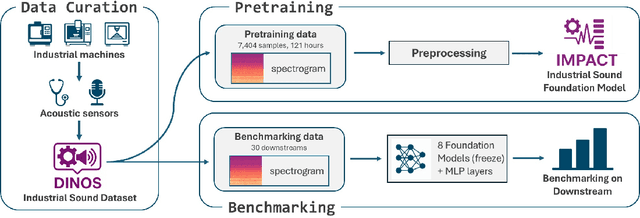
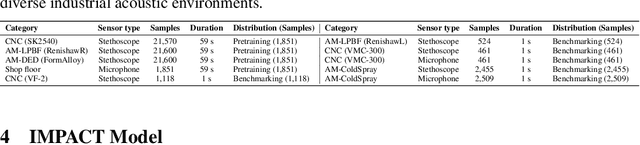
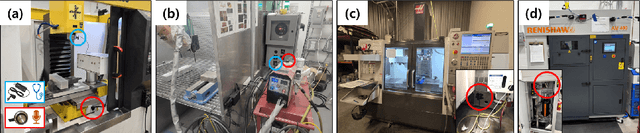
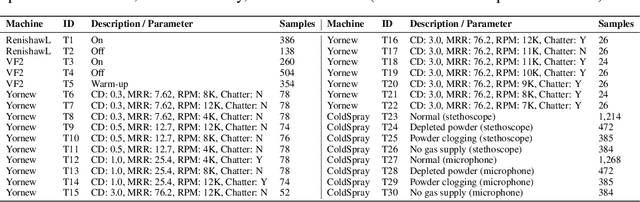
Acoustic signals from industrial machines offer valuable insights for anomaly detection, predictive maintenance, and operational efficiency enhancement. However, existing task-specific, supervised learning methods often scale poorly and fail to generalize across diverse industrial scenarios, whose acoustic characteristics are distinct from general audio. Furthermore, the scarcity of accessible, large-scale datasets and pretrained models tailored for industrial audio impedes community-driven research and benchmarking. To address these challenges, we introduce DINOS (Diverse INdustrial Operation Sounds), a large-scale open-access dataset. DINOS comprises over 74,149 audio samples (exceeding 1,093 hours) collected from various industrial acoustic scenarios. We also present IMPACT (Industrial Machine Perception via Acoustic Cognitive Transformer), a novel foundation model for industrial machine sound analysis. IMPACT is pretrained on DINOS in a self-supervised manner. By jointly optimizing utterance and frame-level losses, it captures both global semantics and fine-grained temporal structures. This makes its representations suitable for efficient fine-tuning on various industrial downstream tasks with minimal labeled data. Comprehensive benchmarking across 30 distinct downstream tasks (spanning four machine types) demonstrates that IMPACT outperforms existing models on 24 tasks, establishing its superior effectiveness and robustness, while providing a new performance benchmark for future research.
A Unified Debiasing Approach for Vision-Language Models across Modalities and Tasks
Oct 10, 2024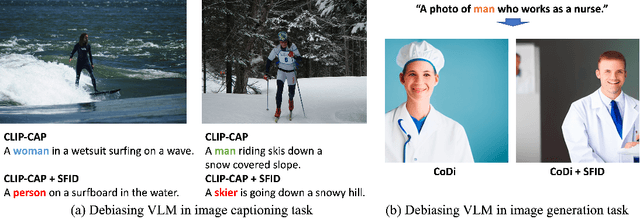
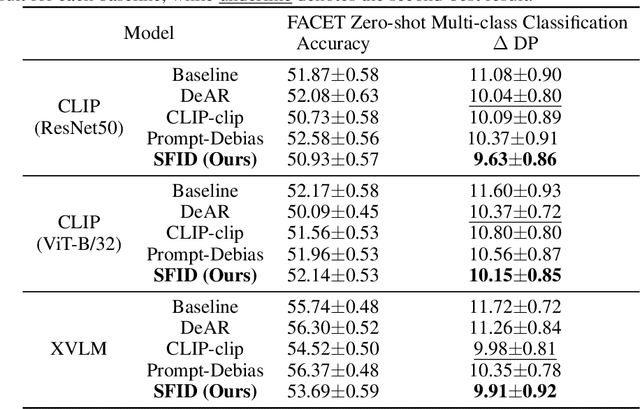
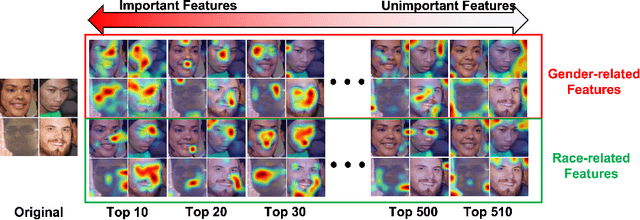
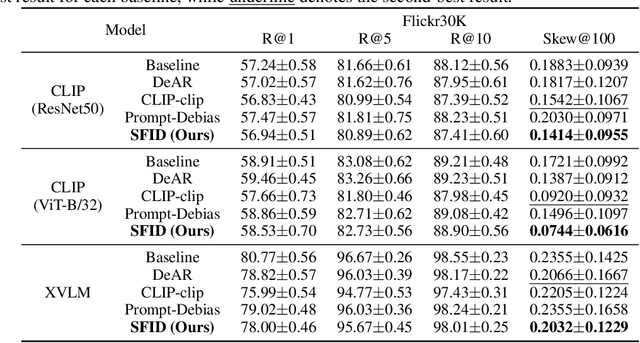
Recent advancements in Vision-Language Models (VLMs) have enabled complex multimodal tasks by processing text and image data simultaneously, significantly enhancing the field of artificial intelligence. However, these models often exhibit biases that can skew outputs towards societal stereotypes, thus necessitating debiasing strategies. Existing debiasing methods focus narrowly on specific modalities or tasks, and require extensive retraining. To address these limitations, this paper introduces Selective Feature Imputation for Debiasing (SFID), a novel methodology that integrates feature pruning and low confidence imputation (LCI) to effectively reduce biases in VLMs. SFID is versatile, maintaining the semantic integrity of outputs and costly effective by eliminating the need for retraining. Our experimental results demonstrate SFID's effectiveness across various VLMs tasks including zero-shot classification, text-to-image retrieval, image captioning, and text-to-image generation, by significantly reducing gender biases without compromising performance. This approach not only enhances the fairness of VLMs applications but also preserves their efficiency and utility across diverse scenarios.
Revealing and Utilizing In-group Favoritism for Graph-based Collaborative Filtering
Apr 23, 2024
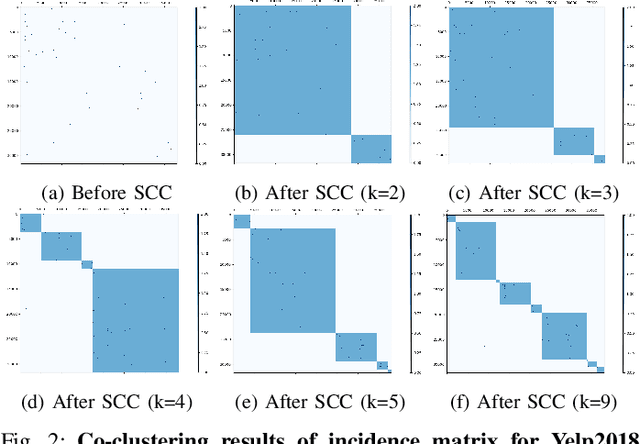


When it comes to a personalized item recommendation system, It is essential to extract users' preferences and purchasing patterns. Assuming that users in the real world form a cluster and there is common favoritism in each cluster, in this work, we introduce Co-Clustering Wrapper (CCW). We compute co-clusters of users and items with co-clustering algorithms and add CF subnetworks for each cluster to extract the in-group favoritism. Combining the features from the networks, we obtain rich and unified information about users. We experimented real world datasets considering two aspects: Finding the number of groups divided according to in-group preference, and measuring the quantity of improvement of the performance.